
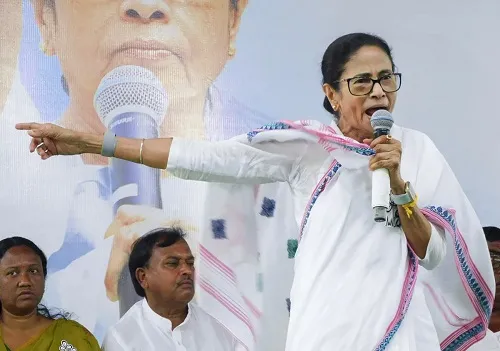
Mamata Banerjee BJP Violence Malda rally accusations dominated Friday's political landscape in West Bengal as Chief Minister Mamata Banerjee used a poll rally in Malda's Manikchak to directly accuse the Bharatiya Janata Party of wanting to stoke violence and using central agencies to target people, specifically referencing the situation in Mothabari as evidence of BJP's alleged interference in the state's electoral and administrative processes. Banerjee asked the gathering not to fall for any provocation by the BJP, urged women voters to physically guard Electronic Voting Machines and VVPAT machines once polling concluded, and issued a direct challenge to Union Home Minister Amit Shah to hold a meeting in Malda and speak to people whose names had been deleted from electoral rolls. The rally came as the Trinamool Congress simultaneously filed a representation with West Bengal Chief Electoral Officer Manoj Kumar Agarwal demanding the immediate removal of the Returning Officer for the Bhabanipur Assembly constituency, alleging his close proximity to BJP candidate Suvendu Adhikari.
The political context in which the Malda rally and the Bhabanipur RO objection sit is one of intense pre-election activity across multiple states, with West Bengal preparing for its first phase of elections on April 23, 2026, and the second phase on April 29, 2026, as part of a broader electoral calendar that includes Assam, Kerala, and Puducherry going to the polls on April 9, and Tamil Nadu on April 23. The counting for all these elections is scheduled for May 4, 2026, creating a concentrated period of democratic activity across India's east, south, and northeast that will significantly reshape several state legislatures simultaneously. In West Bengal, where the TMC-BJP rivalry has been one of the most intensely contested and at times violent electoral competitions in recent Indian political history, the pre-election period has predictably generated accusations, counter-accusations, and institutional complaints that reflect the depth of antagonism between the two parties.
Banerjee's specific reference to the gherao of judicial officers in Malda district added a law and order dimension to her electoral messaging, with the Chief Minister blaming the All India Majlis-e-Ittehadul Muslimeen and the Indian Secular Front for the incident while simultaneously accusing the Congress and BJP of instigating the action. Her challenge to Shah on electoral roll deletions touched on a concern that TMC has been raising about the integrity of the voter list, framing the deletion of names as a targeted disenfranchisement strategy directed at specific communities rather than a routine administrative process. The combination of these specific accusations, from central agency targeting to EVM security to electoral roll manipulation, represents the TMC's comprehensive pre-election narrative about the threats it believes the BJP poses to the integrity of the upcoming West Bengal polls.
The TMC-BJP Rivalry in West Bengal and Its Electoral History
West Bengal's political history since independence has been defined by periods of dominant single-party rule interrupted by intense competitive transitions, with the Left Front's 34-year unbroken governance from 1977 to 2011 representing the longest continuous state government by a single political formation in Indian democratic history. Mamata Banerjee's TMC disrupted that Left dominance in 2011 through a combination of grassroots organisation, mass mobilisation, and a political identity built explicitly around opposition to the Left's administrative culture and its handling of land acquisition controversies including the Nandigram and Singur incidents that became symbols of the Left's declining legitimacy. The 2011 victory established the TMC as Bengal's dominant political force and Banerjee as its defining leader, a position the party has defended through the 2016 and 2021 elections with increasing but contested majorities.
The BJP's emergence as the principal challenger to TMC dominance in West Bengal has been one of the most significant developments in Indian state politics of the past decade, driven by the party's national momentum under Prime Minister Narendra Modi and its aggressive organisational expansion into a state where it had previously been a marginal force. The 2019 Lok Sabha elections, in which the BJP won 18 of West Bengal's 42 parliamentary seats and reduced the TMC to 22, demonstrated that the party had built genuine electoral infrastructure in the state and could compete effectively even against Banerjee's organisational strengths. The 2021 state assembly elections, which the TMC won with a substantial majority despite intense BJP campaigning including Modi's personal visits and extensive central government resource deployment, established the current competitive equilibrium in which the TMC governs but the BJP maintains a strong opposition presence.
The deployment of central agencies including the Central Bureau of Investigation, the Enforcement Directorate, and the National Investigation Agency in cases involving TMC politicians and their associates has been a recurring source of TMC-centre conflict throughout the period of BJP central government. TMC has consistently argued that these agencies are being used as political tools to harass its leaders, create a climate of fear among TMC supporters, and destabilise its government through targeted investigations that serve BJP electoral objectives rather than genuine law enforcement purposes. The BJP and the agencies themselves dispute this characterisation, maintaining that investigations follow established legal procedures and respond to genuine complaints and evidence. Banerjee's reference to the NIA harassing local youths in the context of the Malda gherao incident fits this established pattern of TMC framing central agency activity as politically motivated interference.
The Bhabanipur Constituency and the Returning Officer Controversy
Bhabanipur is one of West Bengal's most politically significant assembly constituencies, located in southern Kolkata and serving as Mamata Banerjee's own electoral base, where she has fought and won her own assembly elections as Chief Minister. Its electoral administration is therefore a matter of heightened political sensitivity for the TMC, whose success in Bhabanipur is directly connected to Banerjee's own parliamentary presence in the state assembly. The TMC's objection to the Returning Officer for Bhabanipur, alleging his proximity to BJP candidate Suvendu Adhikari, reflects both the genuine concern about impartiality that electoral administration requires and the tactical political awareness of a party that understands the leverage that administrative appointments can provide in close contests.
Suvendu Adhikari is himself one of the BJP's most prominent faces in West Bengal, a former TMC minister who defected to the BJP before the 2021 elections and who has been one of the most aggressive voices of BJP opposition to the TMC government. His involvement in Bhabanipur as a BJP candidate, if confirmed, would make the constituency a particularly high-stakes contest with implications beyond the seat itself for the broader TMC-BJP narrative of the 2026 elections. The TMC's representation to Chief Electoral Officer Manoj Kumar Agarwal seeking the RO's immediate removal was filed on the same day as the Malda rally, suggesting a coordinated political-legal strategy combining electoral office complaints with mass mobilisation messaging.
The Election Commission of India's response to the TMC's representation will be watched carefully by both parties and by election observers, because the handling of Returning Officer appointment complaints in contested constituencies is one of the mechanisms through which the Commission's impartiality is demonstrated or questioned. An Election Commission that responds quickly and substantively to a ruling party's complaint about an administrative appointment might be criticised as accommodating state government pressure, while one that dismisses the complaint without examination might be criticised as protecting an appointment that genuinely raises impartiality concerns. The institutional dynamics of this specific complaint therefore illustrate the broader tension between election administration independence and accountability to party complaints that is a recurring challenge in Indian electoral management.
Malda's Political Significance and the Gherao Incident
Malda district in northern West Bengal is one of the state's politically complex regions, with a demographic composition that includes significant minority population communities and a political history of competitive multi-party contests. The gherao of judicial officers that Banerjee addressed at the Manikchak rally, which she attributed to AIMIM and ISF, represents the kind of law and order incident that becomes particularly charged in the pre-election period because it simultaneously raises genuine security concerns, creates communal sensitivity, and provides political fodder for multiple parties with different interests in how the incident is characterised and attributed. Banerjee's decision to address the incident directly at a Malda rally rather than leaving it to administrative channels reflects her assessment that the political interpretation of the incident is as important as its legal resolution.
The involvement of AIMIM and ISF in the gherao, as alleged by Banerjee, places two parties with specific appeal among Muslim voters in the position of accused instigators, a characterisation that serves TMC's interest in maintaining its dominance among Muslim voters in West Bengal by framing these alternative parties as disruptive rather than protective of minority community interests. TMC has historically argued that its governance provides the most effective protection for West Bengal's minorities while alternative parties including AIMIM fragment the minority vote in ways that ultimately benefit the BJP. The Malda gherao incident becomes, in this political reading, an example of that fragmentation creating the disorder that the BJP then exploits through central agencies and provocative political actions.
Banerjee's specific accusation that the BJP wants to stoke violence and used central agencies in Mothabari connected the Malda situation to a specific geographical reference that carries resonance in the district, where political violence and administrative controversies have marked previous election cycles. The Chief Minister's call for women to guard EVMs and VVPAT machines after polling, while framed as a practical instruction, carries the political message that the electoral process itself is under threat from forces that will attempt to manipulate it after votes are cast. That message, directed at a rally audience in a district where electoral competition is intense, is designed to mobilise the highest-turnout demographic in Indian elections, women voters, around a narrative of democratic protection rather than partisan loyalty.
The Election Calendar, the Campaign Narratives, and What the Polls Will Decide
The April 2026 election calendar that frames West Bengal's campaign includes Assam, Kerala, and Puducherry voting on April 9, Tamil Nadu voting on April 23, and West Bengal's two phases on April 23 and April 29, with counting scheduled for May 4 across all these elections simultaneously. The multi-state nature of this electoral round means that the national BJP campaign apparatus is being deployed across multiple fronts, creating both the resource demands and the attention distribution challenges that test a national party's organisational capacity and strategic prioritisation. The BJP's dual role as the ruling party at the centre and the principal challenger in West Bengal, Kerala, and Tamil Nadu means that its electoral messaging must simultaneously defend its central government record and prosecute state-level opposition campaigns in states where it has never governed or has governed previously.
In Tamil Nadu, the BJP is contesting as part of the AIADMK-led NDA alliance, having released its list of all 27 candidates for the assembly elections on the same Friday that Banerjee addressed the Malda rally. The Congress simultaneously announced candidates for 27 of the 28 constituencies allotted to it by the DMK within the INDIA alliance framework in the state, completing the candidate lists of the major alliance groupings ahead of the April 23 polling date. Tamil Nadu's political dynamics, where the DMK and AIADMK have historically alternated in power and where the BJP has struggled to build independent electoral strength despite its national dominance, make the upcoming elections a test of whether the saffron party's alliance strategy can translate national momentum into state-level gains in the Dravidian politics heartland.
The May 4 counting date that applies across all the states voting in this phase will produce a comprehensive electoral picture of regional India's political preferences at this point in the BJP's third consecutive central government term, and the results will be interpreted both as assessments of state-level governance and as indicators of the national party's continued support outside its traditional strongholds in Hindi-speaking states. For the BJP, wins in any of the southern states would represent significant geographical expansion. For the TMC, defending its West Bengal majority would validate Banerjee's leadership and her confrontational posture toward the centre. For the Congress, performance in Tamil Nadu and Kerala alongside its role in the broader INDIA alliance would calibrate its national opposition positioning ahead of the next Lok Sabha election cycle.
TMC's Pre-Election Strategy and Banerjee's Campaign Messaging
Banerjee's Manikchak rally messaging, combining accusations of BJP violence instigation, central agency misuse, electoral roll manipulation, and communal tensions attribution, follows the comprehensive pre-election narrative that the TMC has been developing since the election calendar was announced. By simultaneously addressing multiple dimensions of the alleged BJP threat to West Bengal's electoral integrity, the Chief Minister is attempting to mobilise the TMC's core constituencies around a protective democratic framing rather than a purely policy-based appeal. The challenge to Amit Shah to visit Malda and face voters whose names have been deleted from the rolls is a classic political dare that invites the Home Minister to either accept the challenge and engage on TMC's terms or decline and appear to be avoiding accountability for the roll deletions TMC is alleging.
The TMC's institutional complaint about the Bhabanipur Returning Officer, filed on the same day as the Malda rally, illustrates the party's strategy of conducting electoral competition on multiple tracks simultaneously, using both street-level political mobilisation and formal institutional mechanisms to contest what it characterises as BJP advantages being built into the electoral administration. Whether the Election Commission grants the removal request, the political message of having filed it is established regardless of the outcome, positioning the TMC as vigilant about electoral integrity threats and willing to use available institutional channels to address them. The dual-track approach of rally messaging and institutional complaint reflects a campaign that understands that both public opinion and administrative process are dimensions of electoral competition in the Indian context.
The specific instruction to women to guard EVMs and VVPAT machines after polls close is worth examining for what it reveals about TMC's electoral anxieties and its assessment of the specific threats it believes the BJP might attempt to exploit after voting concludes. EVM security in the post-poll period, when machines are sealed, stored, and transported to counting centres, has been a concern raised across multiple Indian elections by multiple parties, and the instruction to women specifically draws on the high organisational capacity of TMC's women voter networks and their demonstrated willingness to physically protect the democratic process in previous election cycles. By naming women as the guardians of the machines, Banerjee is both making a practical security suggestion and making a political statement about who the defenders of West Bengal's democracy are.