
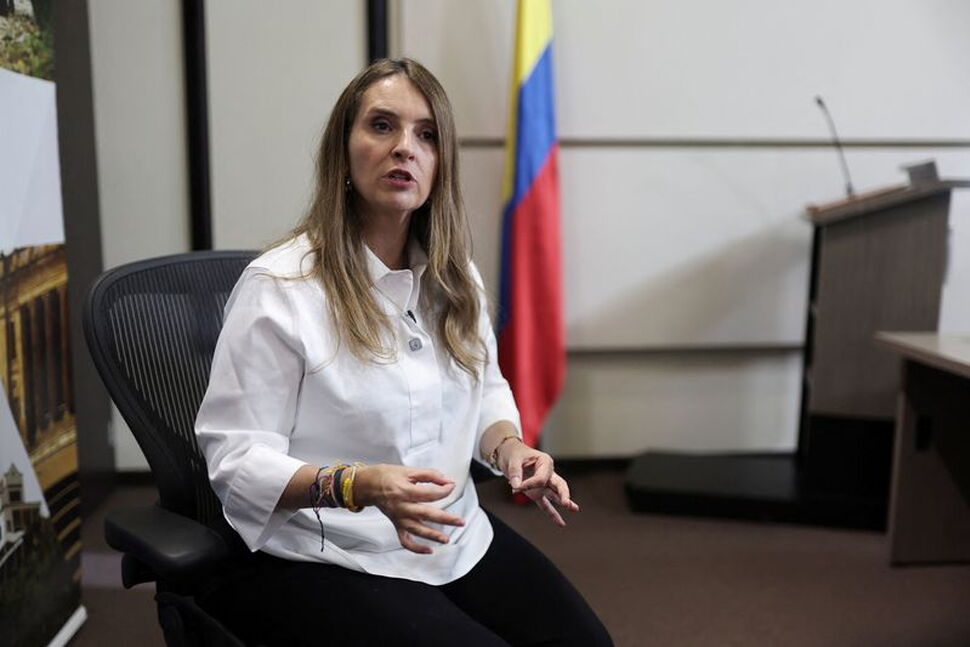
Paloma Valencia Colombia president election 2026 campaign has positioned the 48-year-old right-wing lawyer and senator as one of the leading candidates in Sunday's May 31 first-round presidential vote, with the Democratic Center senator backed by former President Alvaro Uribe running on a platform of security restoration and economic revival that directly challenges the legacy of outgoing leftist President Gustavo Petro, who is constitutionally barred from seeking reelection. Valencia would become Colombia's first female president if she wins, a historic milestone framed within a campaign whose substance is defined less by gender-barrier breaking than by her hawkish security stance, her explicit embrace of Uribe's counter-insurgency doctrine, and her rejection of the peace negotiation approaches that have characterised Colombian government policy under both the 2016 FARC peace deal and Petro's subsequent attempts to reach agreements with remaining armed groups. If no candidate wins more than 50 percent of Sunday's first-round vote, a runoff will be held in June, and Valencia's recent slide in polling to third place means her campaign must generate a strong first-round showing to maintain credibility as a runoff contender against the candidates who have been polling ahead of her.
Valencia's explicit and personal identification with Uribe, the former president whose administration in the 2000s achieved major military victories against the FARC guerrillas through the Democratic Security policy while accumulating a controversial record on human rights and political conduct, is the defining political identity of her campaign and its clearest connection to the voter coalition that remains the foundation of Colombian conservative politics. She told a recent campaign event that Uribe is like a father to her, that she never makes mistakes when it comes to loyalties, and that she wants to take everything that worked in Uribe's government and do it again, a generational inheritance claim that explicitly positions her as the continuation of a political project rather than its evolution. The security policy she promises is correspondingly absolute in its rejection of the negotiation approach, stating at a recent Bogota event that with her there will be no talks with the ELN, nor with the FARC, nor with the so-called Gaitanista Army, and pledging to reactivate all arrest warrants and pursue and hunt down the guerrilla and criminal groups that have been negotiating with Petro's government.
Valencia hails from Cauca province, one of the regions hardest hit by Colombia's six-decade armed conflict that has killed more than 450,000 people, a geographical origin that gives her security platform personal stakes beyond the abstract ideological commitment to a hard-line approach. Representing one of Colombia's most violence-affected regions as a senator since 2014 through the Democratic Center party that Uribe founded has exposed her directly to the communities whose daily lived experience of armed group violence, extortion, and territorial control provides the political foundation for the argument that negotiated accommodation with criminal organisations fails to protect the ordinary Colombians who bear the conflict's heaviest costs. Her campaign's claim that security and the economy have deteriorated under Petro, articulated as justification for the Uribe-inspired policy restoration she is promising, connects directly to the experience of constituents in Cauca and other conflict-affected regions where the security situation's tangible daily reality provides the most compelling evidence for or against the competing security policy approaches.
How Paloma Valencia Built Her Political Career and the Uribe Legacy She Inherits
Valencia's political biography is shaped by a family heritage that gives her the kind of institutional credibility within Colombia's conservative establishment that money alone cannot purchase, with her paternal grandfather being former conservative President Guillermo Leon Valencia and her maternal grandfather having founded a prestigious university, establishing the dual lineage of political and educational authority that her own career has built upon rather than departed from. The political heiress background that her biography presents does not automatically translate into electoral success, as her 2006 failed congressional bid demonstrated, but the family connections, party networks, and institutional relationships that come with conservative dynastic heritage provide the campaign infrastructure that first-time candidates from outside political families must spend years building from scratch. Her successful entry to the Senate in 2014 as a Democratic Center representative established the parliamentary track record that gives her legislative profile beyond the inherited name, with specific contributions to laws supporting sugar producers, formalising small businesses, and reducing working hours documenting a legislative engagement with economic policy that reinforces her campaign's economic revival messaging.
Valencia's academic and media career before formal political engagement, including a master's degree in creative writing from New York University, newspaper column writing, and radio commentary, created the public profile and communication skills that differentiate her from the typical product of a party machine whose political identity is entirely internal to the organisation. The journalism and commentary background gave her the ability to develop and articulate political arguments for public audiences rather than simply transmitting party messages, and the creative writing training from NYU reflects an intellectual range that her political positioning as a hawkish Uribista candidate does not fully capture. These biographical dimensions complicate the simple narrative of conservative dynasty replication, suggesting a politician who made deliberate choices to align with Uribe's project rather than simply following family tradition, a distinction that her stated loyalty to Uribe as like a father makes more personally meaningful than purely institutional.
Uribe's continued influence in Colombian conservative politics despite the legal case in which he was found guilty of fraud and bribery on charges he has consistently denied and characterised as political persecution, convictions later overturned on appeal, reflects the depth of loyalty among the Colombian right to a political figure whose security policy achievements are credited with reducing violence and restoring state control over territory that guerrilla groups had dominated. The legal case's political significance for Valencia's campaign is double-edged: within the Uribe coalition, backing him through the legal controversy demonstrates exactly the loyalty that she has made central to her political identity, while for voters outside that coalition the association with a politician whose legal record remains contested is a vulnerability that opposition candidates will exploit. The authenticity of her personal loyalty to Uribe, as she presents it, means this vulnerability is not managed through calculation but accepted as the price of the political identity she has chosen.
The Security Policy Debate and What Valencia Represents
The fundamental disagreement in Colombian security policy that Valencia's candidacy represents most sharply is between the negotiation-based approach to reducing armed group violence that the 2016 FARC peace deal embodied and the Petro government has continued, and the military-focused counter-insurgency approach that Uribe's Democratic Security policy pursued with significant tactical success in the 2000s. Both approaches have genuine achievements and genuine failures to their credit: the FARC peace deal removed the world's oldest guerrilla group from active warfare and allowed hundreds of thousands of combatants and their families to transition out of the conflict, but the criminal vacuum left by the FARC's demobilisation has been filled by dissident factions, the ELN, and criminal organisations whose territorial competition has produced violence in many former FARC-controlled areas. The Uribe era's military successes degraded guerrilla capacity significantly and restored state presence in many previously ungoverned territories, but the comprehensive military-only approach without accompanying social and economic development left the underlying conditions for armed recruitment and criminal organisation largely intact.
Valencia's complete rejection of talks with the ELN, dissident FARC factions, and the Gaitanista Army represents the most absolute statement of the counter-insurgency position available in the Colombian political debate, going beyond the more nuanced positions of other centre-right candidates who support security strengthening while leaving open the possibility of negotiated frameworks under the right conditions. This absolutism is simultaneously her clearest policy differentiation from competitors and her most significant electoral vulnerability, because Colombian public opinion on the peace negotiations is more divided and more contextual than a binary pro-negotiation versus anti-negotiation framing suggests, with voters in different regions and different security situations having different assessments of whether talking or fighting has more effectively reduced the violence they experience. Cauca province's particular experience of violence, including continued armed group activity despite or following the peace deal, provides Valencia with her most concrete evidence for the failure of negotiation approaches, but that regional evidence does not automatically translate to a nationwide electoral majority for the complete return to counter-insurgency that she promises.
Sunday's Vote, the Polling Slide, and What Valencia Needs to Win
The May 31 first-round vote's dynamics have been shaped by a competitive field in which Valencia has recently slipped to third in polling, a development that creates both the urgency and the strategic challenge that define the final days of her campaign. A first-round showing that consolidates her position as the strongest right-wing candidate in the race is essential for maintaining her viability as a runoff contender, even if first-round victory itself requires reaching the 50 percent threshold that no Colombian presidential candidate in recent memory has achieved in a multi-candidate first round. The electoral mathematics of a Colombian first round, where a third-place finish in a field where the top two candidates are genuinely competitive creates the risk of runoff exclusion, means Valencia must both perform strongly enough to justify a potential runoff position and hope that the candidates polling ahead of her do not build first-round leads sufficient to create a two-candidate dynamic that excludes her from the June runoff.
Valencia's campaign has the particular asset of Uribe's personal backing in a country where his name still commands significant electoral loyalty among the conservative base that Democratic Center's parliamentary performance documents as a substantial and motivated voter coalition. The conversion of Uribe's political network into first-round votes for Valencia depends on the mobilisation effectiveness of the Democratic Center organisation and the degree to which Uribe supporters who might prefer a different candidate within the conservative spectrum are persuaded that Valencia is the most credible vehicle for the policy restoration they want. Her explicit I will copy Uribe campaign messaging is designed precisely to activate this voter loyalty, signalling that her candidacy is not simply Uribe-adjacent but Uribe-committed in a way that a less personal endorsement of his legacy would not communicate.
The first-female-president dimension of Valencia's candidacy operates differently in her campaign than it might in those of candidates whose historic barrier-breaking is more central to their political identity, because her campaign's primary messaging is organised around security and economic policy rather than gender representation. This approach reflects a calculation that the Uribe coalition's primary motivations are policy-driven and that leading with the historic female president narrative would attract voters who are not her natural coalition while potentially creating dissonance with voters who chose her for the security and economic policy reasons that constitute her campaign's substance. The historic dimension remains real and would carry significant symbolic weight for Colombia and for the region if she wins, but it serves as context for her candidacy rather than its defining message, a framing that is itself a political choice about which aspects of her profile to emphasise to which audiences in a competitive multi-candidate first round.