
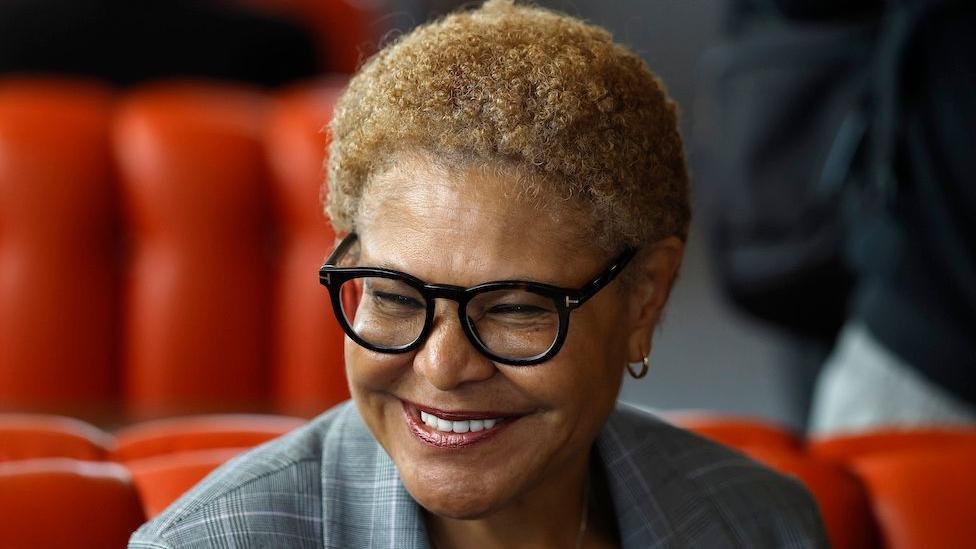
Incumbent Los Angeles Mayor Karen Bass runoff has advanced to November's runoff election to determine who leads California's largest city, with CBS News projecting her through as the first confirmed finalist from Tuesday's primary. The question of who she will face in the general election remained unresolved late Tuesday night, with votes still being counted in a three-way contest that will ultimately come down to either city council member Nithya Raman, a left-wing urban planner, or Spencer Pratt, a Republican reality television star turned political outsider whose entry into the race turned one of America's most watched local elections into a genuine national story. The outcome carries consequences that extend well beyond city hall: the winner will govern the second-largest city in the United States through the 2028 Olympics, while grappling with a homelessness crisis, an affordability emergency, and the lingering accountability questions raised by January's catastrophic Palisades Fire.
From an election-watch perspective, Tuesday's results in Los Angeles are best understood as a preview of the fault lines that will define the November general election across California and nationally. The three-candidate primary field offered voters a clear ideological menu: an experienced incumbent defending her record under sustained public criticism, a progressive challenger arguing the incumbent has not gone far enough on housing and homelessness, and a Republican newcomer who channelled public frustration with the city's direction into a longshot candidacy that has generated far more attention than conventional political calculations would have predicted. That all three found substantial voter support at the primary stage is a signal that Los Angeles voters are genuinely divided about what the city needs and who is best placed to deliver it, which sets up November as a meaningful choice rather than a formality.
California's jungle primary system, which advances the top two candidates regardless of party affiliation, means the November ballot could feature two Democrats in Bass and Raman, or a Democrat-Republican general election between Bass and Pratt, depending on how the remaining vote count resolves. Each possible pairing produces a different kind of general election contest with different strategic implications for both parties. A Bass-Raman matchup would force voters to choose between two competing visions of Democratic governance in a city that has been managed by Democratic mayors for decades. A Bass-Pratt contest would give Republicans a rare opportunity to put a competitive candidate on the ballot in one of America's most prominent liberal cities, using the Palisades Fire response as the central accountability argument in a race that national Republican strategists have already identified as worth watching.
How Karen Bass Built Her Political Career and Why the Palisades Fire Became Her Defining Vulnerability
Karen Bass arrived at the Los Angeles mayoralty with one of the most substantial political resumes in recent California history. Before becoming mayor, she served six terms in Congress representing parts of Los Angeles, chaired the Congressional Black Caucus, and was a senior member of the House Committee on Foreign Affairs. In 2020, she was reportedly considered as a potential vice-presidential running mate for Joe Biden, a shortlist appearance that reflected both her political standing and her long track record of community organising in Los Angeles before she ever ran for office. That depth of experience was central to her pitch to voters when she first ran for mayor and remains the foundation of her case for a second term.
The political vulnerability that her challengers have built their campaigns around is the city's response to the Palisades Fire, one of a series of devastating wildfires that tore through Southern California in January 2025. The fire destroyed thousands of homes, killed 12 people, and became one of California's most destructive blazes on record. Critics argued that the city's emergency management response was inadequate and that Bass herself was out of the country when the fires began, a detail that became a focal point of public anger and media scrutiny in the weeks that followed. That criticism did not come only from political opponents; residents who lost their homes and community leaders across the city voiced frustration with both the speed of the response and the quality of the long-term recovery support that followed.
Spencer Pratt's entry into the race on the one-year anniversary of the fire, at a time when his own home in the Palisades had been destroyed, gave the accountability argument a personal and emotionally resonant dimension that conventional political messaging rarely achieves. His campaign message of a broken and unsafe Los Angeles, combined with his call for mandatory drug treatment to address homelessness, drew on genuine public frustration that crossed traditional partisan lines in a city where the visible consequences of the homelessness crisis and the fire's devastation are impossible to ignore. That he attracted sufficient voter support in a heavily Democratic city to remain a viable contender through the primary stage is an election-watch data point that analysts will be examining carefully as they assess what November's general election is likely to look like.
What the California Governor Race, 2028 Olympics Stakes, and Three-Way Dynamics Mean for November
The Los Angeles mayoral race sits alongside the California governor's primary as one of Tuesday's two most consequential ballot contests, and the two races share a common political theme: a deep uncertainty about direction in a state that has been governed by liberals since 2011 but which is facing mounting pressure on affordability, homelessness, immigration, and public safety. The gubernatorial contest has become the most expensive governor's race on record, with three credible contenders: Steve Hilton, a British-American TV host and former adviser to David Cameron, endorsed by Trump and campaigning on disruption and cooperation with federal immigration enforcement; Xavier Becerra, former Biden health secretary, running on experience and a vow to fight Trump's policies; and Tom Steyer, a left-wing billionaire focused on progressive tax reform and single-payer healthcare.
The stakes of the November runoff in Los Angeles are amplified significantly by the 2028 Olympics, which will place the city at the centre of global attention for the first time since 1984. Whoever wins the mayoralty in November will be the public face of Los Angeles for one of the most watched events on the planet, overseeing the infrastructure, security, housing, and transportation decisions that will shape how billions of viewers around the world perceive the city. For Bass, who has framed her second-term pitch partly around the opportunity the Olympics represents, the fire response criticism creates a narrative challenge: a mayor who struggled with one of the city's worst emergencies is asking voters to trust her with arguably its biggest opportunity. For Raman and Pratt, the Olympics is a closing argument for why fresh leadership matters, even if the two candidates offer radically different visions of what that leadership should look like.
Nithya Raman's presence in the race as the progressive alternative to Bass adds an intra-party dynamic that Democratic voters in Los Angeles will need to navigate carefully. Raman's entry just before the filing deadline, shortly after she had already endorsed Bass, was widely interpreted as a calculated decision to challenge the incumbent from the left at a moment of political vulnerability. Her campaign platform, centred on expanding affordable housing, reducing homelessness, and bringing jobs back to Hollywood, targets the same issues that Bass has made central to her own record, but argues Bass has not delivered sufficiently on any of them. Without a mayoral endorsement from any of her city council colleagues, Raman's path to November depends entirely on whether left-leaning Los Angeles voters are motivated to send a message to the incumbent party rather than consolidate behind the experienced frontrunner. How that plays out in the remaining vote count will determine whether November's runoff is a Democratic primary rematch or a Democrat-versus-Republican accountability contest, and the national election-watch community is paying close attention to which contest emerges.