
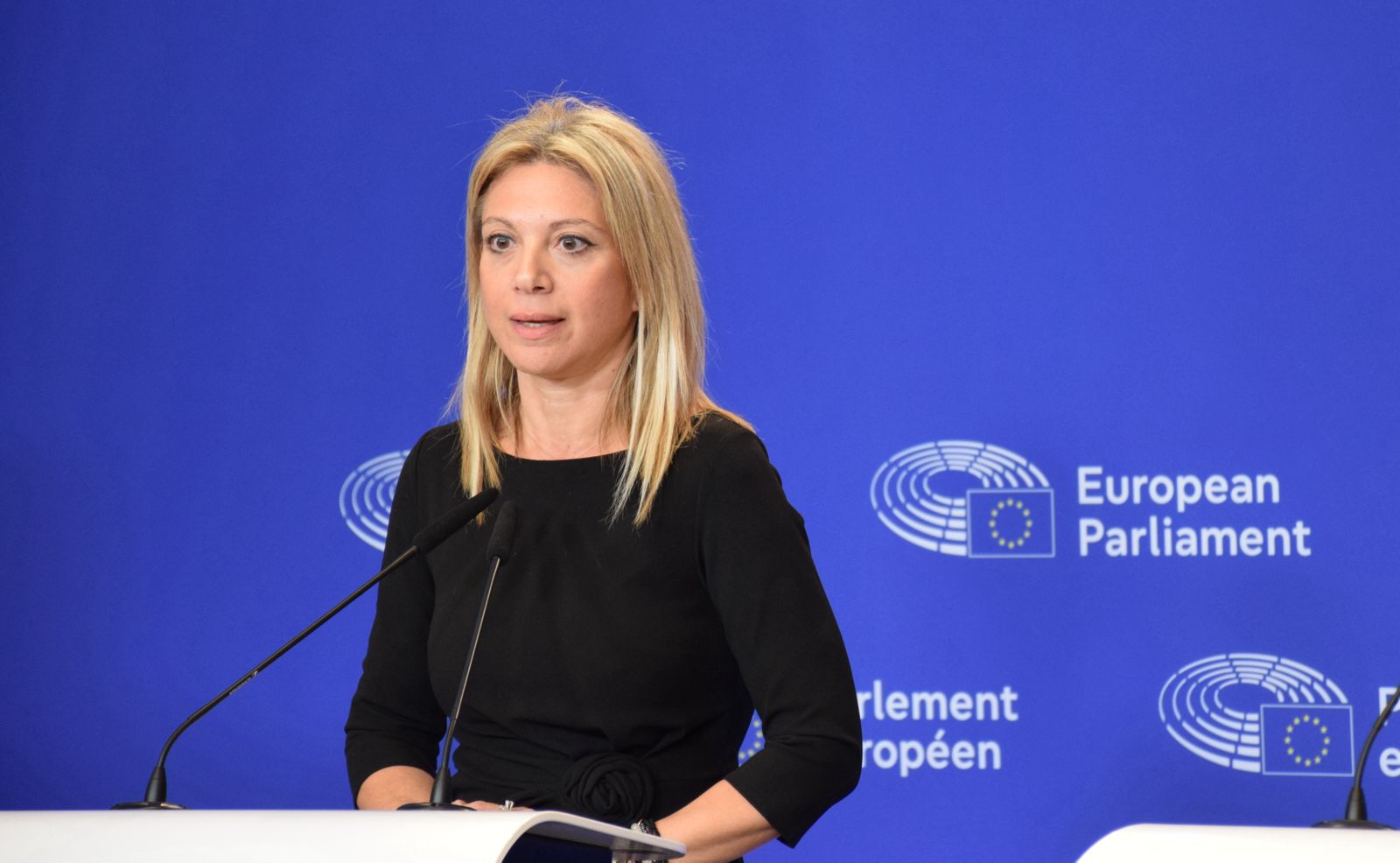
Maria Karystianou Greece Tempi train crash political party 2026 launch has brought one of the country's most powerful grief-turned-activism stories into formal electoral politics, with the paediatrician whose 20-year-old daughter Marthi died in Greece's worst train crash unveiling Hope for Democracy at a packed cinema theatre in Thessaloniki on Thursday, drawing on the frustration of hundreds of thousands of Greeks who took to the streets in the country's biggest rallies in years demanding justice for the 57 victims of the 2023 Tempi disaster. Karystianou, 53, told Reuters her goal was to fight for what was stripped from her, the implementation of the law, framing her political project not as conventional ambition but as the continuation of a justice campaign that has consistently exposed the gap between Greece's legal accountability standards and the political reality of a crash whose investigation has resulted in charges against 36 defendants ranging from station masters to rail executives without any politician facing legal consequences. An Alco poll for Alpha TV this month found that 15 percent of respondents would consider voting for a party launched by Karystianou, a figure that if translated into votes could give her significant parliamentary presence in a political landscape where Prime Minister Kyriakos Mitsotakis' New Democracy party has dropped from 41 percent in the 2023 election to between 23 and 29 percent in current polling.
The launch in Thessaloniki, where people watched both inside the theatre and on a large screen outside, carried the symbolic weight of a political debut that is explicitly constructed around the rejection of the political establishment rather than its accommodation. Karystianou's statement that she did not grow up in a party machine, does not belong to political families, and stands before the crowd as a mother and citizen rather than as someone who followed a political path is a direct challenge to the dynastic and machine politics that defines Greek political culture, with the implicit contrast to Mitsotakis, whose father Konstantinos was a former prime minister, landing with the clarity that the crowd's reception suggested they understood. Her promise to focus on transport safety, health and education reform, fighting corruption, and promoting transparency in state contracts and the banking system represents the convergence of the Tempi accountability agenda with a broader progressive governance platform that goes well beyond the single-issue advocacy that her original campaign represented.
Karystianou's political inexperience, which observers might expect to be her most significant disadvantage, is the characteristic she has explicitly reframed as an advantage in a political system she describes as dominated by cockfights between opponents who implement the same policies when they achieve power. The political authenticity argument that outsider candidates make in systems of deep public mistrust toward established parties has proven electorally effective in multiple European democracies in recent years, and Greece's own history with Syriza's rise as an anti-establishment party from protest movement to governing force provides the most direct local precedent for what a charismatic outsider candidate backed by popular frustration can achieve. Whether Hope for Democracy can replicate any of that trajectory depends on factors including Karystianou's effectiveness as a candidate, the party's ability to recruit credible candidates for parliamentary seats across the country, and the continued momentum of the accountability campaign that has been her political platform.
The Tempi Train Crash and How It Became Greece's Accountability Crisis
The Tempi train crash of February 2023, in which a passenger train and a freight train collided head-on in the Tempi valley in central Greece killing 57 people, was the deadliest rail accident in the country's history and immediately exposed the decades of accumulated negligence, inadequate safety investment, and institutional dysfunction in the Greek railway system that investigators subsequently documented as the disaster's systemic causes. The collision occurred because a station master had allowed both trains onto the same track, a catastrophic operational failure that investigators placed within a broader context of inadequate safety protocols, non-functional signalling systems, insufficient staff training, and the chronic underfunding of railway infrastructure that multiple governments across multiple decades had failed to address. The individual operational failure of the station master at the critical moment was the immediate cause, but the systemic conditions that made such a failure possible and left it without the automated safeguards that modern rail systems use to prevent exactly this scenario were the deeper causes whose political accountability the victims' families have been demanding.
Karystianou's emergence as the leading public face of the victims' justice campaign reflected both the personal circumstances of her loss, her daughter Marthi being among the 57 killed, and her professional background as a doctor that gave her the credibility and communication skills to translate personal grief into effective public advocacy. Her ability to mobilise the mass rallies that brought hundreds of thousands of people onto Greek streets in 2024, the largest demonstrations in years, demonstrated that the Tempi accountability issue had resonated well beyond the immediate circle of victims' families into a broader population that shared the frustration about governmental accountability and railway safety neglect that the crash had made impossible to ignore. The rallies were not simply expressions of grief but demands for systemic accountability that implicitly or explicitly connected the Tempi disaster to the broader governance failures that many Greeks associate with the political establishment regardless of party.
The trial now under way involving 36 defendants on charges ranging from traffic disruption that led to deaths to negligent manslaughter and causing bodily harm represents the formal legal accountability process that the victims' families demanded while simultaneously falling short of the full accountability they sought, because no politicians have faced charges despite the systemic character of the safety failures that investigators documented. The government's denial that any cover-up occurred, alongside Mitsotakis' pledges to modernise the railway network and review ministers' legal immunity, represents the political response to a crisis whose handling has contributed significantly to the 12 to 18 percentage point decline in New Democracy support since the 2023 election. Whether the legal proceedings eventually reach political actors, whether the systemic reform commitments produce measurable improvements, and whether the accountability narrative continues to motivate the political energy that Karystianou is now formally channelling will all shape the electoral environment in which Hope for Democracy makes its debut.
The Accountability Gap and Why It Drives Political Frustration
The specific focus on politicians' immunity from charges in connection with the Tempi crash, when rail managers and operational staff are facing criminal prosecution, captures the accountability asymmetry that is one of the most politically potent features of the Tempi justice campaign. In a system where operational workers and middle management face criminal accountability for the consequences of safety decisions they made within an institutional framework set by political choices about railway funding, staffing, and safety investment, the absence of political accountability for those framework decisions creates an obvious and deeply felt injustice. The legal structure that provides Greek politicians with immunity from prosecution in connection with their ministerial decisions is itself part of the systemic critique that Karystianou's campaign has been making, connecting the specific Tempi accountability gap to the broader governance problem of a political class that makes consequential decisions with limited legal exposure to their consequences.
Mitsotakis' pledge to review ministers' legal immunity, while responsive to this specific criticism, has not yet produced the legislative changes that would make the accountability framework meaningfully different, and the pledge's political credibility has been weakened by the corruption scandals that have simultaneously been dogging the New Democracy government and contributing to its polling decline. A government whose own members are implicated in corruption allegations faces a credibility problem in presenting itself as the agent of the governance reform that the Tempi accountability campaign demands, and the gap between the rhetoric of accountability and the reality of continued political immunity has been exactly the space that Karystianou's political project is designed to occupy. Hope for Democracy's name itself makes the claim that the current political system lacks the hope and democratic accountability that citizens deserve, positioning the party as the institutional expression of the frustration that the street demonstrations articulated.
Polls, Platform, and the Path to Parliamentary Representation
The 15 percent of respondents who told Alco pollsters they would consider voting for a party launched by Karystianou represents a significant reservoir of potential electoral support that needs careful interpretation to understand its meaning for Hope for Democracy's parliamentary prospects. Consider voting is a softer measure of electoral intent than voting intention, meaning the 15 percent figure likely overstates the share that would actually vote for the party in an election, but it also captures the broader population that is reachable through effective campaigning rather than only the committed supporters that a voting intention question would reveal. Greek parties entering the political system from scratch face the specific challenge of converting sympathetic interest into actual votes by building the candidate networks, organisational infrastructure, and voter contact capacity that established parties have developed over years or decades.
Greece's proportional representation electoral system, which has variable threshold requirements for parliamentary entry, creates the specific institutional gateway that Hope for Democracy must pass through to translate its polling support into parliamentary seats. A party that achieves the threshold percentage in a Greek parliamentary election wins seats proportional to its vote share, and the 15 percent consideration figure suggests that with effective mobilisation and campaign execution, Hope for Democracy has the potential to enter parliament with a meaningful contingent rather than the marginal presence that many new Greek parties have achieved on similar promise. The fragmentation of the Greek opposition that Karystianou's party is being described as helping to fill suggests an opposition landscape where new parties can gain ground without facing the zero-sum competition with a single dominant opposition party that would make entry into parliament more difficult.
Karystianou's policy platform as articulated at the Thessaloniki launch, covering transport safety, health, education reform, anti-corruption, and banking transparency, is broader than the Tempi accountability focus that made her a public figure but sufficiently coherent to present as a governance agenda rather than a single-issue campaign. The breadth is both a strength, giving potential supporters reasons to back the party beyond the specific Tempi issue, and a challenge, because each additional policy area requires expertise, positions on complex questions, and eventual legislative capacity that a newly formed party building its structures from scratch must develop rapidly. The abortion question that emerged from Karystianou's January media interview, where her initial comments created concern among leftist parties before she clarified her position on women's right to choose, illustrated the specific vulnerability that politically inexperienced candidates face when the full range of policy positions they hold is explored by the media and political opponents beyond the narrow accountability agenda on which their initial prominence was built.