
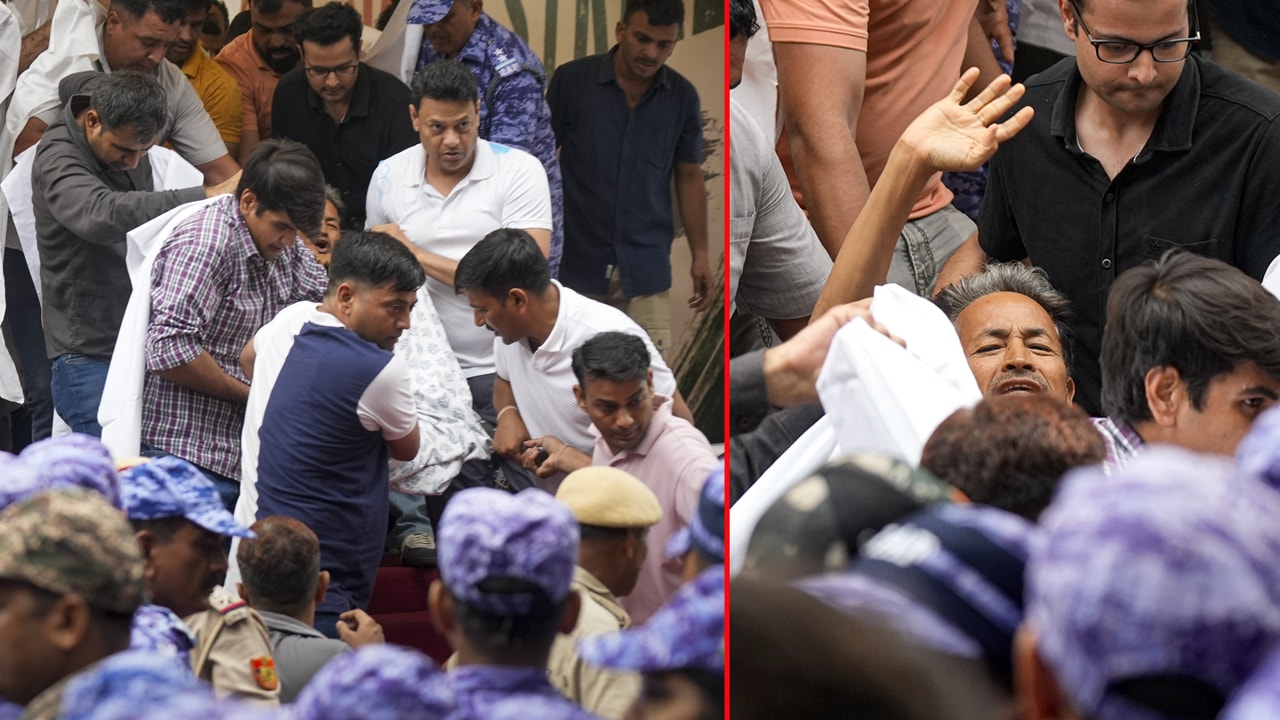
Sonam Wangchuk hunger strike hospital Delhi police education minister 2026 crisis reached its most acute moment on Saturday when authorities moved the 59-year-old social activist to a government hospital after his condition worsened on the 21st day of a hunger strike he launched on June 28 to demand the resignation of federal Education Minister Dharmendra Pradhan over exam paper leaks in May that affected millions of students across India, with television visuals showing dozens of police officers and security personnel in both fatigues and plain clothes arriving at the protest venue, holding large white cloth sheets on the stage before Wangchuk was taken away, while CJP founder Abhijeet Dipke told reporters that a 60-year-old man who had been on hunger strike for 20 days without eating a thing was forcibly dragged away by Delhi Police with supporters having no idea where he had been taken. ANI news agency subsequently reported Wangchuk was conscious and his vitals stable in hospital, providing the medical status update whose confirmation gave some reassurance to the hundreds of thousands of supporters who had been following his fast through the more than 100,000 Instagram reels posted urging him to abandon the protest and through the millions of social media views and shares that his campaign has generated as one of the most significant public challenges to Prime Minister Narendra Modi's government in recent months.
"In compliance with the court's order, and based on health conditions and medical advice, Mr Sonam Wangchuk has been moved from here to an appropriate government hospital for much-needed medical intervention and is currently under medical supervision," said Deputy Commissioner of Police Sachin Sharma at the protest site.
The Delhi High Court had asked authorities on Thursday to watch Wangchuk's health closely and intervene if needed, responding to a petition asking authorities to force-feed him as his condition deteriorated, creating the specific judicial order that the police cited as part of the legal basis for Saturday's removal alongside the medical advice dimension that the DCP's statement emphasised. The police also moved CJP supporters staging a sit-in at the venue, asking them to vacate with visuals showing one woman protester being physically lifted by policewomen and carried away, creating the specific imagery of state force being used against peaceful protesters that will intensify the political accountability debate around how the Modi government has chosen to manage a civil society challenge whose moral authority a 21-day hunger strike of an elderly activist has made particularly difficult to dismiss or minimise.
Dipke's response was immediate and public.
"They dragged Sonam Sir away...a 60-year-old man, who had been on a hunger strike for 20 days and hadn't eaten a thing, was forcibly dragged away by the Delhi Police. We have no idea where they have taken him," he told reporters, before posting on X: "I am starting an indefinite hunger strike beginning right now."
How Wangchuk's Campaign Became India's Most Significant Civil Society Challenge of 2026
The exam paper leaks in May that prompted Wangchuk's hunger strike were not an isolated institutional failure but a systemic crisis affecting millions of Indian students whose entire academic and professional trajectories depend on the national examination systems whose integrity the leaks fundamentally compromised, creating the specific public anger that the Cockroach Janta Party's demands for ministerial accountability have been channelling since the leaks became public and demonstrating that exam integrity is not a procedural educational matter but a social justice issue whose victims are the young people from less privileged backgrounds whose merit-based advancement through the examination system represents their primary avenue for economic and social mobility. Education Minister Pradhan's continuation in office despite the scale of the leak crisis and the extent of the student harm it caused created the specific accountability deficit that Wangchuk's fast was designed to make morally and politically impossible to ignore through the escalating human cost of his continued protest.
The Cockroach Janta Party's name, invoking the cockroach's reputation for survival against all attempts at extermination, reflects the specific political metaphor that the youth movement behind the exam leak accountability campaign has adopted to characterise both their own persistence in demanding accountability and the examination system's corrupt elements that have survived despite repeated official commitments to cleaning up national examination administration. The CJP's emergence as a recognisable political force, sufficient to attract the partnership of Wangchuk's hunger strike and to generate the parliamentary visit planned for July 20 when the monsoon session begins, documents the specific political maturation of a movement that began as a student protest and has developed into an organised civil society campaign with sufficient institutional presence to plan direct parliament engagement on specific policy demands.
Wangchuk himself brings to the fast the specific moral authority and public profile that his previous activism in Ladakh, his engineering innovations for the region's mountain communities, and his association with the educational values whose violation the exam leaks represent have built over decades of public service in one of India's most challenging geographic and political environments. His six months in jail following last year's Ladakh protests, during which Modi's government accused him of inciting people through provocative statements that Wangchuk denied, making him a figure whose government confrontation has a documented history that the fast's supporters can point to as evidence that the accountability challenge Wangchuk is mounting has roots in the specific grievances that the Ladakh territory's communities have been expressing through the democratic participation that his activism has facilitated.
The Third Day Statement That Defined the Fast's Stakes
Wangchuk's third-day statement to Reuters that his fast would last six weeks unless he died first, followed by the careful qualification that hopefully we would not have to go that far and the observation that a sensitive government in a democracy listens to the pains of the people and he hoped they would take action, established from the fast's early days the specific framing of the protest as a test of the Modi government's democratic sensitivity rather than simply a demand for a specific ministerial resignation. The democracy listens framing elevates the accountability question from the personal to the institutional, positioning the government's response not simply as a decision about Pradhan's tenure but as a demonstration of whether the Indian democratic system's feedback mechanisms function when civil society uses the most extreme non-violent protest available to communicate the urgency of its demands. Twenty-one days into the fast, with Wangchuk hospitalised and the government having neither met the resignation demand nor provided the policy response that might have offered an honourable alternative to continued protest, the democratic sensitivity test has produced a preliminary answer whose evaluation the Indian public and the international community watching the fast are forming independently of any official communication.
The 100,000 Instagram reels urging Wangchuk to abandon his protest represent the specific social media solidarity expression whose scale documents both the widespread public engagement with his fast and the complex emotional response it has generated, with supporters simultaneously recognising the fast's moral power and fearing for the health of an activist they regard with affection and respect. The social media attention whose millions of views and shares the campaign has generated provides the specific public pressure mechanism that Wangchuk's team has been using to compensate for the absence of official government response, creating the reputational cost for the Modi government that the fast's continuation and deterioration intensifies with each additional day that passes without the accountability that the CJP and Wangchuk are demanding.
The Hospital Transfer, the Parliament March, and What Saturday's Events Mean
The specific manner of Wangchuk's hospital transfer, with dozens of police officers arriving at the protest site, large cloth sheets deployed apparently to obstruct camera visibility of the removal, and Wangchuk absent from television visuals that showed the proceedings, creates the specific accountability gap between the police's characterised compliance with the court order and the CJP's characterised forcible dragging away of a 60-year-old hunger striker whose contradiction reflects the competing institutional and civil society narratives about what happened on Saturday morning. The Delhi High Court's Thursday order to watch his health closely and intervene if needed provided the judicial authority that police cited alongside medical advice for the transfer, but the CJP's counter that they had no idea where he had been taken and Dipke's description of forcible dragging document the specific manner concerns that compliance with a court order does not automatically resolve when the implementation raises its own procedural and dignity questions.
The CJP's announcement that protesters would march to India's parliament on July 20 when the monsoon session begins to press their demand for Pradhan's resignation and seek exam reforms creates the specific upcoming democratic encounter that Saturday's protest removal has now charged with the additional political energy of a confrontation whose images, a hospitalised hunger striker and physically removed woman protesters, will accompany the parliament march as its immediate political context. Dipke's announcement of his own indefinite hunger strike beginning immediately after Wangchuk's removal represents the movement's specific response to the government's apparent decision to resolve the immediate medical crisis through hospitalisation rather than the political crisis through ministerial accountability, signalling that the fast's coercive moral pressure will continue through a different individual rather than being ended by Wangchuk's hospitalisation.
The broader political significance of Saturday's events lies in what they reveal about the Modi government's approach to civil society accountability challenges of the character that Wangchuk's fast represents, with the combination of inaction on the resignation demand and physical removal of the protester under court and medical cover creating the specific governance accountability record that the opposition, civil society, and the Indian media will be examining against the democratic standards that Wangchuk's own framing of the fast as a test of democratic sensitivity was designed to invoke. Whether the parliamentary monsoon session that begins Monday will provide the political forum in which the exam leak accountability demand and the manner of Wangchuk's removal are both addressed, or whether the government's strategy will be to manage the hospitalisation as a health intervention rather than engage the political demand on its merits, will determine whether Saturday's events represent a temporary pause in the campaign or a governmental response whose character the CJP's parliament march will be directly challenging.