
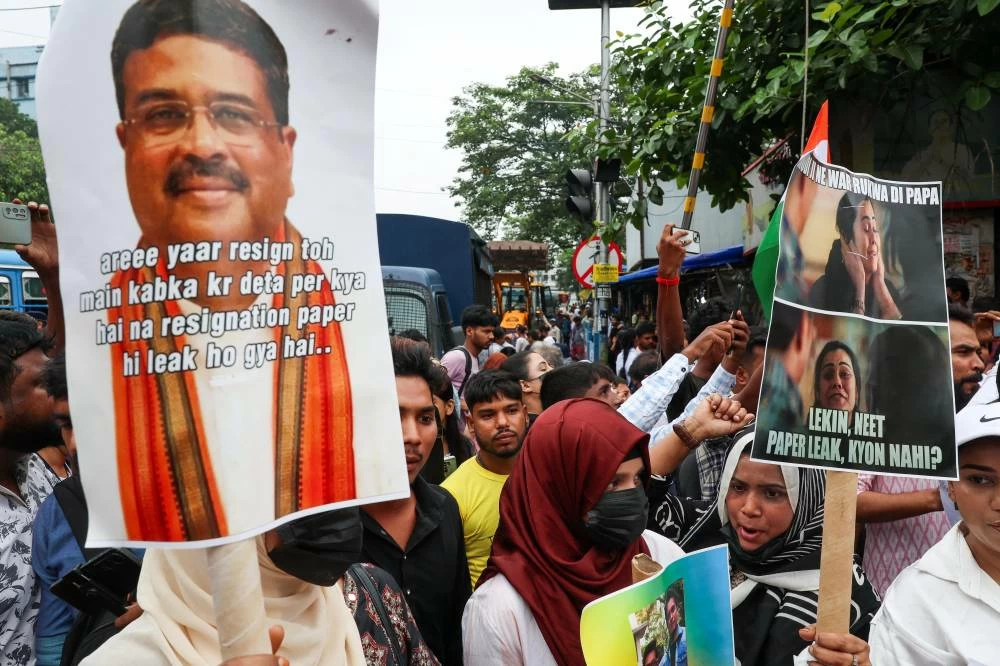
India Education Minister Dharmendra Pradhan announced his resignation on Saturday, handing a significant victory to the nationwide youth protest movement that has been demanding his removal as a consequence of examination paper leaks that affected millions of students across the country, in a development that marks one of the most consequential successful civil society accountability campaigns in recent Indian political history. Pradhan posted his resignation on X even as police were firing tear gas to scatter young protesters at Jantar Mantar in central New Delhi, hours before protest leaders were scheduled to meet with ministers for another round of talks, creating the specific sequence in which the resignation preceded the scheduled dialogue rather than emerging from it.
"Considering the situation that has arisen at Jantar Mantar and across the country, so that anti-national forces do not take advantage of this situation... I have sent my resignation letter to the Prime Minister," Pradhan wrote.
"I deeply respect the aspirations, feelings, and legitimate expectations of the country's youth."
Thousands of protesters injured who received the news at Jantar Mantar erupted in cheers, the specific emotional release of a movement that had been sustaining its pressure through police baton charges, tear gas, internet shutdowns across the capital, restrictions on access to 18 metro stations, and the extended of hunger striker Sonam Wangchuk, whose 21-day fast had given the campaign its most internationally visible individual expression of moral authority and whose physical sacrifice had given the movement's demand the specific urgency that institutional unresponsiveness had previously failed to produce.
The resignation does not resolve the examination system's structural problems that produced the leaks. It does not restore the millions of students whose academic years were disrupted by the cancelled results and rescheduled examinations. It does not address the job scarcity and systemic corruption that the protest movement's analysis of the exam crisis situated within a broader governance failure narrative. What it does is demonstrate that sustained civil society pressure in democratic India, even against a government with a substantial parliamentary majority, can force ministerial accountability when the scale of public anger exceeds the political cost of concession.
The Resignation, the Tear Gas, and the Cheers That Followed
The sequence of Saturday's events captures something essential about the specific kind of political victory the youth movement has achieved. Police were deploying tear gas to disperse protesters at Jantar Mantar when the resignation news arrived. The protest leaders were hours away from another round of government talks whose outcome before the resignation would have been uncertain. Then the resignation was announced, not as the result of a negotiated agreement between government and protest leadership but as a unilateral act that the minister framed as preventing anti-national forces from exploiting the situation.
The anti-national forces framing in Pradhan's resignation statement is the specific political language whose use reveals the defensive character of the resignation even as the act itself represents the concession the protesters demanded. Framing a resignation in terms of preventing exploitation by anti-national forces rather than in terms of accepting accountability for the examination failures that triggered the protest is the specific political communication strategy that allows a minister to concede the demanded action while not fully conceding the demanded accountability. The protesters won the resignation they demanded. The minister declined to frame the resignation as the admission of failure that the protesters' accountability argument required.
The internet restrictions and metro station access limitations that federal authorities had imposed to try to limit the protest in the capital represent the specific institutional response to protest that democracies employ at the edge of their tolerance for public dissent, creating the compressed communications environment in which the resignation news nonetheless spread rapidly enough through available channels to produce the immediate collective cheering response that the scenes from Jantar Mantar captured.
The anger that boiled over when police launched baton charges and fired tear gas to deter crowds marching on parliament earlier in the week had given the protest the specific confrontation imagery that elevated its international and national media attention, transforming what might have remained a student grievance movement into the broader accountability confrontation that forced the resignation's political calculus to change. When a government deploys physical force against peacefully marching students demanding examination fairness, the political optics create the specific public sympathy dynamic that makes continued ministerial tenure more costly than the accountability concession of resignation.
The Examination Leaks, the Protest Movement's Architecture, and the Political Calculation
The examination paper leaks that triggered the protest were not isolated incidents of administrative failure but systematic events whose specific consequences for millions of individual students were severe and measurable. Students who had spent months or years preparing for high-stakes entrance examinations that determine access to medical schools, engineering, civil service careers, and other highly competitive professional pathways lost the specific examination opportunity that their preparation had been building toward when results were cancelled following the confirmation that question papers had been available to some candidates before the examination date.
The cancellation of examination results is not a neutral administrative correction but a direct harm to every student who sat the examination honestly, whose legitimate result was invalidated by the cheating of others and the institutional failure that made cheating possible. For the millions of students affected, the cancelled results represented not simply a scheduling inconvenience but the loss of the competitive advantage that their honest preparation had earned them in examinations whose scarcity of successful places makes each relative position significant for individual life outcomes.
The Cockroach Janta Party, the youth movement whose name invokes the insect's survival against all odds, built its accountability campaign around the specific demand for ministerial resignation that translates the diffuse anger of millions of individually harmed students into a concrete institutional accountability action whose achievement demonstrates that democratic pressure produces consequences for those responsible for governance failures. The CJP's choice of ministerial resignation as its central demand reflected both the movement's understanding of how democratic accountability works and its assessment of what was achievable through sustained pressure, choosing a concrete institutional target over the more diffuse demands for systemic reform that are harder to achieve and harder to declare as victories.
Sonam Wangchuk's hunger strike gave the campaign the specific moral urgency and international visibility that student protest movements frequently lack, connecting the activist's personal sacrifice to the broader accountability demand in a way that created both the human story that media coverage requires and the escalating health crisis whose management the Delhi High Court's intervention and Saturday morning forced on a government that could not simply ignore a 60-year-old man's deteriorating condition. Wangchuk's on the 21st day of his fast, with his vitals stable but his condition having deteriorated to the point requiring medical intervention, created the specific moral and political pressure point whose proximity to the scheduled parliamentary monsoon session talks created the urgency that the resignation's timing reflects.
The political calculation that produced the resignation involves several simultaneous assessments. The cost of continued protest escalation, with baton charges, tear gas, and internet shutdowns having already generated the specific imagery of state force against student protesters that is politically damaging to any government claiming democratic legitimacy. The cost of parliamentary session disruption, with the monsoon session beginning July 20 and the protest's planned march to parliament creating the specific legislative agenda management problem that governments manage by addressing the protest's immediate demand before the session becomes the arena for the accountability confrontation. The cost of the anti-Modi government narrative gaining momentum through an accountability failure that began with examination leaks and has escalated through hunger strikes, police force against students, and internet shutdowns. Each cost individually might have been manageable. The cumulative cost of all simultaneously exceeded the political benefit of ministerial retention.
From Examination Leaks to Cabinet Resignation
May 2026: Examination paper leaks are confirmed for the national undergraduate medical entrance exam and other high-stakes national examinations. Results for the affected examinations are cancelled, affecting millions of students across India whose preparation for the examinations had been extensive and whose competitive position in the rescheduled examinations was uncertain.
May to June 2026: The Cockroach Janta Party emerges as the organised voice of student discontent, demanding Education Minister Dharmendra Pradhan's resignation for education reform as the specific ministerial accountability action for the examination failures. Youth protests begin across India in multiple cities.
June 28, 2026: Sonam Wangchuk begins a hunger strike in solidarity with the CJP, adding his moral authority and public profile to the campaign and escalating it from a student movement to a broader civil society accountability challenge. He tells Reuters on the fast's third day that it would last six weeks unless he died first.
July 2026: The protest continues through the parliamentary monsoon session's opening on July 20. CJP leaders announce a march to parliament. Police deploy baton charges and tear gas against students marching toward parliament, generating the specific confrontation imagery whose political consequences begin accelerating the accountability calculation.
July 18, 2026: Wangchuk is moved to hospital on the 21st day of his fast as his condition worsens, with Delhi Police citing compliance with a Delhi High Court order and medical advice. CJP founder Abhijeet Dipke announces his own indefinite hunger strike. The police removal of both Wangchuk and CJP supporters from the protest venue generates additional political controversy.
July 26, 2026: Education Minister Dharmendra Pradhan announces his resignation on X as police fire tear gas at Jantar Mantar protesters. Thousands of protesters cheer. The CJP's primary demand has been achieved three days before the originally planned July 20 parliament march that the monsoon session opening had activated.
What a Ministerial Resignation Means for the Modi Government
Pradhan's resignation represents the specific accountability concession that a government with a parliamentary majority rarely makes to protest movements, and its occurrence under a Modi government whose characteristic political style has been confident assertion of majority mandate over civil society pressure makes its significance for Indian democratic accountability more notable than a routine ministerial resignation under a weaker government would be.
The Modi government's third term, secured in the June 2024 general election, has proceeded with the specific political confidence that a renewed mandate provides, and the examination leaks controversy presented the administration with one of its most significant early accountability challenges, connecting the specific governance failure of educational examination integrity to the broader dissatisfaction with job scarcity, corruption, and government accountability that the protest movement's analysis identifies as the systemic context for the specific examination failure.
The protest movement's success in forcing a resignation demonstrates that civil society pressure in Indian democracy can override the partisan calculation of a majority government when the specific combination of factors that made this campaign effective is present: a concrete and specific institutional accountability demand, a moral authority figure whose personal sacrifice amplifies the movement's urgency, the capacity to sustain pressure through escalating governmental response including force and communication restrictions, and the parliamentary calendar providing the specific deadline that makes resolution before the session less costly than resolution through it.
The anti-national forces framing in Pradhan's resignation statement deserves direct engagement as a political signal. Framing protesters' legitimate accountability demands as potentially exploitable by anti-national forces is the specific defensive political communication strategy that governments use to manage the optics of concession without full accountability acceptance. The protesters and CJP leadership will not accept the anti-national forces framing as an accurate characterisation of their movement, and the political argument about what motivated the protests and what the resignation represents will continue in Indian public discourse well beyond the immediate celebration of the movement's primary demand being met.
Examination Integrity and India's Human Capital Development
The economic significance of India's national examination system extends far beyond the immediate controversy of the paper leaks to the fundamental question of how India's human capital development infrastructure allocates its most critical resource: places in the professional whose graduates supply the doctors, engineers, civil servants, and technical experts that a growing economy of India's scale requires.
A national examination system whose integrity has been compromised by paper leaks does not simply harm the individual students directly affected by the leaked examinations. It undermines the entire meritocratic allocation mechanism that the system is supposed to provide, creating the specific systemic damage whose consequences accumulate across cohorts of students whose competitive positioning in a fair system would have been different from their positioning in one where some candidates had advance access to questions. The systemic damage to examination integrity is what the protest movement understood as requiring ministerial accountability rather than simply administrative correction.
The job scarcity dimension of the protest's broader analysis is the economic context within which the examination integrity concern has its most acute social significance. India's demographic dividend, the large and growing working-age population whose productive potential is one of the most significant factors in India's economic growth trajectory, requires the educational and examination infrastructure that efficiently and fairly allocates educational opportunities across the millions of young people competing for them. When that infrastructure is compromised by corruption and leaks, the economic cost is not simply the disruption of individual career trajectories but the systemic misallocation of educational opportunity that reduces the efficiency of the entire human capital development system.
What India's Youth Protest Victory Means Beyond the Subcontinent
India's youth protest movement and its successful accountability campaign carries global significance as a demonstration of civil society's capacity to force democratic accountability even within large, majority-government political systems whose institutional power might appear to insulate them from protest pressure. The specific combination of organized student movement, moral authority figure whose sacrifice amplifies urgency, social media mobilisation under communication restriction, and parliamentary calendar leverage that produced the Pradhan resignation represents a template whose elements are recognisable in protest movements across democratic developing nations facing similar challenges of examination corruption, youth unemployment, and government accountability.
The protest's framing within the broader context of job scarcity and systemic corruption rather than simply as a narrow examination integrity complaint gives it the specific analytical sophistication that distinguishes reform-oriented protest movements from purely reactive grievance expressions. The CJP's understanding that examination leaks are symptoms of the broader governance pathology of corruption and unaccountability, rather than isolated administrative failures, positions the movement's accountability demands within a development governance framework whose resolution requires systemic reform beyond the resignation of any single minister.
For international observers of Indian democracy, the protest movement's success in forcing a ministerial resignation against a government with a substantial parliamentary majority demonstrates the vitality of India's democratic civil society whose capacity for organized accountability pressure was not exhausted by the government's baton charges, tear gas, internet restrictions, and the hospitalization of its most prominent moral authority figure. That these instruments of governmental pressure were deployed and nonetheless failed to prevent the accountability outcome the protesters demanded is the specific democratic health signal that the resignation produces.
What Political Scientists Say About the Protest's Success Formula
Political scientists who study social movement effectiveness in democratic developing nations have identified several conditions that determine whether protest movements achieve their institutional accountability demands, and the CJP campaign exhibits a remarkably complete set of the conditions associated with successful movement outcomes.
The specificity of the demand matters enormously. Movements demanding vague systemic improvement rarely achieve the concrete institutional accountability victories that specific demands produce. The CJP's singular focus on Pradhan's resignation gave the movement a clear success condition whose achievement was unambiguous and whose non-achievement was equally unambiguous, creating the specific accountability clarity that sustains movement cohesion through the governmental resistance that vague demands cannot.
The moral authority dimension that Wangchuk provided is the specific personalization of the accountability demand that mass movement politics requires in media environments where individual human stories generate the coverage that aggregate student numbers do not. A 59-year-old hunger striker whose health deteriorates over 21 days because a government has not addressed students' examination concerns is the specific human story that makes abstract corruption accountability emotionally legible to audiences whose own experience of the examination system's injustice may be secondary or distant.
The parliamentary calendar leverage that the monsoon session provided created the specific political deadline that transformed the government's cost-benefit calculation about ministerial retention. A protest that the government could have managed through the summer recess as a slow-burning news story became, with the monsoon session's opening, an immediate parliamentary management problem whose resolution before the session was less politically costly than its resolution through parliamentary confrontation.
Reform Demands Beyond the Resignation and What the Movement Must Now Win
The CJP's primary institutional demand has been achieved. The harder and more consequential demands remain: the systemic examination reform that prevents future leaks, the prosecution of those responsible for the leaks that occurred, the restoration of fair competitive opportunity for the students whose results were cancelled, and the broader accountability for the job scarcity and corruption that the protest's analysis identifies as the systemic context for the specific examination failures.
These demands are harder to achieve through protest pressure than ministerial resignation because they require sustained institutional reform rather than a single dramatic accountability act. The history of accountability movements that win their primary symbolic demand but fail to sustain pressure for systemic change is long enough to suggest that the CJP's movement faces its most difficult phase beginning now, with the emotional energy of the Pradhan resignation victory needing to be channeled into the sustained monitoring and pressure that examination system reform requires over months and years rather than weeks.
The parliamentary monsoon session provides the immediate institutional arena for the reform demands, with CJP's planned march to parliament and the attention that the protest has generated creating the specific legislative pressure opportunity that the movement's leadership must convert from symbolic accountability demand to concrete policy engagement. The difference between symbolic pressure and policy engagement is the specific transition that transforms protest movements into durable forces for institutional change rather than episodic accountability victories whose governance impact is limited to the resignation of the official whose removal was the campaign's primary target.
What to Watch Next
Watch for the appointment of Pradhan's successor and the specific examination reform commitments that the new education minister makes in the first weeks of the appointment, whose substance will determine whether the ministerial change produces policy change or simply personnel change.
Watch for the CJP's organizational response to the resignation victory and whether the movement maintains the cohesion and pressure necessary to convert the symbolic accountability win into the systemic examination reform that its analysis identifies as the necessary consequence.
Watch for Sonam Wangchuk's response to the resignation and his recovery from the hospitalization whose health consequences of his 21-day fast will determine his continued capacity for public advocacy in the examination reform phase that follows the resignation.
Watch for the parliamentary monsoon session's treatment of examination reform legislation and the government's specific policy response to the structural problems that the leaks revealed, whose adequacy or inadequacy will determine whether the Pradhan resignation is the beginning of genuine reform or the management of a political crisis without substantive policy change.