
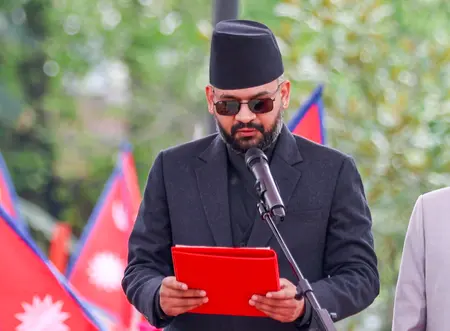
Nepal Asset Investigation new government has wasted little time signaling its intentions on the issue that defined its rise to power, announcing the formation of a dedicated five-member panel to investigate the property and assets of past and present politicians and government officials across the Himalayan nation. The move, announced following a cabinet meeting late on Wednesday, represents one of the most significant anti-corruption initiatives Nepal has seen in recent political memory and fulfills a central campaign promise made by the Rastriya Swatantra Party before its sweeping victory in the March 5 parliamentary election. For a country where public frustration with elite corruption had reached a breaking point dramatic enough to produce mass street protests led by a younger generation demanding accountability, the establishment of this investigative panel carries both practical and deeply symbolic weight.
The government is led by Balendra Shah, a 35-year-old rapper turned politician wb hose journey from cultural figure to national leader is one of the most unconventional political stories in South Asian politics in recent years. Shah became prime minister following the RSP's commanding performance in the March 5 election, which was Nepal's first parliamentary vote held after the anti-graft protests that swept the country last September and fundamentally altered the political landscape by demonstrating the scale of public anger at the established parties that had dominated Nepali politics for decades. The election result was not a narrow victory. It was a decisive rejection of the political establishment by voters who had watched corruption flourish under successive governments and who saw in Shah and his party a credible alternative rooted in demonstrated results rather than political promises alone.
Cabinet spokesperson Sasmit Pokhrel confirmed the details of the panel following the Wednesday cabinet meeting, telling reporters that an impartial investigation would be carried out on the basis of evidence meeting legal standards, and that the panel's report and recommendations would be implemented by the relevant government agencies. The five-member panel will be headed by Rajendra Kumar Bhandari, a retired Supreme Court judge whose legal background and judicial experience are intended to lend the investigation credibility, independence, and procedural rigor. The appointment of a former senior judiciary figure to lead the probe is a deliberate signal from the Shah government that this is not a politically motivated exercise dressed up as accountability but a serious legal process designed to produce evidence-based findings that can withstand scrutiny and form the basis for meaningful consequences.
How Balendra Shah Built His Anti-Corruption Reputation Before Reaching National Office
Long before Balendra Shah became Nepal's prime minister, he was building a reputation as something genuinely unusual in Nepali public life: a local official who actually delivered on his promises and who treated the fight against corruption as a practical governance commitment rather than a rhetorical device deployed at election time. During his three-year tenure as mayor of Kathmandu, Nepal's capital city, Shah earned widespread recognition and genuine public affection for his reformist approach to municipal governance, his willingness to confront entrenched interests and informal power structures that had long treated city resources as available for private benefit, and his ability to demonstrate that accountable governance was possible even within Nepal's challenging political environment.
His background as a rapper before entering politics gave him a cultural credibility and public communication style that connected with younger Nepalis in ways that career politicians from established parties consistently failed to match. Shah understood how to speak directly and authentically to a generation that had grown up watching political figures accumulate personal wealth while public services deteriorated and infrastructure decayed. His music had already established him as someone willing to speak uncomfortable truths, and when he carried that same directness into his role as Kathmandu's mayor, voters responded with a level of trust and enthusiasm that translated directly into the RSP's national electoral breakthrough in March 2026. The line between his cultural identity and his political identity was never sharply drawn, and that authenticity became one of his most powerful political assets.
The September 2024 anti-graft protests that preceded the March 2026 election created the political context that made the RSP's national breakthrough possible, and understanding those protests is essential for understanding why the new government's asset investigation panel carries the weight that it does. Young Nepalis took to the streets in large numbers to demand accountability from a political class they viewed as comprehensively corrupt, institutionally self-serving, and fundamentally unresponsive to the needs and aspirations of ordinary citizens. The protests drew comparisons to similar generational movements in other countries and were notable for their organizational sophistication, their peaceful discipline, and the clarity of their demands. When the RSP subsequently won the March election decisively, it was in significant part because it was seen as the political vehicle most credibly connected to the values and demands of that protest movement.
What the Asset Investigation Panel Will Examine and Why It Matters
The scope of the investigation announced by the Shah government is substantial and historically significant in the Nepali context. Analysts have indicated that the probe is expected to cover hundreds of politicians and officials who held public offices after the popular movement that led to the abolition of Nepal's 239-year monarchy in 2008. That means the investigation's reach extends across nearly two decades of political figures from all the major parties that have governed Nepal during the republican era, a period during which corruption became increasingly systematic and the gap between the lifestyles of political figures and the resources their official salaries could plausibly support became increasingly difficult to explain or ignore. Examining the assets of figures from across this entire period is a genuinely ambitious undertaking that goes well beyond targeting political opponents of the current government.
The panel's mandate to operate on the basis of evidence meeting legal standards is a crucial detail that distinguishes this initiative from politically motivated asset freezes or show trials that have characterized anti-corruption drives in other countries where governments have used accountability rhetoric to target opponents rather than pursue genuine systemic reform. By grounding the investigation in legal evidentiary standards and appointing a retired Supreme Court judge to lead it, the Shah government is attempting to build in structural protections against the panel becoming a tool of political persecution. Whether those structural protections prove sufficient in practice will depend on the independence the panel is actually permitted to exercise, the resources and legal authorities it is given to conduct thorough investigations, and the willingness of the government to act on findings that may implicate figures whose cooperation the RSP needs for its governing coalition.
The implementation mechanism described by cabinet spokesperson Pokhrel, under which the panel's report and recommendations will be implemented by the relevant government agencies, raises important questions about the pathway from investigation to accountability that will determine whether this initiative produces real consequences or remains a process without enforceable outcomes. Anti-corruption panels and commissions have been established in numerous countries with considerable fanfare only to produce reports that sit on shelves while the figures they identify face no meaningful legal or financial consequences. Nepal's history includes its own examples of accountability processes that generated reports without producing prosecutions. The Shah government's credibility on corruption, which was the central basis for its electoral mandate, will be substantially tested by whether the asset investigation panel's work ultimately results in consequences that the public can see and verify.
The RSP's Electoral Mandate and What It Means for Nepal's Political Future
The Rastriya Swatantra Party's victory in the March 5 parliamentary election was a watershed moment in Nepali political history that cannot be adequately understood simply as the success of one party over others in a competitive election. It represented the culmination of years of building public frustration with the established parties, primarily the Nepali Congress and the various Communist factions that had traded power between themselves throughout the republican era, parties that had become increasingly identified in the public mind with corruption, self-dealing, and a fundamental indifference to the accountability demands of ordinary citizens. The RSP, founded only three years before its national breakthrough, had made corruption control the explicit centerpiece of its electoral platform, and the comfortable margin of its victory over parties with vastly longer histories and more extensive organizational networks was a direct measure of how seriously voters took that commitment.
Shah's personal journey from mayor of Kathmandu to prime minister of Nepal in a relatively short period reflects a broader pattern visible in democracies around the world where voters frustrated with entrenched political establishments have turned to figures who combine outsider credentials with demonstrated competence at a local or regional level. His success as Kathmandu's mayor gave him something that purely populist figures often lack: a concrete record of governance achievement that voters could examine and evaluate before deciding whether to extend his mandate to the national level. The anti-corruption credentials he built at the municipal level were not purely rhetorical. They were grounded in specific decisions, specific confrontations with vested interests, and specific improvements in how Kathmandu's city government functioned under his leadership.
The political future of Nepal under the RSP government will be shaped significantly by whether the party's governance at the national level matches the expectations generated by Shah's record in Kathmandu and by the scale of the mandate voters delivered in March. Anti-corruption drives that begin with genuine public enthusiasm can lose momentum when they encounter the full complexity of national governance, when coalition management requires compromise with figures whose commitment to accountability is more limited, or when the legal and institutional barriers to actually prosecuting corruption prove more formidable than campaign rhetoric acknowledged. The Shah government is at the very beginning of what will be a long and difficult process of institutional reform, and the asset investigation panel announced on Wednesday is an important first step whose ultimate significance will be determined not by its announcement but by what it actually produces in the months and years ahead.