
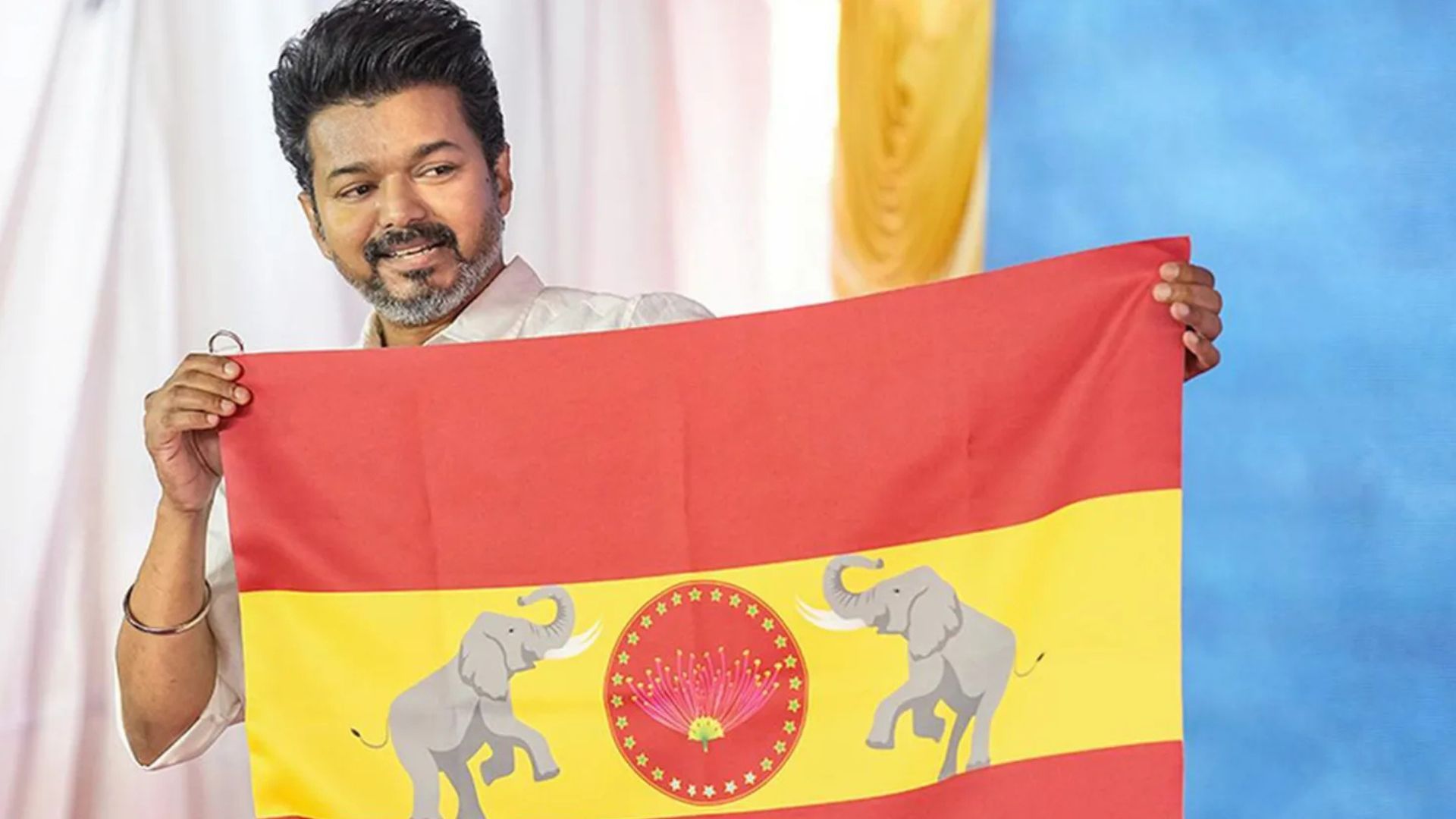
Tamil Nadu has witnessed one of its most dramatic political moments in decades as film superstar turned politician C Joseph Vijay led his party Tamilaga Vettri Kazhagam to a stunning near-sweep of the state assembly election, sending shockwaves through an established political order that has held firm for more than half a century. vijay TVK's performance, which few analysts predicted at the scale it has delivered, has broken the stranglehold of the two dominant regional parties, the Dravida Munnetra Kazhagam and the All India Anna Dravida Munnetra Kazhagam, and placed Vijay on the threshold of becoming Tamil Nadu's next chief minister. The results have electrified supporters, unsettled political veterans, and sparked a national conversation about the enduring power of cinema in shaping democratic outcomes in India's southern states.
The scale of the achievement is remarkable by any measure. TVK has won 108 seats in the 234-member Tamil Nadu Legislative Assembly, falling just 10 seats short of the 118 required for an outright majority. That margin is narrow enough to be bridgeable through coalition negotiations with smaller parties and independent legislators, and Vijay now faces the task of converting his extraordinary electoral momentum into the parliamentary arithmetic that would formally hand him the chief minister's chair. The coming days will test whether the same personal magnetism that drew millions of voters to TVK can translate into the quieter, more transactional work of political deal-making that coalition building requires.
Vijay's rise is being widely compared to that of Maruthur Gopalan Ramachandran, the beloved matinee idol who broke from the DMK in the 1970s to form his own party and became chief minister in 1977, going on to dominate Tamil Nadu politics for a decade. The parallel is imperfect in important ways, but the structural similarity is striking. Both men converted mass cinematic devotion into political organization, both challenged the DMK's hegemony at moments of perceived fatigue within the established party, and both drew their most passionate support from voters who saw in them a form of accessible, personal justice that institutional politics rarely delivers. Whether Vijay's story follows the same arc remains to be written, but the opening chapter is already historic.
How Vijay Built a Political Movement Years Before He Officially Entered Politics
The roots of TVK's electoral success stretch back much further than the party's formal launch in 2024, and understanding that history is essential to understanding why the results of this election were less surprising to close observers than they appeared to the wider public. As early as 2009, Vijay began the deliberate transformation of his fan clubs into the Vijay Makkal Iyakkam, a grassroots welfare network that operated at the neighborhood level providing relief services, educational support, and local community assistance. This was not the passive fan organization common among Tamil film stars. It was a structured, purposeful network that worked like a political ground operation years before Vijay publicly acknowledged any political ambitions.
In previous years, the Vijay Makkal Iyakkam tested its political reach by backing an AIADMK alliance in 2011, a calculated exercise in understanding whether fan loyalty could be converted into votes in a real electoral contest. That experiment yielded useful intelligence about the geographic and demographic distribution of Vijay's support base and the conditions under which it could be mobilized. Over the following decade, Vijay's public film events took on an increasingly explicit political character, with the star addressing audiences of young people about exam stress, youth unemployment, corruption, and governance failures. His 2019 criticism of the Citizenship Amendment Act marked a particularly significant moment, signaling that Vijay was willing to stake out positions on nationally contentious issues rather than restricting himself to the safer terrain of general social commentary.
When Vijay formally stepped away from acting after a career spanning nearly 70 films to commit fully to politics, the transition was presented not as an extension of celebrity but as its deliberate and irreversible conversion into political capital. The framing mattered enormously. It communicated to voters that Vijay was not dabbling in politics as a hobby or a vanity project but was making a genuine and costly personal sacrifice in pursuit of a serious political purpose. That narrative of sacrifice and commitment gave TVK's launch in 2024 a credibility and emotional weight that purely opportunistic political entries rarely command, and it laid the psychological foundation for the level of voter trust that the election results have now quantified.
The Demographics Behind TVK's Victory and Why Younger Voters Changed Everything
The electoral coalition that delivered TVK's stunning result is not a mirror image of the traditional Dravidian voter base, and the differences matter enormously for understanding what this election means for Tamil Nadu's political future. Pollster Pradeep Gupta of Axis My India has identified voters aged 18 to 39, who constitute approximately 42 percent of Tamil Nadu's total electorate, as the demographic group showing the strongest support for TVK. Within that group, first-time voters are particularly enthusiastic, drawn to Vijay with an intensity that reflects both generational restlessness and a relatively shallow attachment to the legacy narratives that have sustained DMK and AIADMK loyalty among older voters for decades.
Women voters have also moved toward TVK in significant numbers, and the pattern of that support is politically significant because it cuts across caste lines in ways that established parties have struggled to achieve. Support for TVK among Scheduled Caste communities and Other Backward Classes suggests that the party's appeal is not reducible to a single demographic or community calculation but reflects a broader sentiment of wanting something different from what the established parties have delivered. Political strategist Prashant Kishor summarized the phenomenon concisely, describing Vijay as the new hope for Tamil Nadu. That framing captures the essentially aspirational character of TVK's support base, which is defined more by what voters want to change than by a specific policy program they have been offered.
Social scientist Shiv Visvanathan offered a more textured analysis of what Vijay represents to his supporters. He described Vijay as carrying a different kind of verve, offering a sense of fun, confidence, and an aura of competence rooted in individuality that gives him a form of political power distinct from what established leaders project. That observation points to something important about the nature of this political moment in Tamil Nadu. The state has not turned against Dravidian politics because of policy failure. Tamil Nadu recorded 11.2 percent economic growth in 2024 to 2025, with strong manufacturing gains and some of India's best social development indicators. The restlessness driving voters toward TVK is not born of crisis but of a subtler hunger for renewal, energy, and a different kind of political imagination.
Temple Visits, Image Management, and the Strategic Construction of Vijay's Political Identity
In the weeks following the election vote but before the results were fully declared, Vijay made a series of highly publicized visits to prominent temples and churches across Tamil Nadu. These visits were carefully documented and images were widely circulated across television channels and social media platforms, reaching millions of voters in the state and beyond. The deliberate visibility of these faith-based public appearances was not lost on political analysts, who noted that they represented a significant tonal shift from the rationalist traditions that have historically defined Dravidian politics. The Self-Respect Movement, which shaped the ideological foundations of Tamil Nadu's dominant political culture, was explicitly skeptical of religious institutional power and envisioned a society where marginalised communities would achieve equality through rational social reform rather than religious hierarchy.
In earlier political generations, a prominent Dravidian politician making conspicuous temple visits would have invited criticism from within the movement's ideological ecosystem. The fact that Vijay has embraced visible religious symbolism without triggering significant backlash from his own support base suggests either that Tamil Nadu's political culture has shifted meaningfully on questions of faith and secularism, or that Vijay's personal popularity is sufficiently strong to absorb positions that would be costly for a more conventional politician. Author and analyst Nilakantan RS reads these moves as calibrated signals aimed at specific audience segments, part of a broader political communication strategy that prioritizes image construction and virality over substantive policy engagement. He has pointed to the absence of original positions on major governance issues as a potential vulnerability for TVK as it moves from opposition to government.
TM Krishna, the prominent Indian vocalist, author, and social activist, offered a more sympathetic interpretation of what Vijay's rise represents. He described elections as being fundamentally about stirring imagination and argued that the Tamil Nadu results should not be read as a verdict against Dravidian politics but as a demand for a new political imagination. That framing positions TVK's success not as a rejection of the social justice values that have defined Tamil Nadu's political identity but as a demand that those values be expressed through fresher leadership and a different kind of political energy. Whether Vijay can deliver on that promise in government, where administrative competence and policy detail matter far more than charisma and crowd-pulling ability, remains the central question that this election has raised without yet answering.
Coalition Mathematics, Political Rivals, and the Road to the Chief Minister's Office
The arithmetic of Tamil Nadu's assembly election result means that Vijay's path to the chief minister's office runs through a coalition negotiation process that will test his political skills in an entirely different register from the campaign trail. TVK's 108 seats leave the party 10 short of the 118 required for a majority in the 234-member assembly, and that gap must be filled through agreements with smaller parties, independent legislators, or a combination of both. The terms of those agreements, and the political costs attached to them, will shape the character and constraints of any TVK-led government from its first day in office. Coalition partners rarely come without demands, and managing those demands while maintaining the reform-oriented political narrative that won voters over will be a delicate balancing act.
The DMK and the AIADMK, the two parties whose combined dominance TVK has shattered, are now navigating their own post-election reckonings. The DMK under Chief Minister M.K. Stalin had positioned itself as the progressive, development-focused option for Tamil voters, and its loss reflects not a collapse of those values but a judgment that a different vehicle is needed to carry them forward. The AIADMK, already weakened by internal divisions and the absence of the commanding leadership it enjoyed under J Jayalalithaa, faces an existential question about its future relevance in a political landscape that has just demonstrated it can sustain a credible third force. How both established parties respond to TVK's emergence will significantly shape the competitive dynamics of Tamil Nadu politics over the next five years.
Vijay has positioned the BJP as his ideological adversary at the national level and the DMK as his immediate political rival at the state level, a dual positioning that resonates with Tamil Nadu's strong regional identity and historical resistance to Hindi imposition and northern political dominance. That positioning has served him well as an opposition figure building a political brand, but governing requires a different calculus. Managing the relationship with the central government in New Delhi, navigating federal fiscal arrangements, and delivering tangible improvements to the daily lives of voters who gave TVK their trust will be the metrics against which Vijay's political project is ultimately judged. The election has established that star power can win votes. The government that follows must prove that it can also deliver governance.