
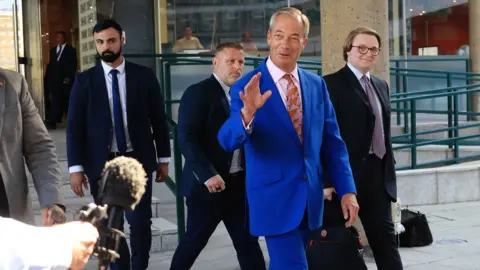
Nigel farage's decision to resign his Clacton seat and immediately re-stand in the resulting by-election has produced one of the most unusual electoral situations in recent British political history: a by-election in which the incumbent, facing a parliamentary standards investigation and a finance controversy, faces no opposition from any of the five major parties. Labour, the Conservatives, the Liberal Democrats, the Green Party, and Restore Britain, the breakaway group founded by suspended Reform MP Rupert Lowe, have all confirmed they will not field candidates, leaving Farage to contest the seat against a field that currently consists of comedian Count Binface and any independents who choose to enter.
The parties' reasons for standing aside diverge in their framing but converge on a shared conclusion: contesting the election plays into Farage's hands rather than holding him accountable. Foreign Secretary Yvette Cooper described it as a "political stunt" and accused Farage of wanting to "duck and dive around the rules that apply to everyone." Conservative leader Kemi Badenoch called it a "fake election" designed to distract from the standards inquiry. Liberal Democrat leader Sir Ed Davey argued that Clacton voters needed all the facts from the parliamentary investigation before casting their votes. None of the three offered a positive case for why standing aside served the democratic interest of Clacton's electorate, which is itself a notable omission.
Reform home affairs spokesman Zia Yusuf offered the opposing framing without subtlety. "The only reason they are choosing not to field a candidate is because they know in their hearts that they have virtually no chance of beating him," he told BBC Radio 4's Today programme. That assessment is grounded in electoral reality: Farage won Clacton in 2024 with a majority of more than 8,000 votes, beating the Conservatives into second place with Labour finishing third. The parties choosing not to stand are not doing so from a position of democratic principle alone. They are also doing so from a position of anticipated defeat in a seat where Reform's support base is deeply entrenched.
What triggered the by-election: the £5 million gift, the standards probe, and the parliamentary investigation now on pause
The by-election exists because of a parliamentary standards investigation that has been building since May. Standards commissioner Daniel Greenberg began investigating Farage after it emerged he had not declared a £5 million gift received from billionaire Reform donor Christopher Harborne before he became an MP. Parliament's rulebook requires newly elected MPs to declare gifts or benefits received in the twelve months before their election that relate to their parliamentary or political activities, with an exemption for gifts that are "purely personal." Farage has argued that the Harborne money falls under that personal exemption, describing it as "the equivalent of a lottery win" given to help cover his personal security costs.
The standards commissioner's investigation has been paused following Farage's resignation, but it will be resumed if he wins the by-election and returns to Parliament. That procedural detail is the critical election watch fact: the investigation does not disappear because Farage stood down and re-stood. It waits. If he wins in Clacton, he returns to Westminster under renewed investigation. One possible outcome of that investigation is a suspension, which under recall petition rules would require 10 percent of eligible registered voters in Clacton to sign a petition to remove him, potentially triggering yet another by-election. The political and legal cycle Farage has set in motion does not end with a Clacton victory.
The Sunday Times added a further layer of complexity over the weekend, reporting that George Cottrell, a longstanding Farage ally, had provided support before the 2024 election that included paying for staff who handled Farage's security and working on his social media content. Farage has said he "done nothing wrong." The Liberal Democrats' argument that Clacton voters should wait for the investigation to conclude before voting carries more force in this context than their party leader's public framing suggested: the electorate is being asked to return a judgement on a man whose full financial picture has not yet been established by the body constitutionally responsible for making that assessment.
The NCA referrals, Richard Tice's £80,000 loan, and the financial cloud now sitting over Reform UK's senior leadership
The financial scrutiny of Reform UK extends beyond Farage himself. It has emerged that George Cottrell and his mother both made payments to companies and organisations connected to Reform's deputy leader Richard Tice, and that those payments were flagged to the National Crime Agency as part of its Suspicious Activity Reports programme. Specifically, Tice's company Tisun Investment received an £80,000 loan from Cottrell in late 2024, while his think tank Britain Means Business received a £1 million donation from Fiona Cottrell in June 2024. Tice says he only became aware of the NCA referrals when contacted by the Guardian newspaper.
Tice has written to the head of the NCA asking whether the organisation is responsible for leaking his private financial information to the media. The NCA's response was a formal non-answer that simultaneously revealed and concealed: "The NCA does not confirm or deny the receipt of suspicious activity reports, nor comment on how any SAR is used. SARs are confidential and breaching that confidentiality risks committing a tipping off offence under the Proceeds of Crime Act." That statement confirms the legal framework around SARs without addressing the substance of Tice's question, leaving the source of the media disclosures publicly unresolved. The SAR programme flagged 866,616 reports in 2024 to 2025, making it a routine law enforcement tool rather than a targeted political instrument, but its application to senior Reform figures in the middle of a by-election controversy will sustain the financial cloud over the party regardless of eventual outcomes.
The cumulative picture of the financial questions surrounding Reform UK's leadership, Farage's undeclared £5 million gift, the Cottrell security payments, the £80,000 loan to Tice's company, and the £1 million donation to Tice's think tank, is one that the party's election watch narrative of "people versus the establishment" is designed to pre-empt rather than answer. Farage framed the by-election in his 20-minute video statement as a chance for voters to "stick two fingers up to the entire establishment," positioning financial scrutiny itself as establishment persecution rather than legitimate accountability. Whether that framing holds with Clacton voters will be the election's central question.
What the by-election result will mean for Reform UK's trajectory, the standards investigation, and British political dynamics heading into 2027
A Farage win in Clacton, which on current polling and the arithmetic of a majorless contest looks highly probable, would deliver a short-term political triumph but a medium-term legal complication. He returns to Parliament with the standards investigation resuming, the full financial picture of his relationship with Harborne and Cottrell still to be established, and the possibility of a suspension and recall petition remaining live. Reform would claim a massive popular mandate. The parliamentary standards process would continue regardless. The tension between those two outcomes would define Reform's political positioning for months.
The parties that chose not to stand carry their own political risk from the by-election regardless of the result. If Farage wins with a large majority against minimal opposition, Reform and its media allies will use the result to claim a popular verdict on the investigation itself, arguing that Clacton's voters have effectively cleared Farage by returning him to Westminster. That argument is constitutionally illiterate, since a by-election result has no standing in parliamentary standards proceedings, but it will be politically potent. The decision not to contest the seat leaves the mainstream parties without the argument that voters had a genuine choice and chose Farage anyway.
Lord Hayward, Conservative peer and polling expert, raised a separate legal concern about Reform's offer to cover the cost of the by-election, which is normally paid from central government funds. "The whole principle of British electoral law is that you separate the administration of the election from the party contest. Therefore it would be illegal for them to make a payment to cover the cost of the by-election," he told the Today programme. If Reform proceeds with that offer, it would add a further potential legal complication to a by-election already surrounded by financial and parliamentary questions. The election in Clacton may be the easiest contest Farage has fought. The period immediately after it, back in Parliament under investigation, may be the hardest.