
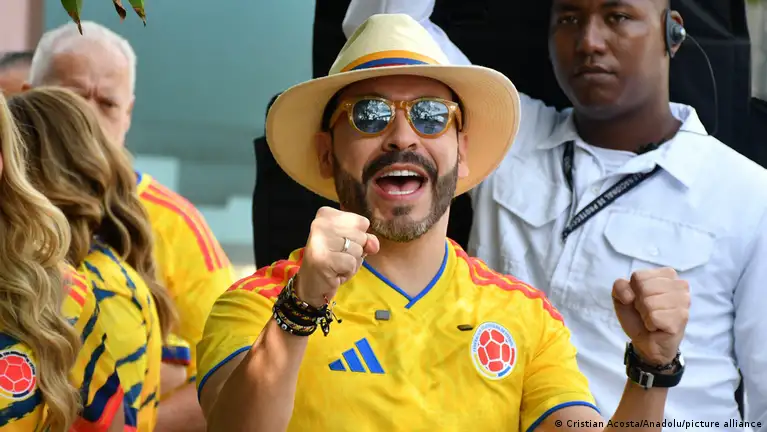
Right-wing candidate Abelardo de la Espriella has won Colombia's presidential election, according to an initial vote count showing him with nearly 49.7 percent of the vote against left-wing rival Ivan Cepeda's 48.7 percent, with over 99 percent of ballots counted. The result marks a dramatic shift in Colombia Election Results political direction, ending several years of left-wing governance under President Gustavo Petro and bringing to power a candidate who ran on a platform of military crackdown, tighter US alignment, and a complete rejection of Petro's negotiation-based approach to armed conflict.
De la Espriella, a lawyer and businessman from the Caribbean coastal region with no prior political experience, addressed a large crowd of supporters in Barranquilla following the initial count, declaring the beginning of "a new stage for our country, a stage built on the free and democratic will of millions of citizens who chose to believe in a great, safe, prosperous Colombia full of opportunities." He pledged to govern for all Colombians, including those who voted for Cepeda, and reaffirmed his commitment to the country's 1991 constitution, a signal directed at critics who questioned how his security policies would interact with constitutional protections.
The result has not yet been formally conceded by Cepeda. He stated that the preliminary count is "not yet official or binding" and said his side would recognise only the result produced after the official canvass and verification process has been completed. Reuters reported that the verification process showed little difference from the initial count in the first round of voting on May 31, lending credibility to the initial figures, but the formal outcome remains procedurally open while the count is certified and any challenges are assessed.
Who is Abelardo de la Espriella and why did Trump endorse him?
De la Espriella is a lawyer and businessman who became a US citizen in 2023 after years of living and working in Miami, a background that shaped both his political outlook and his relationship with Washington. As a defence lawyer, his client list included Alex Saab, an ally of Venezuela's ousted president Nicolas Maduro facing US money-laundering charges, and David Murcia Guzman, described as one of Colombia's biggest fraudsters. De la Espriella has consistently argued these representations were professional legal duties, but his critics have used them to question his judgment and values.
Trump endorsed de la Espriella and praised him as someone who would "stop illegal immigration, crack down on crime and drugs, and restore LAW AND ORDER." Before the election, Trump added that de la Espriella would have the "total support and strength of the United States behind him," a statement that both energised his base and alarmed voters who saw it as foreign interference in a sovereign election. After the initial count confirmed de la Espriella's lead, Trump posted on Truth Social: "He Won, BIG!" a characteristically direct expression of enthusiasm for the outcome.
De la Espriella has invited comparisons with El Salvador's President Nayib Bukele for his hardline security platform and even his beard style, while his supporters' use of "Make Colombia Great Again" hats at rallies draws a straight line to Trump's political brand. At rallies he frequently appears behind bulletproof glass screens, addresses crowds in Colombia's national football jersey, and leads military-style salutes, a performance of strength and national identity that his critics describe as the deliberate cultivation of an authoritarian aesthetic rather than a substantive security policy.
What happened in Colombia's past election cycles and how did the current political crisis develop?
The election's immediate context is inseparable from the record of the outgoing Petro government. Gustavo Petro, a former guerrilla member and Colombia's first left-wing president, pursued a "total peace" strategy that prioritised negotiation with armed groups over military confrontation. Critics, including de la Espriella throughout the campaign, argued that this approach failed catastrophically by allowing armed groups to exploit ceasefires to expand their territory and influence, while violence and cocaine production both reached record levels during Petro's tenure.
Membership of armed guerrilla groups and cartels, including FARC dissidents, the ELN, and the Clan del Gulfo, has doubled over the past five years, according to available security data. A brutal offensive along the Colombia-Venezuela border last year displaced tens of thousands of people, and cocaine production in the world's largest producer hit a record high, directly undermining Petro's central claim that peaceful engagement with armed groups could produce security gains. Those failures gave de la Espriella a powerful campaign argument: that the left's experiment with negotiation had been tested and had demonstrably not delivered safety for ordinary Colombians.
Colombia's relationship with the United States also deteriorated sharply under Petro. The two countries clashed repeatedly over US immigration policy, tariffs, and military intervention in Latin America, straining a bilateral relationship that had historically been among Washington's closest in the region. De la Espriella's election restores a pro-US alignment, with his platform explicitly including closer collaboration with Washington on security, and his American citizenship and Miami background making him a candidate the Trump administration was always likely to embrace warmly.
How deeply divided is Colombia right now, and what is the risk of post-election unrest?
The approximately one-percentage-point margin between de la Espriella and Cepeda makes this one of the closest presidential results in recent Colombian history, and that closeness is already shaping how both sides interpret the outcome. Supporters of Cepeda have been open about their unease. "There's a palpable sense of unease in the air," said Catalina La Grande, a student and activist who backed Cepeda, speaking to the BBC. "Such a narrow margin also worries us, because it reflects how divided the country is and the enormous challenges we face in defending democracy, peace, and people's rights."
The risk of post-election unrest materialised quickly in some parts of the country. Late on Sunday, reports emerged of clashes between protesters and police in Cali, Colombia's third-largest city, with demonstrators burning US flags and police deploying tear gas to break up large crowds angered by de la Espriella's win. President Petro escalated the political tension further by posting on X that "neither can be proclaimed president" after a "pre-count result" and demanding an audit of voting software, alleging without evidence that some polling stations were "compromised."
Those allegations from a sitting president carry significant weight regardless of the evidence behind them, because they shape how Petro's supporters interpret the legitimacy of the result and whether they accept the official outcome once it is formally certified. Another Cepeda supporter, Maria, offered a more measured reaction, noting that while the division was real, the immediate aftermath had remained peaceful in most areas. "There have been no violent incidents in the streets, which is positive considering the level of polarisation we are experiencing," she said, a cautiously hopeful observation in a country with a long history of political violence.
What does de la Espriella's win mean for Latin America's wider rightward political shift?
Colombia's result does not stand alone. It is the latest in a series of elections across Latin America in which right-wing candidates have defeated or succeeded left-wing governments, driven primarily by voter anxiety about security, crime, and economic instability. Argentina's President Javier Milei was among the first regional leaders to congratulate de la Espriella, saying Colombians had chosen the path of "economic freedom, prosperity, unwavering security, and telling organised transnational crime and drug trafficking ENOUGH ALREADY." Chile's president Jose Antonio Kast similarly framed the result as the beginning of a new stage of freedom and security for Colombia.
The regional significance is sharpened by Trump's direct personal investment in the outcome. His public endorsement and his immediate celebration of the result on Truth Social place Colombia's election within a broader US foreign policy narrative about the Western Hemisphere shifting back toward Washington-aligned governments after years of leftward drift. De la Espriella's pledge to collaborate closely with the US on security, and his plan to scrap negotiations with armed groups in favour of military crackdowns, directly aligns Colombia's future approach with Trump administration priorities on drugs, migration, and regional order.
Whether de la Espriella's security platform delivers in practice will determine his political legacy far more than the margin of his election win. The scale of Colombia's armed conflict, with doubled guerrilla membership, record cocaine production, and tens of thousands displaced by recent violence, presents a challenge that military force alone has historically struggled to resolve in the country's decades-long internal conflict. His ability to convert the political momentum of a narrow victory into tangible security gains, without triggering new cycles of violence through abrupt crackdowns, will be the central test of his presidency from its first days.