
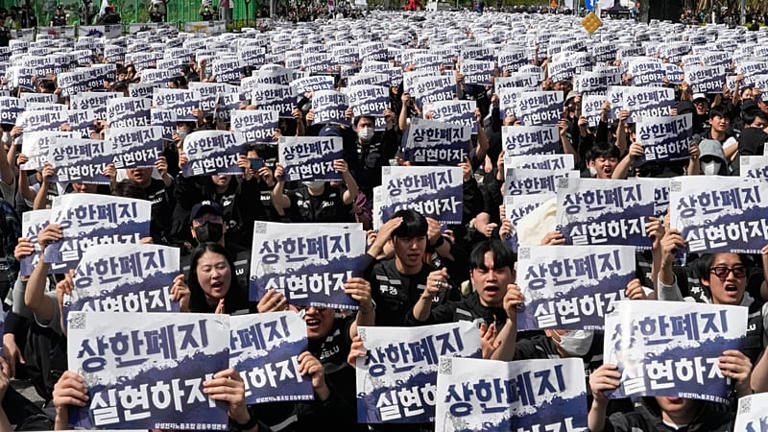
More than 45,000 Samsung Electronics workers are threatening to stage the largest strike in the South Korean conglomerate's history beginning May 21, a labor action that has alarmed government officials, rattled foreign investors, and raised urgent questions about the stability of global semiconductor supply chains at a moment when demand for AI-related chips has never been higher. Samsung worker strike At the heart of the dispute is a question that the AI boom has made unavoidable for one of the world's most complex technology companies: when a corporation generates enormous profits from one division while another division bleeds billions in losses, how should workers on both sides of that divide share in the rewards? Samsung's answer to that question, a proposed bonus structure that would pay memory chip workers up to six times more than their colleagues in logic chip manufacturing, has united tens of thousands of employees in opposition and brought the company to the edge of a crisis that analysts say could cost it between 14 billion and nearly 21 billion dollars in lost operating profit.
Samsung Electronics occupies a unique and structurally complicated position in the global semiconductor industry. Unlike more specialized competitors such as Micron, which focuses on memory, or TSMC, which concentrates on contract chip manufacturing, Samsung has pursued an ambitious strategy of becoming the world's only true one-stop semiconductor shop, offering memory chips, logic chip design, and foundry manufacturing services under a single corporate roof. That strategy has delivered competitive advantages in some market conditions but created deep internal tensions in others, and the current bonus dispute is exposing those tensions in ways that Samsung's internal negotiations have been unable to resolve. Reuters reviewed hundreds of pages of transcripts covering Samsung's internal wage negotiations and spoke with more than ten workers including union leaders, uncovering a picture of division, employee departures, and strategic vulnerability that the company has not previously disclosed publicly.
The financial backdrop to the dispute makes the internal inequality feel particularly acute to workers on the losing end of the bonus calculation. Samsung's memory chip business has reaped huge profits from a global memory shortage driven by surging demand from AI data center operators, smartphone manufacturers, and laptop makers. The logic chip and foundry businesses, meanwhile, have suffered billions in losses in recent years as Samsung struggled to compete with TSMC for advanced chip manufacturing contracts from customers including Nvidia and Tesla. The company's proposed bonus formula reflects that performance gap, rewarding memory workers handsomely while offering logic chip employees bonuses of between 50 and 100 percent of annual salary, compared to 607 percent for their memory colleagues. For workers who share the same buildings, work comparable hours, and consider themselves equally central to Samsung's strategic ambitions, that gap feels less like performance-based compensation and more like institutional abandonment.
The Bonus Divide and How Deep Internal Fractures Threaten Samsung's One-Stop Chip Strategy
The specific numbers at the center of the Samsung bonus dispute illuminate just how wide the internal inequality has become. In March, Samsung proposed that memory chip workers receive bonuses amounting to 607 percent of their annual salary, a level that would surpass the bonuses offered by rival SK Hynix, which had abolished its pay cap for ten years and previously offered bonuses more than three times higher than Samsung's, triggering an initial wave of employee departures. For logic chip workers, including those working on base die components that are crucial elements of advanced AI chips, the proposed bonus range of 50 to 100 percent represents not just a lower payout but a fundamentally different message about how the company values their contribution to its stated strategic goals. Samsung Chairman Jay Y. Lee has publicly declared his ambition to make Samsung the clear number one in the logic chip market by 2030, a goal that requires exactly the kind of skilled foundry engineering talent that the current bonus structure is actively driving away.
Union leader Choi Seung-ho made the practical stakes of the disparity explicit during wage negotiations, according to transcripts reviewed by Reuters. He posed a direct question to Samsung management: if memory division workers receive 500 million won while foundry workers receive 80 million won, what motivation would those employees have to keep working in the foundry business? The question was not rhetorical. Workers and union officials describe an exodus of foundry engineers that is already underway, with talent moving both to Samsung's own memory division, attracted by higher compensation, and to external competitors including SK Hynix and Micron. A foundry engineer based in Pyeongtaek told Reuters that his team had shrunk sharply over the past two years as colleagues departed for better-paying positions elsewhere. Two other employees said many of their colleagues are currently applying to rival firms, a development that directly undermines the talent base Samsung needs to execute its logic chip ambitions.
Samsung management's response to the union's equity argument has been to insist that performance bonuses must reflect business results, a position that is defensible in isolation but that union officials argue ignores the strategic logic of keeping the one-stop shop model viable over the long term. Samsung negotiator Kim Hyung-ro was direct in the transcripts, arguing that the logic chip business had posted losses in the trillions of won and would likely not have survived without cross-subsidy from the profitable memory division. His framing, while financially accurate, essentially told logic chip workers that their employment security depends on memory division charity, a message that further erodes morale and motivation among the very people whose skilled work Samsung's 2030 logic chip ambitions depend upon. Samsung's public statement maintained that the logic chip business remains strategically significant and that the company's latest compensation proposal would offer employees the best pay in the industry.
Government Alarm, Investor Concerns, and the Global Supply Chain Stakes of the Samsung Strike
The potential Samsung strike has generated concern far beyond the company's own boardroom and union negotiating rooms. South Korean President Lee Jae Myung made remarks in late April that were widely interpreted as a pointed message to Samsung's unions, saying that some unions were making excessive demands at a moment of economic sensitivity. Samsung's own chairman circulated an internal memo warning that a strike could trigger capital outflows, a decline in tax revenue, and a weakening of the South Korean won, framing the labor dispute as a national economic risk rather than simply a corporate compensation disagreement. The American Chamber of Commerce in Korea weighed in as well, warning that labor uncertainty at Samsung could damage Korea's reputation as a dependable partner in global manufacturing and supply chains, a concern that carries particular weight given how deeply Samsung's chip production is embedded in the technology supply chains of companies worldwide.
JPMorgan's estimate that the strike could impact Samsung's operating profit by between 21 trillion won and 31 trillion won, equivalent to between 14 and nearly 21 billion dollars, with additional sales losses of approximately 4.5 trillion won, quantifies the financial exposure in terms that give the dispute genuine systemic significance. Samsung is the world's leading memory chip producer by sales, and a significant disruption to its memory chip output would ripple through the supply chains of AI data center operators, smartphone manufacturers, and consumer electronics companies globally at a time when memory supply is already tight due to AI-driven demand. The interconnectedness of modern semiconductor supply chains means that a labor dispute at a single facility or company can propagate costs and delays across an entire ecosystem of downstream manufacturers and technology providers.
Legal and academic observers tracking the dispute have noted its potential significance as a precedent for labor-management relations across South Korea's technology sector. Korea University law professor Park Ji-soon told Reuters that if Samsung sets a precedent in which union demands are pushed through by strike action, other companies could find themselves in a significantly weaker bargaining position in future negotiations. That concern reflects the degree to which the Samsung dispute is being watched not just as a company-specific event but as a potential bellwether for how the benefits of the AI boom will be distributed between capital and labor across the technology industry more broadly. At a rally of approximately 40,000 workers held in late April, a chip researcher with thirty years at Samsung told Reuters he had applied to work at Micron and that he could no longer sit in his office and simply work. He added the words that perhaps best capture the human dimension of the dispute: he had lost his pride in Samsung.