
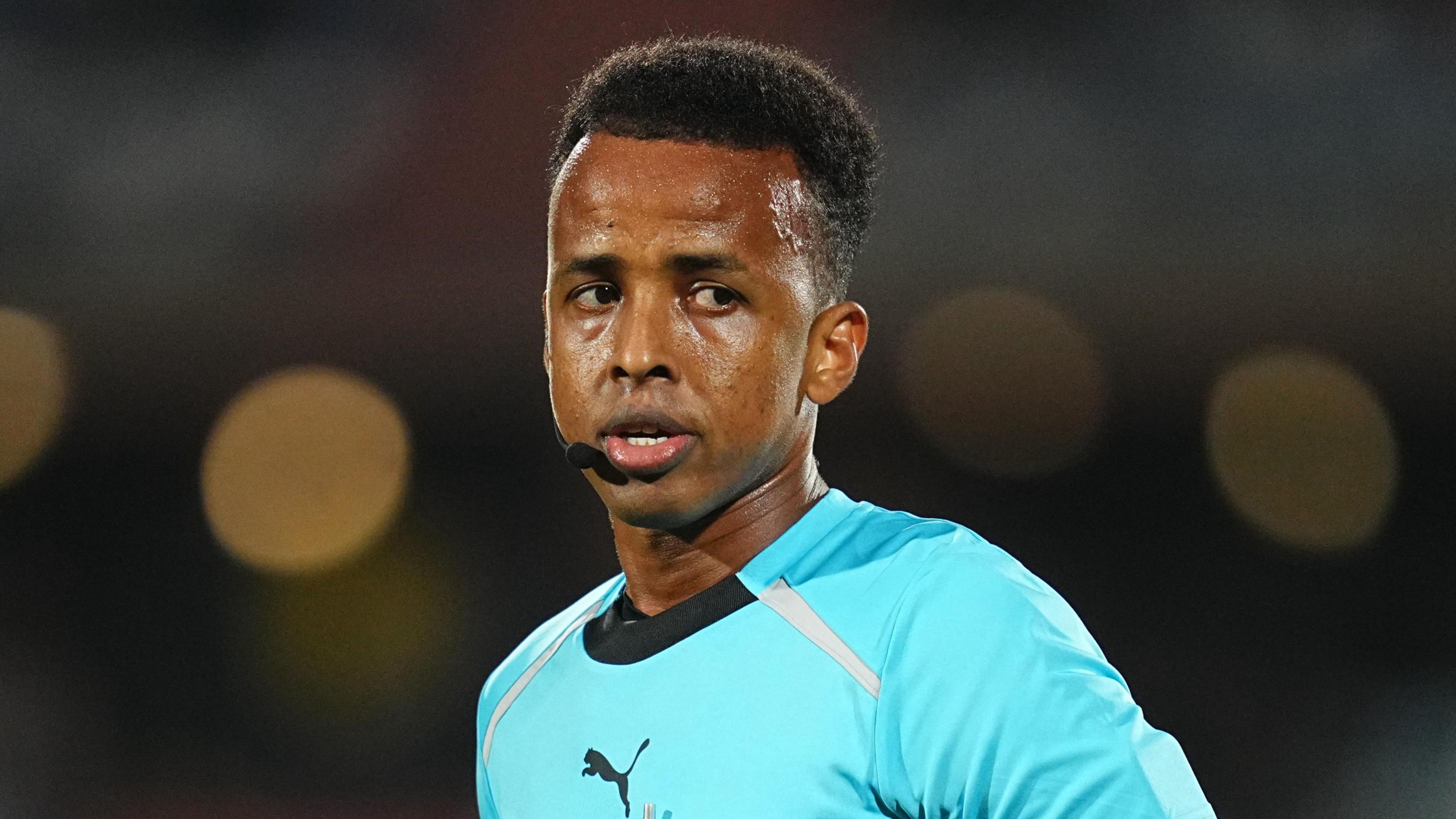
Omar Artan, who was poised to become the first Somali referee to officiate at a FIFA World Cup finals, has been removed from the list of match officials after being denied entry to the United States at Miami International Airport, with no reason publicly provided by US immigration authorities for a decision that has drawn immediate and pointed questions about accountability, transparency, and the intersection of immigration policy with global sporting competition. Artan, the 2025 Confederation of African Football men's referee of the year, is currently in Turkey after being repatriated, and FIFA has formally confirmed he will miss the entire tournament. Somalia is among the countries on a travel ban list maintained by the Trump administration, but no specific grounds for Artan's exclusion have been offered by the authorities responsible for it.
The accountability gap at the centre of this story is stark and requires direct examination. A senior adviser to Somalia's Ministry of Youth and Sports confirmed to the BBC that Artan had been travelling with valid documents. A Somali embassy official in Nairobi told the BBC that Artan had been issued a diplomatic passport specifically to ease his travel after encountering earlier visa difficulties, a sequence of events that suggests both awareness of the risk and a deliberate effort by Somali officials to ensure the journey proceeded without obstruction. Despite those measures, he was turned away at the border. The only public comment from the US side came from Andrew Giuliani, who leads the White House Task Force on the World Cup 2026. He told BBC World Service that he could not discuss the "derog," meaning derogatory information on file, but that he supported the decision by customs and border protection as "the right decision." That formulation offers official endorsement without a single verifiable fact about what justification exists, which is the precise accountability deficit that institutions and public observers have a legitimate interest in challenging.
FIFA's statement, while confirming Artan's removal from the tournament, was notably careful in its language about institutional responsibility. "FIFA is not involved in host country immigration processes, including visa adjudications," the governing body said, adding that a host government "ultimately determines who receives a visa and who is admitted into their country." That framing is legally accurate and politically safe for FIFA, but it raises a question the organisation has not addressed directly: what obligations does a host country agreement place on the United States when a credentialed match official with a diplomatic passport and a confirmed training assignment is denied entry without explanation? The silence on that question from both FIFA and the US authorities responsible for the decision is where the accountability story sits, and it is a question that will follow this incident well beyond the tournament it has disrupted.
How Artan Built a Career That Made His World Cup Appointment a Historic Achievement
Omar Artan's path to the World Cup officials list was built over years of consistent performance at the highest levels of African football. He became a FIFA-registered referee in 2018, the formal certification that opens the pathway to international appointment at the elite level. He has officiated at the Africa Cup of Nations, one of the continent's most demanding and high-profile tournaments, where the standard of refereeing is judged against the same criteria FIFA applies to its own appointments. His selection as the 2025 CAF men's referee of the year, the continent's most prestigious individual officiating honour, was both a recognition of that accumulated performance record and a confirmation that the continent's football authorities judged him ready for the world stage.
The historic significance of his World Cup appointment was not merely symbolic. Somalia's football infrastructure has developed against the backdrop of decades of civil conflict and institutional fragility, making the emergence of an internationally certified referee of Artan's calibre a genuine marker of the sport's growth in a country where the conditions for athletic development have been profoundly difficult. His appointment was widely celebrated within the Somali football community and by CAF as evidence that African refereeing talent could compete and be recognised at the global level regardless of the geopolitical status of the country from which an official comes. The Somali Football Federation's decision to contact FIFA seeking urgent clarification after his exclusion reflects not just institutional concern but the sense that something that represented a significant national achievement has been taken away without legitimate public justification.
The earlier visa difficulties that led to the issuance of a diplomatic passport are a detail that demands accountability scrutiny of their own. If Artan had encountered entry problems before the tournament and those problems were significant enough to trigger the intervention of the Somali embassy and the issuance of a diplomatic travel document, then the question of whether FIFA and the US World Cup task force were aware of that history and what steps they took to resolve it becomes directly relevant. FIFA's training hub for the tournament's 52 referees and 88 assistant referees is based in Miami, and the governing body's own rules require all match officials to be resident at the Florida base for training, preparation, and security purposes. That structure means there was no viable accommodation for Artan to remain outside the US and officiate only at matches hosted in Canada or Mexico, a logistical fact that made his US entry not a matter of convenience but a precondition for participation. Whether that precondition was ever properly secured through the formal accreditation process is a question for which no satisfying answer has yet been publicly provided.
What Giuliani's Statement, FIFA's Silence, and the Diplomatic Passport Failure Mean for the World Cup's Credibility
The most significant accountability failure on display in this case is not simply that a referee was denied entry, but that the explanation offered for a decision affecting a credentialled international official has been limited to a US government spokesman's confirmation that unspecified "derogatory information" exists and that the decision was the right one. That formulation inverts the normal standard of public accountability: rather than providing evidence to justify an action that has disrupted a historic individual achievement and raised questions about equal treatment of officials from travel-banned countries, the authorities responsible have simply asserted that the decision was correct and declined to substantiate it. In a democratic system operating under the rule of law, that standard of justification is not normally considered sufficient for decisions that carry significant public consequences and that affect individuals who have been credentialled by an international governing body after thorough vetting.
FIFA's institutional response compounds rather than resolves the accountability problem. By stating that it is not involved in host country immigration processes, FIFA has accurately described its legal position while declining to exercise the moral and contractual authority it holds as the organiser of the world's largest sporting event. FIFA negotiates host country agreements for the World Cup that include specific provisions about the treatment of accredited officials, participants, and delegates. Whether those agreements include explicit protections for credentialled match officials against exclusion without cause is not publicly known, but FIFA's choice to respond with a statement about process rather than a statement about principle is a governance decision that will be examined in the wider context of how the organisation manages its relationship with host governments whose immigration policies conflict with the values of global sporting participation.
Artan himself, demonstrating a quality of character that his exclusion did not diminish, issued a statement saying he remained in a positive mood and focused on his next challenge. He thanked FIFA, CAF, and the football community for their support and wished his colleagues success at the tournament. That response, measured and dignified under circumstances that would justify considerably more public anger, stands in pointed contrast to the opaque and unaccountable manner in which his exclusion was handled by the authorities responsible for it. The Somali Football Federation, FIFA, CAF, and the international football community now face the question of whether the circumstances of Artan's exclusion will be formally investigated, whether the host country agreement that governs FIFA World Cup 2026 is adequate to prevent a recurrence, and whether a referee who earned his place on the world stage through merit and years of dedicated service is owed something more than an unanswered diplomatic passport and a confirmation from a White House task force adviser that the decision was right.