
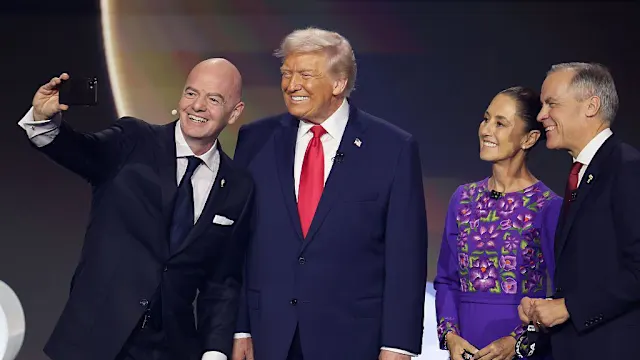
World Cup 2026 US Canada Mexico host relations trade tensions are casting a long diplomatic shadow over football's most ambitious co-hosting experiment in history, with the 39-day tournament spanning 16 cities across three countries arriving at a moment when the political relationships between those three countries are as strained as they have been in decades, shaped by Trump's tariffs on both neighbours, Canada's counter-measures and consumer boycotts of American products, Mexican cartel violence and airport readiness questions, and the added security complexity of the ongoing Iran war that has heightened American border and event security concerns in ways that will affect every fan travelling between the three nations. Think of it as a dinner party where the hosts are in the middle of a tense argument when the guests arrive, and the guests number in the millions, speaking dozens of languages, travelling on hundreds of flights across borders that the host with the largest army has been making progressively harder to cross. The December draw in Washington DC, where Trump, Canadian Prime Minister Mark Carney, and Mexican President Claudia Sheinbaum posed for a smiling selfie with FIFA boss Gianni Infantino, captured the aspirational face of the co-hosting project, but the structural political tensions beneath that photograph have not gone away and will not be resolved by 39 days of football regardless of how well the tournament is organised.
The geopolitical context surrounding the tournament is uniquely complex for a World Cup that was always going to be logistically ambitious as the first three-nation co-hosted men's tournament in history. Trump's tariffs on Mexico and Canada, implemented early in his second term, targeted the two countries that are simultaneously the United States' top trading partners and its World Cup co-hosts, creating the specific political irony of a president who claims credit for hosting the world's largest sporting event having imposed economic measures on the neighbours whose cooperation makes that hosting possible. Canada's counter-tariffs and the provincial removal of American alcohol from shelves, combined with a significant drop in Canadian travel to the United States, created a bilateral irritant that sits uncomfortably alongside the FIFA-mandated requirement that Canadian fans can travel freely to American host cities to watch their national team. Mexico and Canada's bilateral relationship has been separately complicated by Canadian officials having characterised Mexico as a back door for Chinese investment in North America, a claim that Carlo Dade, director of international policy at the University of Calgary, describes as downright disrespectful and that Canadian Prime Minister Carney has been working to repair as part of his broader effort to diversify Canadian trade away from United States dependence.
The Iran war's security implications add a specific and less predictable complication to the already complex co-hosting environment, because heightened American security concerns following months of active military engagement have the potential to manifest in more intensive border screening, additional restrictions on travelers from certain countries, and a general security posture at major public events that could create the seemingly innocuous incidents that NYU clinical assistant professor Lindsay Sarah Krasnoff warns could escalate unexpectedly. A World Cup hosting environment where American security agencies are operating with Iran war threat awareness simultaneously with the normal FIFA event security requirements creates the conditions for friction between the diplomatic imperative of welcoming football fans from around the world and the security imperative of managing the threat landscape that the ongoing conflict has created. Fans from countries whose nationals face additional security scrutiny in the post-February 28 environment may find their World Cup experience shaped by geopolitical realities that have nothing to do with football.
How the Three-Way Hosting Relationship Developed and Where It Has Been Tested
The 2026 World Cup was awarded to the United States, Canada, and Mexico in 2018 in the very different political environment of Trump's first term, when the USMCA trade agreement that replaced NAFTA had been negotiated but was still awaiting ratification, and when the three countries' political leaders were managing a difficult relationship through the institutional framework of North American trade interdependence rather than the active tariff conflict that characterises the relationship in 2026. The eight years between the bid's winning and the tournament's arrival have produced a dramatic deterioration in the specific relationship dimensions that matter most for co-hosted tournament operations, including border crossing ease, bilateral government coordination capacity, and the political goodwill that smooths the bureaucratic friction that any cross-border event inevitably generates. The USMCA review that is currently creating trade uncertainty across the three-country partnership provides the specific economic backdrop against which the tournament's diplomatic potential is being assessed, with analysts suggesting that a successful co-hosting experience could create positive momentum for the trade negotiations if the leaders choose to use the tournament's diplomatic encounters productively.
The relationship between Canada and Mexico, which might seem peripheral to the dominant U.S.-focused tensions in North American politics, has acquired specific importance in the current period because both countries are simultaneously managing difficult bilateral relationships with the United States while also needing each other's cooperation for the World Cup logistics and needing to rebuild the bilateral trust that the Chinese investment back door controversy damaged. Carney's effort to patch things up with Mexico reflects the strategic logic of a Canadian leader who understands that Canada's ability to present itself as a reliable North American partner in the post-Trump trade disruption environment requires repairing all three legs of the trilateral relationship rather than simply managing the US bilateral dimension. The World Cup provides the specific occasion for Carney and Sheinbaum to demonstrate the Canada-Mexico relationship rehabilitation publicly in a context where both leaders benefit from positive imagery that contrasts with the tariff conflict narrative.
Mexico's specific preparedness challenges, including questions about the readiness of the capital's main airport, the capacity of its saturated public transport system, and the revamped Azteca stadium, alongside the short-lived but widely publicised cartel street displays earlier in the year, have created a domestic political context in which the World Cup must succeed not only to demonstrate international sporting competence but to counter a broader narrative about Mexican institutional capacity and security that President Sheinbaum has been pushing back against throughout her term. Mexican football journalist Rafael Puente's hope that fans will show patience and good behaviour in the face of problems that cannot be hidden reflects the honest assessment of a domestic commentator who understands that the international audience will form impressions of Mexico through the tournament experience that will outlast the football and affect the country's international standing. Sheinbaum's publicly upbeat framing of the tournament as an opportunity to share not only cultural heritage but an empowered people reflects the leadership communication strategy of a president who has decided that projecting confidence about the co-hosting project serves Mexico's interests more than acknowledging the preparation challenges would.
The 2002 Japan-South Korea Precedent and What It Reveals About Co-Hosting Limits
The only previous men's World Cup co-hosting experience, Japan and South Korea in 2002, provides the most directly relevant precedent for assessing what three-way co-hosting in 2026 can realistically deliver diplomatically, and the assessment of that experience as a mixed bag rather than a transformative relationship breakthrough should temper the more optimistic interpretations of the 2026 tournament's diplomatic potential. Krasnoff's characterisation of the 2002 tournament as having been a draw that did not negatively impact the bilateral relationship but also did not produce the positive transformation that the hosting narrative had promised reflects the general pattern of major sporting events as relationship stabilisers rather than relationship transformers, creating conditions for positive encounters and suppressing the most visible expressions of bilateral tension without addressing the underlying structural disputes that produce tension in normal times. The Japan-South Korea bilateral relationship had deep historical wounds from the colonial period that a month of football could not heal, just as the US-Canada-Mexico relationship has structural trade, immigration, and sovereignty disputes that 39 days of World Cup matches will not resolve.
The 2023 Women's World Cup co-hosted by Australia and New Zealand, which Krasnoff describes as a net positive for the bilateral relationship, provides a more encouraging precedent but operates in a different political context from the current North American situation, because Australia and New Zealand share a fundamentally cooperative relationship without the specific tariff conflicts, immigration enforcement disputes, and security environment complications that define the US-Canada-Mexico dynamic in 2026. The lessons that transfer most usefully from both precedents are the operational ones: that logistics coordination between co-hosts requires sustained bureaucratic cooperation that political tensions can complicate but rarely fully derail, that the tournament's success in sporting and fan experience terms is largely independent of the hosting nations' political relationships, and that the diplomatic opportunities that major international events create depend entirely on whether the political leaders choose to use them constructively.
Trump's Dominance Instinct, the Fan Experience, and What Diplomatic Success Requires
Trump's characteristic desire to dominate the World Cup proceedings, whether through attending high-profile matches, firing off Truth Social posts claiming credit for the tournament's success, or using the global platform to reinforce his narrative of American pre-eminence, creates the specific diplomatic risk that his co-hosting neighbours find their contributions marginalised in a tournament narrative that American media and the American president's communications team will inevitably frame through an American lens. Trump's regular assertions that the United States is the hottest country in the world, combined with his historical pattern of framing bilateral relationships as American generosity toward dependent partners, sets up the dynamic in which Canada's and Mexico's co-hosting roles are acknowledged formally while being treated as supporting parts in an American production. Krasnoff's concern that Trump's dominance instinct could foster resentment among America's neighbours and ultimately cause damage to North American relations identifies the specific mechanism by which a tournament that FIFA hopes will create continental unity could instead reinforce the hierarchical relationship dynamic that the smaller partners find most grating.
The fan experience dimensions of the co-hosting tensions are less abstract than the diplomatic analysis and more immediately consequential for the actual people who will be travelling between the three countries over 39 days of tournament football. Stepped-up US immigration enforcement, which has been a consistent feature of Trump's second term and which the Iran war's security context has further intensified, creates the practical risk that fans holding tickets for matches in multiple countries encounter border crossing experiences that are frustrating, discriminatory, or simply much more time-consuming than the FIFA-promoted vision of seamless continental football tourism implies. FIFA's own statement that the tournament represents three countries saying they are united as one to welcome the world conflicts directly with an immigration enforcement reality that has been treating certain categories of international visitors with suspicion rather than welcome, and the management of this tension between the tournament's hospitality narrative and the operational security posture will be one of the less visible but most consequential aspects of the co-hosting experience for millions of fans.
The USMCA review that is continuing through the tournament period provides the most direct diplomatic opportunity that the co-hosting leaders could choose to pursue, with the positive imagery of presidential encounters at World Cup events providing the public relationship narrative that makes continued negotiating engagement politically easier to sustain than it would be in the absence of such imagery. Dade's observation that anytime you get leaders together it is generally a good thing reflects the basic diplomatic truth that personal encounters create relationship context that bureaucratic negotiations alone cannot generate, and the multiple occasions during 39 days of football when Trump, Carney, and Sheinbaum will share platforms, attend events, and interact publicly provide the relationship-building raw material that skilled diplomats can convert into negotiating progress if the political will exists. Whether the World Cup becomes the occasion for genuine North American relationship repair or simply an interlude in the ongoing tensions depends less on the football itself than on the choices the three leaders make about how to use the diplomatic opportunities the tournament creates.