
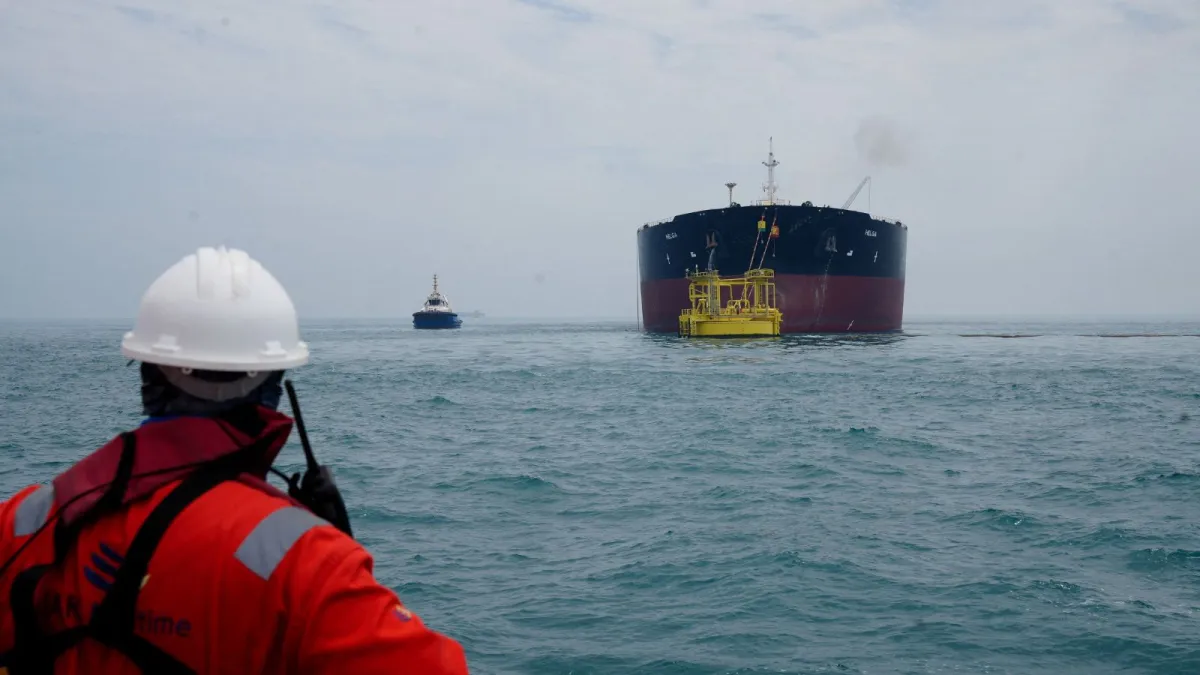
US Iran ninth day strikes Hormuz oil tankers exploded 2026 has entered its most economically alarming and humanly costly phase since the ceasefire collapse, with U.S. Central Command announcing a new wave of strikes aimed at degrading Iran's ability to attack commercial vessels in the Strait of Hormuz on Monday, Iran saying two oil tankers had exploded and been immobilised in the strait, oil prices rising 2 percent to more than $90 a barrel, and the total count of American military personnel killed since the war began on February 28 reaching 17 with more than 420 wounded after a service member was killed in northern Iraq during a controlled detonation of unexploded ordnance from a downed Iranian attack drone. Iran's semi-official Tasnim news agency reported U.S. missiles struck several Iranian cities in the early hours of Monday including Tabriz, Chabahar, Konarak, Bandar Mahshahr, and Bandar Imam Khomeini, while the IRGC announced a surprise strike on what it described as the enemy's special operations headquarters in Syria's Al-Tanf area and the targeting of U.S. aircraft at Jordan's Aqaba airport with ballistic missiles, expanding the geographic scope of the conflict's strike exchange to Syria in a development whose implications for the regional proxy conflict dimension extend beyond the bilateral U.S.-Iran framework that the ceasefire agreement had nominally contained.
"The Strait of Hormuz are international waterways, and they continue to launch against the ships in that international waterway," said Secretary of State Marco Rubio. "As long as Iran insists on controlling an international waterway, we're gonna have to respond to that. The United States always remains open to a diplomatic solution."
Rubio's framing of the conflict as a navigation rights enforcement operation whose continuation is determined entirely by Iranian behaviour, combined with the maintained diplomatic openness that Rubio appended to the warning, reflects the specific dual-track communication that has characterised American Iran policy since the ceasefire's collapse but whose credibility gap with the facts of nine consecutive nights of strikes grows wider with each additional day of operations. The $90 oil price threshold crossed on Monday, representing a return to levels not seen since the conflict's most acute earlier phase, applies the specific economic pressure on the Trump administration that the Republican Party's November congressional election vulnerability makes politically dangerous, with American consumers experiencing the fuel price consequences of a conflict whose duration and intensity the ceasefire's collapse has extended beyond what the June agreement appeared to have resolved.
Kuwait's government said a desalination plant was attacked for the second consecutive day, causing a fire, in what it explicitly described as a direct strike on vital civilian infrastructure, making it the most direct official Gulf Arab state characterisation of Iranian attacks as targeting civilian rather than military facilities and the specific diplomatic statement whose accumulation across Kuwait's repeated infrastructure damage creates the political pressure on Iran from its neighbours that could eventually complicate the IRGC's Gulf base targeting strategy.
How Nine Nights of Strikes Created a New Phase in the Iran War's Trajectory
The interim ceasefire agreement signed a month ago whose unravelling has produced the nine consecutive days of mutual strikes documents the specific structural weakness that the June memorandum contained from its inception, with the unresolved Hormuz navigation authority dispute providing the operational conflict source whose management through ceasefire text without resolution left both sides' coercive incentives intact and available for re-activation when the compliance costs of the memorandum's shipping arrangements exceeded either side's assessment of the alternative. The escalating cycle that has characterised the nine days since the ceasefire's collapse, with each night's strikes adding new target categories and geographic scope, documents the specific escalation mathematics in which the absence of an agreed framework for stopping produces the continuous upward pressure that gives neither side an obvious point at which to pause without appearing to have accepted terms worse than those available before the escalation began.
The four vessels that transited the Strait of Hormuz on Sunday, down from eight the previous day according to LSEG shipping data, with at least three oil products tankers and one Very Large Crude Carrier having entered since Friday to load oil, provides the specific quantitative measure of how severely the two oil tanker explosions and the general security environment have affected commercial shipping's willingness to transit the world's most critical energy corridor. The downward trajectory from eight to four transits across 24 hours, against the backdrop of two tankers exploding and being immobilised, creates the specific shipping industry risk assessment whose expression in reduced transit volumes will translate into the supply reduction whose market pricing the $90 oil level is beginning to reflect. At pre-conflict levels, approximately 17 to 19 million barrels per day of oil and equivalent energy in liquefied natural gas transited Hormuz daily, making the current fraction of that volume the specific supply deficit whose continuation at this level will compound the global inflationary pressure that has been building since the conflict began.
The conflict's origins on February 28, when the United States and Israel attacked Iran seeking to disable Tehran's nuclear and missile programmes and weaken its regional proxies, provide the foundational strategic context within which the current nine-day escalation must be understood as the most recent expression of an objective-means mismatch that has characterised the conflict throughout: the objectives of nuclear programme disablement, missile industry destruction, and regional proxy weakening have not been achieved by four months of intensive military operations, while the means applied have produced the Hormuz closure, Gulf state infrastructure attacks, regional proxy expansion, and now $90 oil that were the predictable consequences of the military approach whose strategic wisdom the conflict's current state invites reassessment of.
The American Casualty Count and Its Political Significance
The 17 American military personnel killed since February 28, with more than 420 wounded, represents the specific human cost whose accumulation creates the political accountability that American war authorisation and congressional oversight are supposed to impose on executive war-making decisions, and whose political salience grows as the casualty count rises and the conflict's stated objectives remain unachieved. The service member killed in northern Iraq during a controlled detonation of unexploded ordnance from a downed Iranian attack drone documents the specific category of combat-support casualty that conventional military operations produce beyond direct combat deaths, with ordnance disposal and base security operations both creating the lethal risk that the total casualty count encompasses regardless of whether the specific death occurred in a direct exchange of fire with Iranian forces. The unidentified remains found at the site of Friday's Jordan attack, with the examination process to verify them ongoing, documents the specific forensic dimension of conflict casualty accounting whose uncertainty in the immediate aftermath of strikes creates the delayed confirmed death notification that military families waiting for news of missing personnel must endure.
Two service personnel dying in Jordan and a third missing whose remains were being examined document the specific geographic spread of American casualties across the multiple host states in which U.S. forces are operating in support of the Hormuz enforcement and Iran strike campaign, with Jordan's territory having become one of the most active sites of both American strike operations against Iran and Iranian retaliatory strikes against American assets. Jordan's air defence intercepting ballistic missiles from Iranian territory in previous exchanges and now sustaining the casualties that suggest not all Iranian strikes on Jordan are being fully intercepted, creates the specific host state security and sovereignty management challenge that the King Abdullah government must navigate between its American alliance obligations and its domestic political environment's response to Jordanian territory being used as both a base for strikes on a Muslim-majority country and as a target for retaliation.
Syria Expansion, the Kuwait Desalination Attack, and the Diplomatic Gap
The IRGC's announced surprise strike on what it described as the enemy's special operations headquarters in Syria's Al-Tanf area represents the most significant geographic expansion of the current conflict phase, bringing the Syria dimension into direct operational contact with the bilateral U.S.-Iran strike exchange that has been confined primarily to the Gulf region and Iranian territory in the nine days since the ceasefire's collapse. Al-Tanf is the U.S. military garrison near the Syria-Iraq-Jordan border triangle whose strategic significance derives from its blocking of the land route that Iran has been using to move personnel and supplies westward to Hezbollah and other proxy forces in Syria and Lebanon, making it one of the most geopolitically sensitive American military positions in the region from Iran's perspective given its direct impact on the land bridge connectivity that Iran's regional proxy network depends on. An Iranian strike on Al-Tanf moves the conflict from the maritime and Gulf base exchange pattern that the nine days of strikes have established toward the land-based proxy conflict dimension whose escalation creates different regional dynamics and different risks of conventional ground force engagement than the air and naval exchange has produced.
The Kuwait desalination plant's second consecutive day of attack, explicitly described by Kuwait's government as a direct strike on vital civilian infrastructure, represents the specific deterioration in Iran's Gulf state relationship management that prolonged Gulf base targeting produces, because a country whose civilian water supply infrastructure is attacked on two consecutive days has the specific complaint that goes beyond the diplomatic protest about military base hosting into the territory of civilian population harm whose continuation challenges Kuwait's domestic political management of the American military relationship more acutely than purely military site targeting would. Iran's targeting of Kuwait's Al-Adiri camp and Ali Al Salem Air Base alongside the desalination plant creates the specific simultaneity of military and civilian infrastructure targeting that makes Kuwait's bilateral relationship management with both Iran and the United States extremely difficult, having to absorb Iranian attacks on civilian infrastructure while hosting the American forces whose operations the attacks are nominally retaliating against.
Rubio's maintained diplomatic solution openness alongside the we are going to have to respond formulation creates the specific policy communication whose dual message, we will keep striking and we remain open to diplomacy, is increasingly difficult to sustain as the ninth day of operations produces the $90 oil price, the two immobilised tankers, the expanded geographic strike package, and the 17 dead American service members whose combination documents a conflict whose trajectory toward diplomatic resolution the current strike pattern is not clearly producing. The gap between the maintained diplomatic openness and the operational military reality of nine consecutive nights of strikes is the specific credibility challenge that American Iran policy faces at the Monday stage of the conflict's current escalation cycle, with the international community, energy markets, and the American public all assessing whether the diplomatic openness is genuine and available or is rhetorical cover for a military campaign whose continuation is the operational reality regardless of diplomatic posturing.