
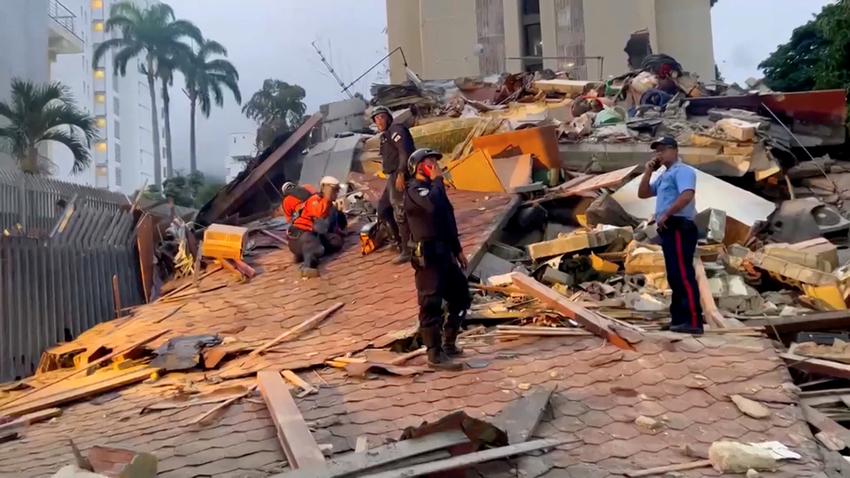
Venezuela earthquake Caracas magnitude 7.5 casualties 2026 crisis has struck the South American nation with catastrophic force, with two powerful earthquakes hitting within less than a minute of each other on Wednesday afternoon, the first a magnitude 7.2 approximately 160 kilometres west of Caracas followed almost immediately by the more powerful 7.5 tremor, prompting the U.S. Geological Survey to warn that high casualties and extensive damage are probable and the disaster is likely widespread, with the agency's initial death toll estimate ranging from 10,000 to 100,000. Buildings collapsed across Caracas during a public holiday when millions of Venezuelans were at home, trapping residents in rubble while emergency workers climbed through ruins as night fell and distraught family members gathered outside collapsed structures seeking news of loved ones they had not been able to reach. Three people were confirmed killed in Caracas's Baruta district after two buildings collapsed and one in Chacao district where four buildings completely collapsed, with 22 people hospitalised and 15 missing adults being searched for in the coastal state of Falcon, though these early confirmed figures represent a fraction of what authorities and USGS scientists believe the final toll will document as rescue operations reach areas whose access was blocked by the quakes' initial violence.
Interim President Delcy Rodriguez, who has been running Venezuela since U.S.-brokered moves ended Nicolas Maduro's presidency in January, declared a state of emergency and said she would request funds from multilateral organisations to back the recovery effort, while extending condolences without releasing a national death or injury count in her television address. Interior Minister Diosdado Cabello confirmed buildings, homes, and houses had collapsed across the country and that security and civil assistance resources were being deployed with everything available. The closure of Venezuela's largest airport at Maiquetia due to damage, the cancellation of classes for the rest of the week, and the activation of hospital night shift doubling at Caracas's Hospital de Clinicas collectively document an administration mobilising its disaster response infrastructure in the immediate hours while the full scale of the crisis remained uncalculated.
U.S. President Trump said the United States was ready, willing and able to help, describing the two massive earthquakes as having left a devastating number of deaths, with the U.S. State Department confirming it was in contact with Venezuelan authorities and mobilising assistance. The U.S. embassy in Caracas urged American citizens to seek secure shelter and avoid damaged areas. International leaders including El Salvador's Nayib Bukele, Dominican Republic's Luis Abinader, and Brazil's Luiz Inacio Lula da Silva offered support and sympathy. Rodriguez said she had instructed the foreign ministry to coordinate the international aid offers flowing in from multiple countries simultaneously.
Venezuela's Seismic History and Why This Double Quake Is Unprecedented
Venezuela's position in a seismically active zone where the Caribbean Plate meets the South American Plate creates the geological foundation for the earthquake risk that Wednesday's double quake has expressed at its most devastating scale in more than a century of the country's modern history. The 1812 Caracas earthquake, which USGS estimates killed approximately 30,000 people in the cities of Merida and Caracas when Venezuela's population was a fraction of its current size, remains the historical benchmark for catastrophic Venezuelan seismic events, and the 80-year-old pensioner Maria Romero's description of Wednesday's quake as worse than the one in 1967 situates the current event within living memory of Caracas's last major earthquake, the magnitude 6.3 tremor that killed hundreds in the capital nearly six decades ago. The 1967 event, which damaged or destroyed thousands of buildings and demonstrated the vulnerability of Caracas's residential stock to strong ground motion, prompted the building code updates that the city's subsequent construction was supposed to reflect but whose enforcement in Venezuela's economically stressed and institutionally weakened recent decades has been inconsistent.
The double earthquake sequence, with a magnitude 7.2 followed within seconds by a 7.5, is the specific seismic characteristic that makes Wednesday's event potentially more destructive than a single equivalent-magnitude quake, because the sequential ground shaking exhausts structural resilience in ways that the individual tremors' magnitudes alone do not capture. A building that survives the initial 7.2 with damage to its structural members is then subjected to the 7.5's energy when its resistance has already been compromised, creating the collapse cascade that the Baruta and Chacao building failures document and that the USGS's 10,000 to 100,000 death toll range reflects in its acknowledgment of the disaster's scale.
Caracas's specific urban vulnerability to major earthquakes reflects the compound risk factors that disaster scientists identify as the determinants of seismic mortality beyond the ground shaking intensity itself: building stock quality, population density, emergency response capacity, and the time of day of the event. Wednesday's public holiday timing, with residents at home rather than in offices or schools, creates the specific residential building exposure that produces high casualty rates when buildings collapse, because homes are simultaneously occupied at higher densities than commercial buildings during work hours and typically have less structural redundancy than purpose-built commercial or industrial structures. Maria Alejandra's description of the collapse scene as like a horror movie and her account of seeing only one family escape from a neighbouring building captures the specific residential block mortality dynamic that the USGS's range reflects.
Venezuela's Infrastructure and Governance Context for Disaster Response
Wednesday's earthquake strikes a country whose infrastructure, institutional capacity, and economic resources have been severely degraded by years of economic crisis, hyperinflation, international sanctions, and the political turbulence that culminated in Maduro's January departure and Rodriguez's transitional administration. The hospital system whose workers are doubling their shifts to manage the injured is a system that has been operating at reduced capacity for years, with medicine shortages, equipment maintenance backlogs, and medical staff emigration having reduced Venezuela's per-capita healthcare capacity significantly from its pre-crisis levels. The emergency response infrastructure whose deployment Cabello described in his state television address must manage a large-scale multiple-site urban disaster with the resources of a system that has been underfunded and understaffed throughout the crisis years.
The Maiquetia airport closure due to damage creates the specific international relief logistics challenge that converts the goodwill of international assistance offers into the practical operational problem of how relief materials, search and rescue teams, and medical support personnel will actually reach Venezuela when the country's primary air entry point is non-functional. Venezuela's secondary airports, port facilities, and road infrastructure from neighbouring Colombia and Brazil will need to absorb the international relief supply chain that the airport's closure redirects, requiring the coordination between Rodriguez's foreign ministry and the offering countries that she has activated. The U.S. State Department's mobilisation of assistance, occurring in the context of the same U.S. administration that brokered Maduro's removal, creates the specific political complexity of American disaster relief to a country whose recent political transformation the United States facilitated, a relationship whose diplomatic dimensions Rodriguez's government must manage alongside the operational disaster response.
The Search Operations, Oil Infrastructure Assessment, and International Aid Coordination
The critical 72-hour window that international disaster response doctrine identifies as the period of highest survivor probability in collapsed building rescue operations defines the specific timeline urgency that Wednesday night's footage of emergency workers climbing through Caracas rubble represents. Every hour after the initial collapse reduces the statistical probability of finding survivors alive, making the speed of rescue team deployment, search equipment mobilisation, and rubble clearance the specific operational variables that will determine the human cost differential between the USGS's lower and upper death toll estimates. The 15 missing adults in Falcon state represent known missing persons whose search is already activated, but the unknown number of people trapped in the multiple collapsed buildings across Caracas whose extent is still being catalogued by district mayors represents the larger population of unknown unknowns that the systematic search of affected areas over the coming hours and days will progressively reveal.
Venezuela's oil infrastructure assessment, whose early indications suggest no immediate damage to the critical oil production facilities near Lake Maracaibo, provides the specific economic stabilisation signal that the disaster's immediate economic consequences require, because Venezuela's oil production is the primary revenue source whose disruption would compound the economic dimensions of the disaster recovery. The source's note that extended power loss could affect crude output levels creates the specific infrastructure interdependency concern that disaster managers must monitor, because power grid damage in an earthquake of this magnitude is common and its effects on oil pumping, processing, and transport infrastructure cascade through the production system in ways that the initial facility damage assessments may not fully capture. Shell's confirmation that all its Venezuela-based employees are accounted for with no injuries represents the early foreign company accountability response that international investors and joint venture partners monitoring Venezuela's oil sector will be tracking.
The tsunami warning's issuance and swift cancellation after the danger passed represents the specific precautionary response that any major coastal earthquake triggers and whose rapid resolution has removed one of the disaster's potential additional crisis dimensions, allowing coastal evacuation efforts to stand down and coastal search and rescue resources to redirect toward the inland building collapse response that represents the primary mass casualty scenario. The Falcon state's 22 injured and 15 missing document the coastal region's separate crisis whose management Governor Clark described on state television and which requires parallel response resources to the Caracas-focused effort that the capital's building collapse concentration is demanding.
Relevant Content For More Read...