
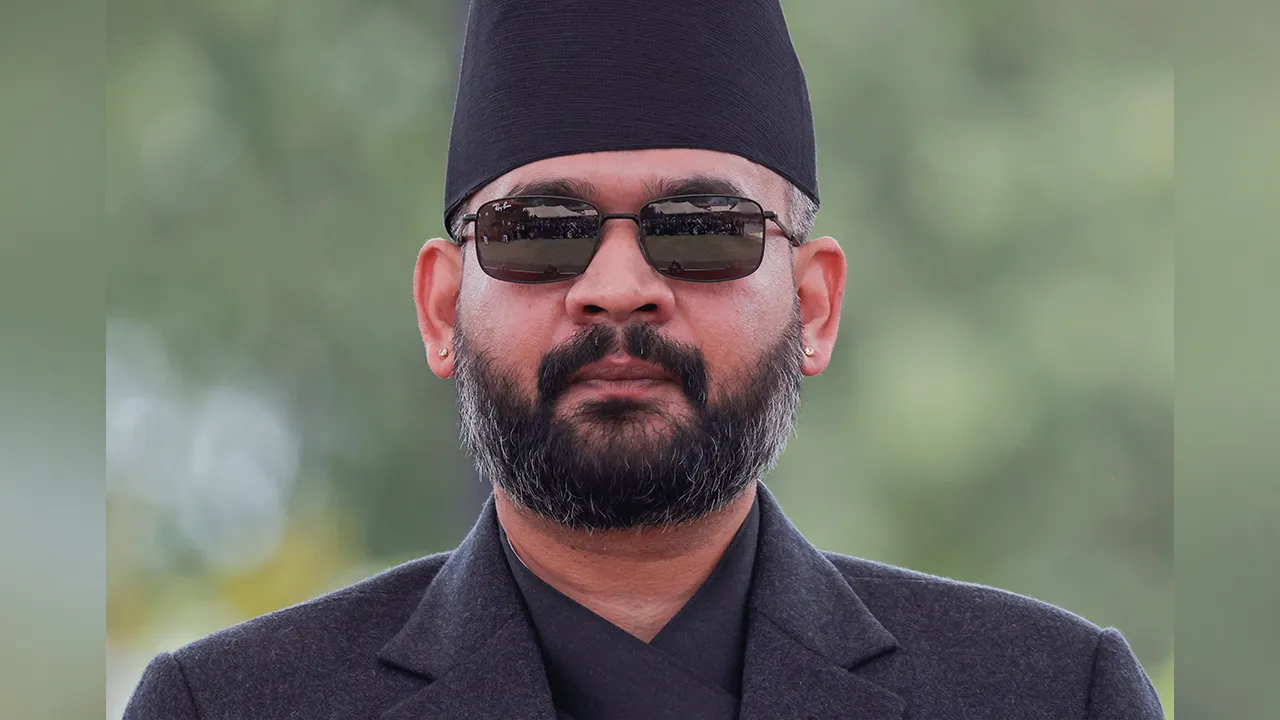
Balendra Shah Nepal prime minister era has officially begun after the 35-year-old rapper-turned-politician was sworn in at the President House in Kathmandu on Friday, making history as Nepal's youngest prime minister in decades and the first Madhesi leader to govern a Himalayan nation that has been defined for generations by political instability, endemic corruption, and the chronic inability of its governments to deliver the economic opportunities that 30 million citizens deserve. Shah arrived at the ceremony in skin-tight trousers, a matching jacket, his signature black Nepali cloth cap, and sunglasses an entrance that captured everything about what his candidacy represented to the young, frustrated, and energised voters who swept his three-year-old Rastriya Swatantra Party to 182 seats in the 275-member parliament in the March 5 election. More than 200 Hindu priests and Buddhist lamas chanted hymns and peace prayers alongside the blowing of conch shells as Nepal's most unlikely prime minister took his oath of office.
The election result was not merely a win it was a generational verdict delivered by a population that had run out of patience with the traditional parties that have cycled through power across 32 governments since 1990 without any of them completing a five-year term. Shah's Rastriya Swatantra Party, which did not exist three years ago, won 182 seats while the Nepali Congress the country's oldest party collapsed to a distant second with just 38 seats. The Communist Party of Nepal led by former Prime Minister K.P. Sharma Oli, who was forced to resign following the Gen Z anti-corruption protests that killed 76 people in September last year, controls just 25 members. The message from Nepal's electorate was unambiguous and historic: the old order has been rejected and a new one, built around a former mayor of Kathmandu who released a patriotic music video on the eve of his swearing-in ceremony, has taken its place.
The scale of the mandate creates both an extraordinary opportunity and a set of immediate challenges that will test whether Shah's political energy translates into the governance competence that Nepal's systemic problems demand. He has promised a small cabinet to cut state expenses and delivered on that promise immediately by naming just 14 ministers including Harvard-educated economist Swarnim Wagle as finance minister. The first test, according to political analyst Puranjan Acharya, comes as early as Sunday a working day in Nepal when citizens will be watching for early signs of the good governance they voted for with such decisive force. The rapper who made Nepal's heart full of red blood with his campaign songs must now make its government function with a consistency that 32 previous administrations failed to achieve.
How Nepal Got Here and Why Balendra Shah's Rise Was Inevitable
Nepal's political history since the restoration of multiparty democracy in 1990 reads as a chronicle of systemic failure so consistent and so damaging that it has become the defining context for every political development the country experiences. Thirty-two governments in thirty-six years means an average government duration of just over a year not enough time to design policy, let alone implement it, evaluate its effects, and adjust course based on evidence. In a country where a fifth of the population lives in poverty and an estimated 1,500 people leave daily for work abroad a human outflow representing both the failure of domestic economic opportunity and the diaspora remittances that prop up the economy in the absence of formal sector growth the inability of any government to complete a term has been catastrophic in its cumulative effect.
The political instability was not random it was structurally produced by a party system in which the major parties treated government as a mechanism for distributing patronage and protecting elite interests rather than as a vehicle for delivering services and building economic capacity. The Nepali Congress and the Communist Party of Nepal alternated in power across coalitions and counter-coalitions whose composition changed faster than any policy agenda could be implemented, creating a political class that learned to optimise for government access rather than governance outcomes. Endemic corruption the issue that drove the 2025 Gen Z protests and that has been the central promise of Shah's political career since his time as Kathmandu's mayor was not an aberration in this system but a feature of it, the mechanism through which political access was converted into economic benefit for those with power and connections.
The youth-led protests of September 2025 that killed 76 people and forced K.P. Sharma Oli's resignation were the culmination of this accumulated frustration reaching a breaking point. Young Nepalis who had grown up watching their peers leave the country at 1,500 per day, who had experienced the gap between the country's democratic promises and its governance reality as a personal economic injury, and who had access to social media that allowed them to coordinate and communicate across the country's geography took to the streets with the kind of moral clarity that comes from having nothing to lose in a system that has consistently failed to offer them a stake. The deaths of 76 protesters created both a political crisis that ended Oli's government and a demand for accountability that Shah's campaign made central to its platform.
Balendra Shah's Journey From Rap to Kathmandu Mayor to Prime Minister
Balendra Shah's path to the prime ministership is unlike any in South Asian political history beginning in the world of Nepali hip-hop, moving through a period of social activism and urban engagement, and arriving at the mayoralty of Kathmandu in 2022 as an independent candidate whose appeal was rooted in authenticity and directness rather than party machine support. His time as mayor of Kathmandu gave him both the governance experience and the public profile that made a national political career credible demonstrating that he could manage a major urban institution with the transparency and efficiency that his campaign promised rather than merely performing it rhetorically.
His Madhesi identity adds a dimension of historic significance that extends beyond his personal biography into the political geography of Nepal. Madhesi people the communities of Nepal's southern plains bordering India have historically been marginalised in Nepali political life, with hill-origin elites dominating the government, bureaucracy, and military despite the Madhesi community representing a substantial portion of the population. Shah's election as prime minister represents the most dramatic disruption of that hierarchy in modern Nepali history, and its significance is understood clearly by the Indian government whose Prime Minister Narendra Modi wrote on X specifically referencing his desire to strengthen India-Nepal friendship and cooperation a message calibrated to the Madhesi dimension of Shah's identity and the India-Nepal border geography that Madhesi communities straddle.
The Rastriya Swatantra Party that Shah leads is three years old younger than some of the students who voted for it and its 182-seat parliamentary majority represents the most decisive mandate any Nepali party has received since multiparty democracy was restored. The party was built around Shah's personal brand and the anti-corruption, good governance agenda that his mayoral record gave him the credibility to advocate. Its rapid rise from founding to parliamentary majority in three years reflects both the depth of public rejection of the traditional parties and the degree to which Shah's combination of cultural resonance, political authenticity, and governance track record filled a vacuum that Nepal's political system had been producing for decades. The RSP is not a fully institutionalised political party in the traditional sense it is a movement organised around a figure, and the challenge of converting that movement into durable governance capacity is the central test of the coming term.
The Gen Z Protests, the Panel Report, and the Accountability Demand
The September 2025 anti-corruption protests that reshaped Nepali politics were not simply an expression of frustration they produced a specific institutional output whose implementation will be the first and most politically charged governance test of the Shah administration. A panel was established to investigate the violence during the protests, and its report recommended the prosecution of those responsible for the security crackdown that killed 76 protesters including former Prime Minister K.P. Sharma Oli. That recommendation creates a direct collision between the legal accountability demand that the victims' families and the protest movement consider non-negotiable and the political reality that prosecuting a former prime minister requires institutional courage, judicial independence, and political will of a kind that no previous Nepali government has demonstrated.
Political analyst Puranjan Acharya identified implementing the panel's report as Shah's early challenge using language that distinguished it from a future aspiration and framed it as an immediate governing priority that will define the new administration's credibility. The families of the 76 people killed in the crackdown have been waiting for accountability since September 2025, and their patience with the political process that Shah represents has been extended specifically because of his campaign promises on this issue. If the implementation of the panel report is delayed, diluted, or redirected through political negotiation, the moral authority that Shah's election represents will be damaged before his government has had the opportunity to demonstrate its broader governance agenda.
The Chinese foreign ministry's statement that Beijing would support Nepal in safeguarding its independence, sovereignty, and territorial integrity is the standard Chinese diplomatic formulation for welcoming a new government in a strategically important neighbouring country calibrated to signal continuity and non-interference while maintaining the infrastructure of the relationship that China has been building with Nepal as part of its broader South Asian engagement. Nepal sits between India and China in a geographic position that both powers regard as strategically significant, and Shah's government will need to manage that bilateral dynamic with the same pragmatic balance that every Nepali government has attempted maintaining the India relationship that geography, economics, and the Madhesi dimension of Shah's own identity make essential while not alienating the Chinese relationship that infrastructure investment and political diversification make valuable.
Cabinet Choices, First Tests, and the Scale of What Must Change
Shah's decision to name just 14 cabinet members fulfilling his campaign promise of a small, efficient government designed to reduce state expenses and eliminate the ministerial proliferation that has historically been used to distribute political rewards rather than deliver governance is the first concrete signal that his administration intends to govern differently from its predecessors. The choice of Swarnim Wagle as finance minister is particularly significant, bringing Harvard-educated economic expertise to the portfolio most critical for addressing Nepal's structural development challenges. Nepal needs sustained economic growth that creates the formal sector employment opportunities preventing the daily departure of 1,500 workers to jobs abroad a target that requires sound macroeconomic management, investment climate improvement, and structural reforms that Wagle's professional background equips him to design and implement.
The small cabinet size is both a governance philosophy and a political signal telling Nepal's traditional political class that the patronage distribution model of government formation is being explicitly rejected in favour of a merit-based, function-focused approach to building an executive. The traditional parties built their coalitions partly by allocating ministerial positions to coalition partners as political currency, creating bloated cabinets where portfolio responsibilities overlapped and accountability for outcomes was diffuse. A 14-member cabinet creates clear lines of ministerial responsibility that make it harder to deflect accountability for policy failures a design choice that reflects Shah's governance philosophy but also raises the stakes for each minister's individual performance.
The music video Shah released on the eve of his swearing-in ceremony featuring large crowds cheering him during the campaign, lyrics emphasising patriotism and a bright future, and his characteristic performance style was not a departure from governance into celebrity but a deliberate communication choice that reflects how he understands his relationship with Nepal's electorate. He built his political career through cultural resonance rather than party machinery, and maintaining that direct communication channel with the population that elected him is both authentic to who he is and strategically important for sustaining the public trust that his governance agenda requires. The video's message Nepal is not scared this time, laughter and happiness will reach every household is simultaneously a political promise and a cultural statement about what his prime ministership represents to the young Nepalis who made it possible.
The Accountability Challenge and What Justice for 76 Deaths Requires
The implementation of the protest violence panel's report is not just a legal and institutional challenge it is a political test of whether Nepal's governance system can hold its own former leaders accountable in a way that no previous system has managed. Prosecuting K.P. Sharma Oli a former prime minister who still controls 25 parliamentary seats and who represents a significant political institution would require a criminal justice process that operates independently of political pressure, a prosecution service with the institutional courage to pursue a politically connected defendant, and courts that can deliver judgments without being subject to the interference that has historically compromised Nepal's judicial independence. Shah's government cannot simply order the prosecution it must create the institutional conditions in which justice can proceed, which is a harder and slower project than any executive announcement.
The families of the 76 people killed have been the moral anchor of Nepal's political transformation since September 2025, and their continued engagement with the political process rather than alienation from it represents a form of public trust that Shah's government has inherited and must not squander. Acharya's framing of the panel report implementation as Shah's early challenge uses the word early deliberately suggesting that this is not a problem to be managed over the long term but a test that will reveal the administration's character in its first weeks and months. A government that delays implementation because it is difficult will lose the moral authority that the election result represents faster than almost any other failure could produce.
Nepal's position between India and China means that its internal political accountability processes are observed by two regional powers whose own governance models differ fundamentally and who have different interests in Nepal's political development trajectory. India's democratic system gives it a natural affinity for accountability processes and judicial independence. China's authoritarian model has a different relationship with the prosecution of former political leaders. Shah's navigation of the accountability demand while maintaining both regional relationships will require the diplomatic sophistication that his background as an urban mayor has not specifically prepared him for but that the scale of his electoral mandate gives him the domestic political authority to attempt.
Economic Reform, Job Creation, and the 1,500 Daily Departures
The economic challenge that Shah's government inherits is the most fundamental and the hardest to address quickly Nepal loses an estimated 1,500 people per day to work abroad because the domestic economy cannot offer them jobs at wages that compete with what they can earn in the Gulf, Malaysia, or other destination countries. That daily outflow is both a symptom of economic failure and a structural feature of the Nepali economy that remittances have made financially sustainable even as it represents a continuous drain of human capital and productive potential. Reversing it requires creating formal sector employment at scale a project measured in years and decades rather than in the months that Shah's political capital will be most concentrated.
Swarnim Wagle's appointment as finance minister signals an intention to approach economic reform with professional rigour rather than political improvisation his Harvard economics training and policy research background give him the analytical toolkit to diagnose Nepal's structural constraints and design evidence-based interventions. The immediate priorities include improving the investment climate for both domestic and foreign capital, addressing the infrastructure gaps that make Nepal expensive to do business in despite its geographic proximity to two of the world's largest consumer markets, and managing the fiscal space required to fund public services without the corruption-driven waste that has historically absorbed a large share of government expenditure before it reaches the services it was intended to fund.
The Chinese and Indian governments' statements welcoming Shah's election reflect their respective assessments that his government represents a stable and manageable interlocutor for their Nepal interests China through infrastructure investment and political engagement, India through trade, cultural ties, and the particular significance of having a Madhesi prime minister in a country whose southern border communities share deep historical and familial connections with Indian states. Shah's economic agenda will need to leverage both relationships without becoming dependent on either using Indian trade access and Chinese infrastructure investment as complementary inputs to a domestically driven development strategy rather than as competing sources of political patronage that recreate in foreign policy the dependency dynamics his domestic agenda is trying to dismantle.