
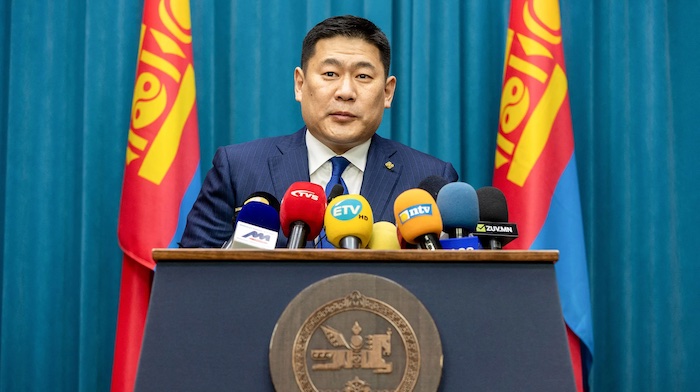
Mongolia prime minister resignation has been confirmed after Zandanshatar Gombojav submitted a letter of resignation to the ruling Mongolian People's Party, according to Chinese state broadcaster CCTV, which reported the development on Friday. The resignation of a sitting prime minister in a country that sits between Russia and China two of the world's most strategically consequential powers and that controls some of the world's most significant deposits of coal, copper, gold, and rare earth minerals carries implications that extend well beyond Mongolia's domestic politics into the geopolitical and economic calculations of its neighbours and the international investors and governments with interests in the country's natural resource wealth. The circumstances surrounding the resignation, the internal party dynamics that produced it, and the question of who leads Mongolia next are all questions whose answers will shape the country's trajectory at a moment of significant regional and global uncertainty.
The fact that the resignation was reported by CCTV rather than by Mongolian state media or official government channels first tells its own story about the information environment surrounding the development and about the closeness of Chinese monitoring of Mongolian political developments. Mongolia is landlocked between Russia and its northern border and China and its southern border, making it one of the world's most geographically constrained nations in terms of its economic and political options. Every political transition in Ulaanbaatar is observed with close attention in Beijing and Moscow, and the speed with which CCTV reported the resignation reflects the strategic interest China takes in developments that affect the government of a country through which significant Chinese economic interests operate.
The Mongolian People's Party, to which Gombojav submitted his resignation letter, is the dominant political force in Mongolian politics a party with roots in the Soviet-era Mongolian People's Revolutionary Party that transformed into a democratic socialist party after the 1990 democratic revolution and has governed Mongolia for the majority of the post-communist period. The party's internal dynamics, its relationship with the parliamentary opposition, and its capacity to manage a leadership transition smoothly will determine how quickly Mongolia can form a new government and how much political uncertainty the resignation introduces into a country whose economic development agenda requires consistent policy execution to attract the foreign investment that its mineral wealth could generate at scale.
Mongolia's Political History and the Context of the Gombojav Government
Mongolia's democratic transition in 1990 was one of the most peaceful and complete transformations of a Soviet-bloc country from communist single-party rule to multiparty democracy, achieved without the violence that characterised transitions in Romania or the prolonged instability that affected other post-Soviet states. The transition produced a parliamentary democracy with a directly elected president and a parliament called the State Great Khural, and over the subsequent three and a half decades Mongolia has conducted regular elections, experienced peaceful transfers of power between parties, and built the institutional infrastructure of democratic governance despite significant challenges from economic volatility, geographic isolation, and the pressures of operating between two authoritarian neighbours.
The Mongolian People's Party has been the dominant force throughout this period, alternating in government with the Democratic Party and various coalition arrangements, but consistently returning to power as the largest and most institutionally developed political organisation in the country. The party's dominance reflects both its organisational depth it inherited the infrastructure of the communist-era party and its ability to adapt its political positioning to the changing demands of Mongolian voters across different economic cycles. During periods of commodity price booms when Mongolia's mining revenues are strong the party governs with relative comfort; during busts when revenues contract and social pressures mount the governing party faces the political consequences of economic disappointment.
Gombojav's tenure as prime minister occurred during a period of significant economic and geopolitical complexity for Mongolia managing the country's relationships with both China and Russia while maintaining the democratic institutions and the third neighbour policy that successive Mongolian governments have pursued as a way of balancing the overwhelming geographic and economic influence of its two giant neighbours. The third neighbour concept refers to Mongolia's cultivation of strong relationships with the United States, Japan, South Korea, and European nations as a counterbalance to the dominance of China and Russia in its immediate environment a foreign policy strategy that requires consistent diplomatic investment and that any new government must continue to manage with care.
Mongolia's Strategic Position Between Russia and China
Mongolia's geographic position between Russia and China makes it one of the world's most carefully watched small nations from a geopolitical perspective, because its territory, its transit infrastructure, and its political alignment all carry significance for the strategic calculations of both neighbouring powers. Russian gas and oil pipelines that could transit Mongolia to reach Chinese markets represent infrastructure projects of enormous economic value to both neighbours, and Mongolia's willingness to host and facilitate those projects is partly a function of its relationship with both governments. Chinese investment in Mongolian mining infrastructure, processing facilities, and rail connections that carry Mongolian coal and copper to Chinese markets has made China Mongolia's dominant trading partner and the destination for the overwhelming majority of its mineral exports.
The mineral wealth that makes Mongolia strategically significant includes some of the world's largest known deposits of coal, copper, and gold, alongside rare earth elements whose global supply chains have become a focus of intense geopolitical competition as the green energy transition has increased demand for the materials used in electric vehicle batteries, wind turbines, and other clean energy technologies. Mongolia's Oyu Tolgoi copper and gold mine, operated in partnership with Rio Tinto, is one of the largest such operations in the world and represents the kind of internationally integrated resource extraction project whose stable operation requires consistent regulatory and political conditions in the host country. Political transitions that introduce uncertainty into the investment climate create risk premiums that affect Mongolia's ability to attract the capital its resource development agenda requires.
Russia's relationship with Mongolia carries both historical depth Mongolia was effectively a Soviet satellite state for most of the twentieth century and Russian technical, educational, and institutional influence remains significant and current strategic relevance given the energy infrastructure projects and the military cooperation frameworks that connect the two countries. Russia's isolation following its invasion of Ukraine has made its relationship with Mongolia more strategically important to Moscow as one of the few countries with which it maintains open and functional engagement, and the Mongolian government has navigated the pressure to align with either Western sanctions regimes or Russian political positions with a careful neutrality that reflects both its genuine non-alignment aspirations and the practical reality that landlocked energy dependence on Russian supply makes full sanctions compliance economically impossible.
Zandanshatar Gombojav's Tenure and the Issues Shaping His Resignation
Gombojav's time as prime minister encompassed the period of Mongolia's post-pandemic economic recovery, the management of the country's relationship with China during a period of significant China-West tension, and the ongoing challenge of translating Mongolia's mineral wealth into broad-based economic development that reduces poverty and creates opportunities for citizens beyond the capital Ulaanbaatar where economic activity, government employment, and social services are disproportionately concentrated. The challenges of Dutch disease the tendency for resource-rich economies to see non-resource sectors decline as mineral revenues dominate economic activity and currency appreciation makes other exports uncompetitive have been a persistent feature of Mongolian economic management that successive prime ministers have attempted to address with limited success.
The specific circumstances that led Gombojav to submit his resignation letter to the Mongolian People's Party have not been fully disclosed in the available reporting, and the fact that the news broke through Chinese state media rather than Mongolian official channels suggests that the resignation emerged from internal party processes rather than from a public political crisis with an obvious external trigger. Party-internal leadership dynamics, disagreements over policy direction, factional pressures within the MPP, or the management of specific governance challenges could all be factors whose relative weight is impossible to assess from the currently available information. What is clear is that the resignation represents a significant political development whose full context will emerge through subsequent reporting and official statements from Mongolian government and party sources.
The Mongolian People's Party's capacity to manage the leadership transition smoothly will be tested by the speed and manner in which it identifies Gombojav's successor, manages the parliamentary dynamics of government formation or continuation, and communicates its policy intentions to domestic and international stakeholders. A party with the MPP's institutional depth and democratic experience should be capable of executing a leadership transition without triggering a broader governance crisis, but the international observers and investors watching Mongolia will be assessing both the process and the outcome for signals about the country's political stability and policy continuity.
Implications of the Resignation and What Comes Next for Mongolia
The submission of a resignation letter to the ruling party rather than directly to parliament or to the president reflects the constitutional and political mechanics of how leadership transitions work within Mongolia's parliamentary system, where the prime minister's continuation in office depends on maintaining the confidence of the parliamentary majority that the ruling party controls. The Mongolian People's Party's response to Gombojav's resignation whether it accepts it immediately, seeks to persuade him to continue, or begins the process of identifying and installing a successor will determine the pace and character of the political transition that follows. A party with a stable parliamentary majority has the institutional capacity to manage this process without triggering an early election, but the transition period always introduces some degree of policy uncertainty that markets and investors observe carefully.
The question of who succeeds Gombojav as prime minister is the most consequential immediate political question for Mongolia's domestic and international stakeholders. The successor will inherit the full complexity of Mongolia's geopolitical position between Russia and China, the ongoing management of the third neighbour relationships with the United States and other democratic nations, the mining sector investment climate including the Oyu Tolgoi operations and other major projects, and the domestic economic and social policy agenda that the Mongolian People's Party has been implementing under Gombojav's leadership. Continuity of policy direction is generally the preference of foreign investors and international partners, but leadership transitions also create opportunities for policy recalibration that new leaders sometimes choose to exercise.
The timing of the resignation within the broader regional context is notable Mongolia's northern neighbour Russia is engaged in the ongoing Ukraine war and its southern neighbour China is managing a complex relationship with the United States and the West across multiple dimensions simultaneously. Both neighbours are watching the Mongolian political transition with the attention they always give to leadership changes in a country whose territory, resources, and political alignment matter to their respective strategic calculations. The new Mongolian prime minister will face these external pressures from their first day in office, and their management of the relationship with both neighbours while maintaining Mongolia's democratic character and third neighbour relationships will be the defining foreign policy challenge of their tenure.
Mongolia's Economic Agenda and What Political Transition Means for Investment
Mongolia's economic development agenda centred on translating its mineral wealth into sustainable growth, infrastructure investment, and poverty reduction requires a level of policy consistency and institutional reliability that political transitions always put under some degree of stress. Foreign investors in Mongolia's mining sector, including the international consortium operating Oyu Tolgoi, evaluate their risk exposure partly through the lens of political stability and regulatory predictability factors that a prime ministerial resignation places under renewed scrutiny regardless of how smoothly the party manages the succession process. The mining sector's importance to Mongolia's revenues, employment, and economic development means that investor confidence is not an abstract concern but a practical determinant of the country's fiscal capacity.
The rare earth dimension of Mongolia's resource profile has become increasingly significant as the global competition for clean energy minerals has intensified and as the United States, European Union, Japan, and South Korea have all pursued strategies to reduce their dependence on Chinese-dominated rare earth supply chains. Mongolia's potential as an alternative rare earth supplier geographically proximate to Asian manufacturing markets, politically distinct from China, and possessing significant mineral endowments gives it a strategic value to Western governments that is separate from and potentially larger than its value as a conventional mining investment destination. A political transition that maintains Mongolia's investment climate and its third neighbour foreign policy orientation preserves that strategic value; a transition that tilts Mongolia's policy in directions more accommodating of Chinese or Russian preferences could reduce it significantly.
The domestic economic pressures that ordinary Mongolians experience including the seasonal extremes of the country's climate, the concentration of economic opportunity in Ulaanbaatar, the gaps in rural infrastructure and services, and the impact of global commodity price cycles on government revenues and social spending will shape the political environment in which the new prime minister operates. These pressures are not new and are not created by the leadership transition, but they create the political context within which any new government must establish its credibility and demonstrate its commitment to the broad-based economic development that successive Mongolian governments have promised and partially delivered. The new prime minister's ability to show visible progress on these domestic priorities will determine their political sustainability in the medium term regardless of how successfully they manage the external geopolitical pressures.
China's Reporting and What It Signals About Regional Attention
The fact that CCTV reported Gombojav's resignation before Mongolian official channels had made a formal announcement reflects the closeness of Chinese monitoring of Mongolian political developments and the speed of Chinese state media's response to significant political events in neighbouring countries that Beijing regards as strategically important. CCTV's reporting on a Mongolian prime ministerial resignation as a news event worthy of immediate international broadcast signals that Beijing treats Mongolia's political transitions as relevant to Chinese interests and worth communicating quickly to Chinese and international audiences. The nature and framing of CCTV's reporting the details it includes, the context it provides, and the sources it cites will itself be an object of analysis for Mongolia watchers trying to understand how China is reading and responding to the political transition.
Mongolia's relationship with China is the most economically consequential bilateral relationship it manages, given that China absorbs the overwhelming majority of Mongolian mineral exports and that Chinese investment has funded significant infrastructure development in the country. The new prime minister's approach to managing this relationship how they balance Chinese economic engagement with the maintenance of Mongolia's political independence and its third neighbour policy commitments will be closely watched both in Beijing and in the Western capitals that have cultivated relationships with Ulaanbaatar precisely because Mongolia's democratic character and geographic position make it a potentially important partner in the broader effort to develop alternative supply chains for critical minerals.
The international community's response to Gombojav's resignation from China's CCTV reporting to the diplomatic cables being prepared in Washington, Tokyo, Seoul, Brussels, and Moscow reflects the degree to which a small landlocked country of three million people has acquired geopolitical significance disproportionate to its population and economic size through the combination of its mineral wealth, its strategic location, and its democratic governance model in a region where democratic institutions are not universal. The new prime minister who emerges from the Mongolian People's Party's succession process will inherit that disproportionate significance alongside the domestic responsibilities of governing a country whose citizens expect their mineral wealth to deliver the economic opportunities and public services that justified the democratic transition of 1990.