
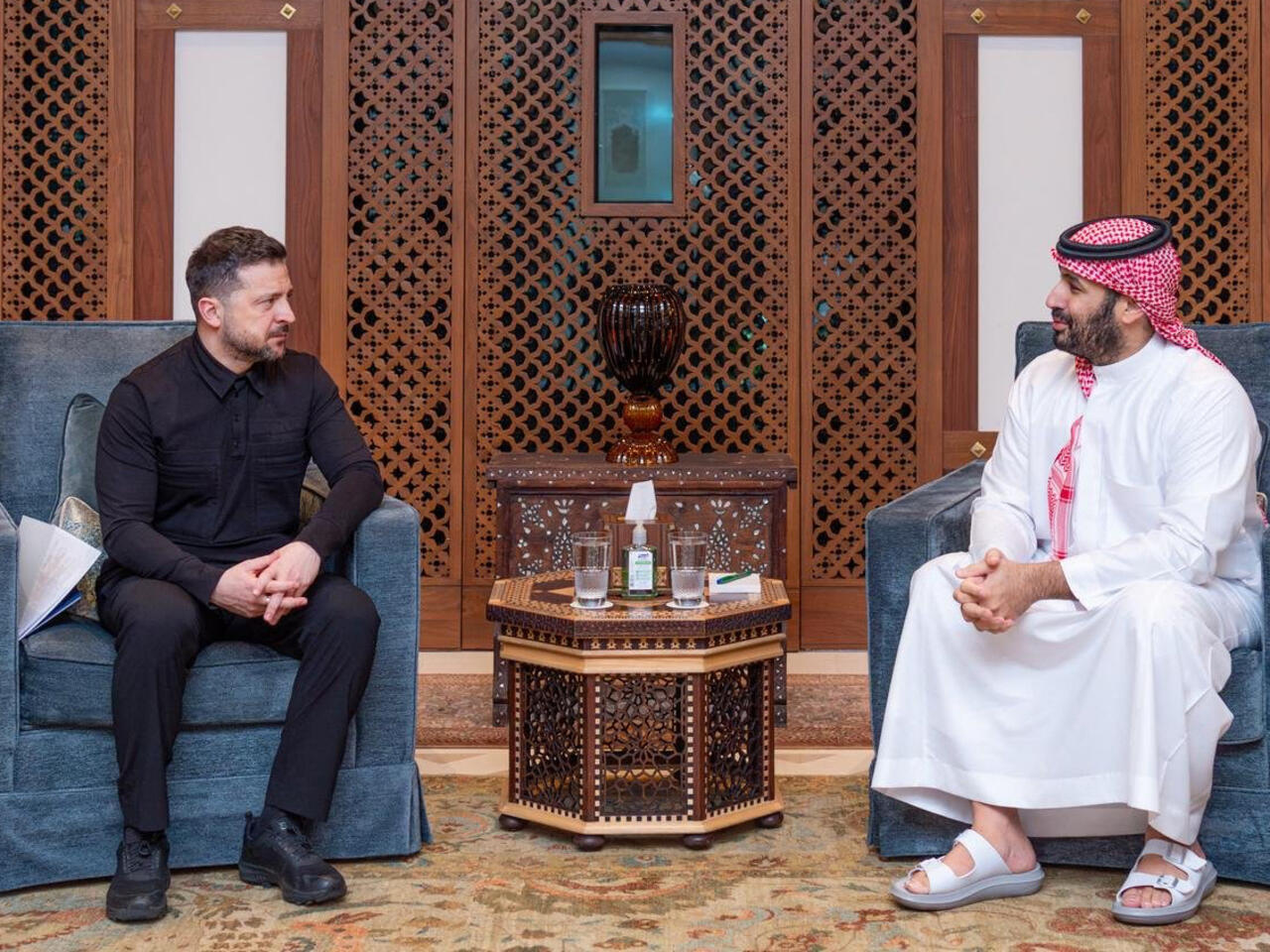
Ukraine Saudi Arabia defence deal has been signed during an unannounced visit by President Volodymyr Zelenskiy to the Gulf, laying what Kyiv describes as the foundation for future weapons contracts, technological cooperation, and mutual investment at a moment when the Iran war is simultaneously threatening Ukraine's American supply line and creating urgent demand for Ukrainian air defence expertise across the entire Middle East region. Zelenskiy announced the framework agreement ahead of a meeting with Saudi Crown Prince Mohammed bin Salman, describing it on Telegram as a platform for sharing Ukrainian expertise and systems while gaining access to Saudi capabilities and financial resources that Ukraine needs to sustain its war effort against Russia now entering its fifth year. The visit was unannounced Ukraine Saudi Arabia Defence Deal Signed as Zelenskiy Turns Gulf Crisis Into Strategic Opportunitya security precaution consistent with the wartime protocols of a head of state who cannot publish his travel itinerary without risking his own safety.
The timing of the Riyadh visit is not coincidental. The Washington Post reported on Thursday that the United States was weighing redirecting weapons supplies intended for Ukraine toward the Middle East as the Iran conflict strains existing American munitions stocks a development that, if confirmed, would represent a direct material threat to Ukraine's battlefield position at a moment when Russian pressure along the front line has not diminished. Zelenskiy's response to that threat is not to wait and see but to build alternative supply and partnership frameworks before any American redirection of weapons becomes official policy. The Saudi defence cooperation agreement is one element of that diversification strategy an attempt to convert Ukraine's battlefield expertise in drone warfare, air defence, and electronic countermeasures into diplomatic and financial capital in a region that has discovered, through the Iran war, that it needs exactly the capabilities Ukraine has spent five years developing under existential military pressure.
The 220 Ukrainian military experts already deployed across several Middle East countries this month air defence specialists and Security Service of Ukraine officials sent to advise Gulf governments on intercepting the drone attacks that have damaged energy infrastructure across the region represent the operational foundation on which Zelenskiy's defence diplomacy is building. Ukraine is not selling promises or theoretical expertise to Gulf partners. It is offering the knowledge of people who have spent years in the most drone-intensive conflict in military history, who have intercepted Russian drones over Kyiv and Kharkiv and Odesa in conditions of genuine operational urgency, and who understand from direct experience what works and what does not in the air defence environment that the Iran war has created for Saudi Arabia, the UAE, Kuwait, and Bahrain. That credibility is not available from any other supplier at any price.
How Ukraine Built the World's Most Advanced Drone Warfare Capability
Ukraine's emergence as the world's leading practitioner of drone warfare is the direct product of five years of fighting a war against a larger and better-equipped adversary that forced rapid innovation or defeat. When Russia launched its full-scale invasion in February 2022, Ukraine faced a conventional military imbalance that made symmetric response impossible Russian advantages in artillery, armour, manpower, and air power meant that Ukraine had to find asymmetric capabilities that could impose costs on Russian forces disproportionate to their own investment. Drones commercially available, domestically manufacturable, rapidly improvable, and deployable by small teams without the logistical infrastructure that conventional weapons require — became the asymmetric tool that Ukrainian innovation culture seized and developed with remarkable speed.
The Ukrainian drone programme has evolved from the improvised use of commercial quadcopters in the conflict's early stages to a sophisticated industrial production system capable of manufacturing thousands of units per day across multiple categories reconnaissance drones, attack drones, naval surface drones, and the drone interceptors whose production capacity Zelenskiy told Reuters this week could reach 2,000 per day with sufficient financing. Each category has been developed through a cycle of battlefield deployment, performance assessment, enemy countermeasure identification, and rapid design iteration that has compressed what would normally be years of military development into months of operational learning. The result is a Ukrainian drone industry that is simultaneously a genuine military capability and a globally relevant technology development programme whose products and expertise are now attracting serious commercial and defence interest from governments that are facing their own drone threats.
The air defence dimension of Ukraine's five-year learning curve is particularly relevant to the Gulf states now facing Iranian drone attacks on their energy infrastructure. Ukraine has been intercepting Russian drone swarms over major cities and critical infrastructure since 2022, developing the sensor networks, command and control systems, interceptor drone capabilities, and tactical procedures that effective counter-drone defence requires. Saudi Arabia, Kuwait, and Bahrain have been dealing with drone threats for a much shorter period and have been caught without the integrated air defence architecture that Ukraine's experience has shown is essential for high-success-rate interception. The 220 Ukrainian experts sent to the region this month are not lecturing from textbooks they are sharing the operational procedures and system configurations that have been tested against real Russian drone swarms in conditions of genuine urgency.
Ukraine's Wartime Diplomacy and the Search for Non-American Support
Ukraine's diplomatic strategy throughout the Russia war has involved the constant cultivation of support from as many governments as possible not because American and European support was insufficient but because diversification of backing reduces vulnerability to any single ally's political changes. The Trump administration's return to the U.S. presidency in 2025 and its pursuit of a rapprochement with Moscow that European allies view with deep suspicion created exactly the kind of political vulnerability that Ukraine's diversification strategy was designed to hedge against. The Washington Post report about potential weapons redirection from Ukraine to the Middle East is the most direct materialisation of that vulnerability yet a concrete scenario in which American political and military priorities could reduce the supply of weapons on which Ukraine depends for its battlefield survival.
Zelenskiy's response to this vulnerability has been to accelerate the development of alternative partnerships with the speed and directness that wartime urgency demands. The Gulf trip is part of a broader pattern of engagement with Middle Eastern, Asian, and Global South governments that has intensified since it became clear that the Trump administration's approach to the Ukraine war was fundamentally different from the Biden administration's. Saudi Arabia is a particularly significant partner because of its financial resources the kingdom's sovereign wealth fund and government budget give it the capacity to provide the financing that Zelenskiy told Reuters Ukraine needs to reach 2,000 drone interceptors per day. Money from Riyadh could fund drone production capacity in Ukraine that reduces Ukrainian dependence on American weapons supplies more effectively than any diplomatic statement could.
The framework nature of the defence cooperation agreement establishing the foundation for future contracts and technological cooperation rather than specifying immediate deliverables reflects the early stage of a relationship that both sides are building carefully. Saudi Arabia has its own considerations about publicly aligning too closely with any party in the Ukraine conflict given its complex relationships with Russia and China, and Ukraine needs to offer the Gulf a partnership framework that delivers real value for Saudi Arabia's specific security needs rather than simply asking for financial support in exchange for diplomatic gestures. The mutual benefit framing that Zelenskiy emphasised in his Telegram statement Ukraine sharing expertise and systems, Saudi Arabia providing capabilities of interest to Ukraine reflects a genuine attempt to construct a relationship with reciprocal value rather than a one-directional aid arrangement.
The Iran War's Impact on Ukraine's Strategic Position
The Iran war that began on February 28 has paradoxically created both a threat and an opportunity for Ukraine's strategic position simultaneously. The threat is the American weapons redirection scenario a military establishment fighting a major Middle East war that is consuming munitions at unprecedented rates while simultaneously supporting Ukraine faces real supply constraints that could eventually force prioritisation choices. Ukraine's concern about being deprioritised relative to the Iran war effort is not paranoia but a rational reading of military logistics and political attention that any competent national security team would be making.
The opportunity is the demand for Ukrainian expertise that the Iran war has created across the Gulf. Every Saudi, Emirati, Kuwaiti, and Bahraini government official who has watched Iranian drones strike energy facilities in their country during the past five weeks has a new and urgent interest in acquiring better air defence capabilities. Ukrainian air defence experts who have been doing exactly this work in conditions of genuine operational pressure for five years are the most credible and experienced advisers available in the world on this specific problem. The 220 experts already deployed to the region, the workshops conducted for Saudi officials, and the briefings provided to the Saudi General Staff are converting that credibility into the political and financial relationships that Zelenskiy's defence diplomacy needs to build alternative support structures for Ukraine's war effort.
The strategic calculation underlying Zelenskiy's Gulf visit is therefore more sophisticated than it might appear he is using Ukraine's wartime expertise as the commodity that purchases the financial and technological partnerships that reduce Ukrainian dependence on American supply, while simultaneously demonstrating to Washington that Ukraine has alternative partners who value Ukrainian capabilities, making American support less politically costless to reduce than it might otherwise appear. This is the diplomacy of a small country that has learned to operate in a complex international environment with the strategic sophistication that survival requires.
The Saudi Deal, the Expert Deployment, and What Ukraine Gets in Return
The framework agreement signed between Ukraine and Saudi Arabia establishes the legal and institutional architecture for a defence partnership whose specific content will be defined through subsequent negotiations over contracts, technology transfer arrangements, and investment structures. Framework agreements are the standard diplomatic tool for initiating defence partnerships between countries that have not previously had formal military cooperation they create the regulatory permissions, information sharing protocols, and liability frameworks that allow specific commercial and technical arrangements to follow. The Saudi-Ukraine agreement's significance lies not in what it immediately delivers but in what it makes legally possible and diplomatically legitimate to pursue in subsequent months.
The specific Ukrainian capabilities that Saudi Arabia is most likely to seek through this framework include counter-drone systems, electronic warfare equipment, air defence radar technology, and the tactical training and doctrine development that makes hardware effective in operational conditions. Ukraine has developed or adapted all of these in response to Russian drone campaigns, and some of the specific systems and procedures Ukraine has developed have no direct equivalent in the Western defence procurement market because they were created for conditions that NATO doctrine and procurement systems did not previously prioritise. Saudi Arabia's willingness to pay for access to these capabilities which Zelenskiy has explicitly framed as requiring money and technology in return gives Ukraine a potential revenue stream for its defence industry that reduces dependence on aid transfers and creates a sustainable commercial foundation for continued military production.
The Saudi capabilities that are of interest to Ukraine, as Zelenskiy described them, likely include financial resources to fund drone production scale-up, advanced electronic components available through Saudi commercial networks, and potentially specific military technologies developed or acquired by the kingdom that complement Ukrainian capabilities in ways not publicly specified. Saudi Arabia has invested heavily in its own defence industry development and has procurement relationships with Western, Russian, and Chinese suppliers that give it access to a technology base broader than Ukraine's own production capacity encompasses. The mutual benefit framing reflects a genuine complementarity between what Ukraine has operational expertise, drone technology, air defence experience and what Saudi Arabia has financial capacity, procurement access, and specific technical capabilities developed for the Gulf's distinct security environment.
The 220 Ukrainian Experts and What They Are Teaching Gulf Governments
The deployment of more than 220 Ukrainian military experts to advise Middle East countries on intercepting drone attacks represents the operational core of Ukraine's Gulf engagement strategy demonstrating through direct interaction the depth and credibility of Ukrainian air defence expertise in a way that no amount of diplomatic communication could substitute for. The expert group consists of air defence specialists and Security Service of Ukraine officials whose combined experience covers the detection, tracking, interception, and electronic countermeasure dimensions of counter-drone defence developed through years of protecting Ukrainian cities and infrastructure from Russian drone swarms that are sophisticated, numerous, and continuously evolving in response to Ukrainian countermeasures.
The workshop conducted for Saudi officials and the briefing to the Saudi General Staff represent the beginning of a training relationship whose depth will be determined by how the broader defence partnership framework develops. A one-time workshop transfers knowledge but does not build the institutional capability that effective air defence requires that requires sustained training, joint exercises, system integration work, and the kind of ongoing advisory relationship that embeds Ukrainian expertise in Saudi military planning and procurement processes. The framework agreement signed by Zelenskiy creates the legal basis for that deeper engagement to proceed, and the expert deployment provides the personal relationships and credibility assessments on both sides that sustained cooperation requires.
Zelenskiy's statement to Reuters that Ukraine could produce 2,000 drone interceptors per day with sufficient financing is both a capability claim and a sales proposition directed at Gulf governments whose need for drone interceptors has become acute and immediate. A country that can produce 2,000 interceptors per day at industrial scale offers something that Western defence contractors currently cannot match on timeline not because Western technology is inferior but because Western procurement and production systems were not designed for the rapid scaling that wartime drone warfare demand requires. Ukraine's wartime production culture, which has compressed development and manufacturing timelines by necessity, gives it a competitive advantage in exactly the market that the Iran war has created across the Gulf.
What This Means for Ukraine's War Against Russia
The strategic implications of Zelenskiy's Gulf diplomacy for Ukraine's war against Russia operate through several channels simultaneously. The most direct is financial Saudi investment in Ukrainian drone production capacity funds the weapons that Ukraine needs to maintain its battlefield position regardless of what happens to American supply. If the Washington Post's reporting about potential weapons redirection proves accurate and American supply to Ukraine is reduced, the financial relationships being built in Riyadh could partially substitute for the missing American materiel by funding increased Ukrainian domestic production. This substitution is imperfect American weapons include capabilities that Ukraine cannot yet produce domestically but it is meaningfully better than having no alternative at all.
The diplomatic signalling dimension of the Gulf trip is also significant for Ukraine's relationship with Washington. A Ukrainian president who is actively building defence partnerships with major American allies in the Gulf the UAE, Saudi Arabia, other Gulf states whose security relationships with Washington are central to American Middle East strategy is demonstrating that Ukraine has strategic value beyond the European context and that reducing support for Ukraine has diplomatic costs in the Gulf relationships that Trump's administration also cares about. The 220 Ukrainian experts helping protect Gulf energy infrastructure from Iranian drones are simultaneously serving Ukrainian and American strategic interests, creating a practical interdependence that makes the case for continued American support to Ukraine more compelling than any political argument could.
The drone production capability that Zelenskiy is marketing to Gulf partners is the same capability that Ukraine needs for its own battlefield use against Russia, creating a potential tension between export revenue and domestic military requirements that the Ukrainian leadership will need to manage carefully. Selling drone interceptor capacity to Saudi Arabia generates the financing to build more production capacity, which eventually produces both export revenue and domestic military capability but the sequencing of those benefits matters in a war where current battlefield conditions create immediate demand that cannot wait for future production scale-up. The framework agreement's future contracts language suggests that the commercial dimension of the Saudi relationship will develop over months rather than weeks, giving Ukraine time to build the production capacity that can serve both markets simultaneously.