
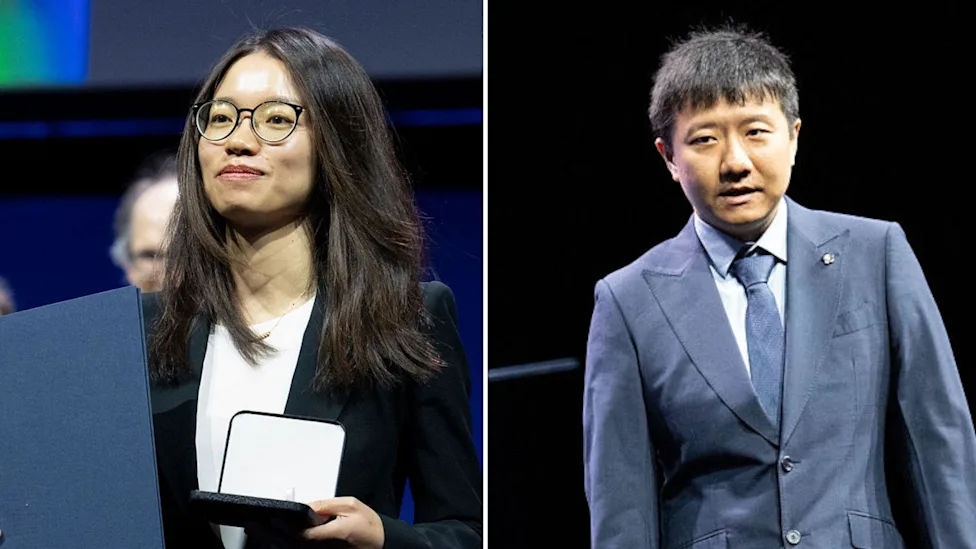
Two Chinese academics have made history by becoming the first Chinese mathematicians Fields Medal nationals to win, mathematics' most prestigious honour and the discipline's closest equivalent to the Nobel Prize, in a recognition of intellectual achievement that has generated celebration across Chinese social media, personal congratulations from the French president, and global attention at a moment when human mathematical reasoning is under heightened scrutiny in the age of artificial intelligence. Hong Wang, 35, a professor at New York University and a permanent professor at France's Institut des Hautes Études Scientifiques, and Yu Deng, 37, a mathematics professor at the University of Chicago, were awarded the medal on Thursday in the United States alongside John Pardon from the US and Jacob Tsimerman from Canada. Each winner received 15,000 Canadian dollars, approximately $10,500, a sum whose financial modesty is inversely proportional to the professional significance of what it represents.
Both Chinese winners were honoured for solving mathematical problems that have stood unanswered for more than a century. Wang solved the Kakeya conjecture in three dimensions, a problem first posed by Japanese mathematician Soichi Kakeya in 1917, in collaboration with her colleague Josh Zahl. Deng resolved Hilbert's Sixth Problem, a question posed by German mathematician David Hilbert in 1900 about how the behaviour of a whole system can be calculated from the movement of its individual particles. The combination of two century-old problems falling to Chinese mathematical minds in the same year, and both receiving the Fields Medal in the same cycle, has produced a moment of national pride in China that extends well beyond the academic mathematics community.
Wang's achievement carries an additional historical dimension: she is only the third woman ever to receive the Fields Medal since it was first awarded in 1936. The medal is given every four years to outstanding mathematicians under the age of 40, a constraint that makes each award cycle a relatively limited pool and gives every winner a place in the permanent record of the discipline's history. Wang and Deng join a list that includes some of the greatest mathematical minds of the twentieth and twenty-first centuries, and their presence on it as the first representatives of Chinese nationality is a milestone that China's mathematical community has been working toward for decades.
The 2025 Fields Medal Ceremony and Its Historic Results
The International Mathematical Union awards the Fields Medal every four years at the International Congress of Mathematicians. The 2025 ceremony, held in the United States, named four winners: Hong Wang, Yu Deng, John Pardon, and Jacob Tsimerman. The selection process is conducted by a confidential committee of distinguished mathematicians who evaluate candidates against the standard of exceptional mathematical achievement before the age of 40, a criterion that necessarily limits the pool and makes selection extraordinarily competitive in a discipline where careers often peak in middle age.
The reaction in China was immediate and extensive. The hashtags "Fields Medal" and "First Chinese mathematicians to win Fields Medals" generated millions of views across Weibo, Rednote, and other platforms within hours of the announcement. "Pride of all Chinese people," wrote one Weibo user. "We are witnessing history," wrote another. Chinese media devoted extensive coverage to both winners, detailing their educational backgrounds, their mathematical work, their personal interests, and what their achievement represents for a country that has invested heavily in scientific and mathematical education over the past two decades. Shing-Tung Yau, the first ethnic Chinese Fields medallist who won in 1982 as an American citizen, described the moment as the realisation of a decades-long dream for China's mathematical community.
French President Emmanuel Macron telephoned Wang on Thursday night to offer personal congratulations. "She embodies the excellence of our research and our training," Macron posted on X, adding "Choose France for science." The presidential call reflects Wang's dual institutional identity: she holds a position at NYU in the United States while also serving as a permanent professor at IHES in France, making her achievement a point of national pride for two countries simultaneously. The geopolitical dimension of that dual affiliation, at a moment of intense competition between the United States, France, and China for global scientific talent, was not lost on observers noting where the congratulations came from and where they did not.
Decades of Investment, Elite Education, and the Chinese Mathematics Pipeline
The emergence of two Chinese Fields medallists in the same year is not a coincidence of random genius but the visible output of a decades-long investment in mathematical education and talent development that China has made since the post-Cultural Revolution reopening of its universities and scientific institutions. Both Wang and Deng followed a path that begins with China's highly competitive primary and secondary school mathematics culture, continues through elite university entry at Peking University, and then extends abroad to the world's most distinguished mathematics departments at institutions including MIT, Princeton, Paris-Sud, and the École Polytechnique.
Wang was admitted to Peking University at 16 after skipping two grades, initially studied earth sciences, and transferred to mathematics after a year, a trajectory that suggests mathematical talent identified through the competitive examination system but refined through genuine personal engagement with the discipline rather than purely instrumental pursuit of a high-status degree. She subsequently moved to France for graduate study before earning her doctorate at MIT, one of the most demanding mathematics PhD programmes in the world. Deng's path was parallel in its early stages: admitted to Peking University in 2007, the same year as Wang, he transferred to MIT in 2009 and went on to earn his doctorate from Princeton before joining the University of Chicago faculty in 2024.
The pattern is significant for what it reveals about where the best mathematical talent incubates and where it is ultimately developed. Both Wang and Deng began in China, in an educational culture that takes mathematics competition seriously from primary school and that produces the highest concentration of competitors in the world's elite undergraduate programmes. Both then pursued their most advanced training at American and French institutions with the resources, academic freedom, and research culture that the current stages of their careers required. The Fields Medal, in this sense, belongs simultaneously to the Chinese educational system that identified and developed their early talent and to the American and French institutions where their most significant work was done.
From a 1917 Pencil Problem and a 1900 Physics Question to the 2025 Fields Medal
1900 — David Hilbert, one of the most influential mathematicians in history, presents 23 unsolved problems at the International Congress of Mathematicians in Paris. His Sixth Problem asks how the macroscopic behaviour of physical systems can be derived rigorously from the microscopic movement of individual particles, a question sitting at the boundary of mathematics and physics.
1917 — Japanese mathematician Soichi Kakeya poses what becomes known as the Kakeya problem: if you rotate a needle or pencil through 360 degrees, what is the minimum area it needs to sweep through? In two dimensions, a counterintuitive solution involving a specific mathematical construction allows the area to be made arbitrarily small. In higher dimensions, the conjecture that certain sets must have full dimension has remained an open problem.
1936 — The Fields Medal is first awarded at the International Congress of Mathematicians in Oslo. It becomes the most prestigious award in mathematics, given every four years to mathematicians under 40.
1982 — Shing-Tung Yau, born in China and holding American citizenship, becomes the first ethnic Chinese Fields medallist. The award recognises his work in differential geometry and its applications across mathematics and theoretical physics.
2007 — Hong Wang and Yu Deng are both admitted to Peking University in the same year, beginning parallel academic journeys that will converge at the 2025 Fields Medal ceremony.
2009 — Deng transfers to MIT. Wang continues at Peking before moving to France and then MIT for her doctorate.
2024 — Wang and Josh Zahl publish their solution to the Kakeya conjecture in three-dimensional space. Deng publishes his resolution of Hilbert's Sixth Problem by analysing the behaviour of gases.
2025, Thursday — The Fields Medal is awarded in the United States. Wang and Deng become the first Chinese nationals to win. Wang becomes only the third woman in the medal's 89-year history to receive it.
What the First Chinese Fields Medal Means for China's Scientific Ambitions
The significance of the first Chinese Fields Medal winners extends well beyond academic mathematics into the domain of national scientific strategy and global competition for intellectual prestige. China has invested enormously in scientific education and research infrastructure over the past two decades, with specific programmes designed to identify and develop mathematical talent from primary school age through to international research careers. The achievement of Wang and Deng is, in one sense, the visible return on that investment: a demonstration that the Chinese mathematics pipeline, from competitive primary school programmes through Peking University to international research institutions, is producing mathematicians capable of solving the problems that define the frontier of the discipline.
The political resonance in China is amplified by the context of technological and scientific competition with the United States and, to a lesser degree, with European scientific powers. In an era when Chinese technological capabilities are scrutinised by Western governments for security implications and when access to semiconductor technology, artificial intelligence infrastructure, and scientific talent is a contested geopolitical issue, a Fields Medal won by Chinese nationals is a form of soft power that operates differently from military or economic indicators but resonates with educated populations who understand what the recognition means. The millions of social media engagements in China, the national media coverage, and the explicit framing in Chinese commentary as a collective national achievement reflect an understanding of the medal as a data point in a broader global competition for intellectual standing.
Macron's personal congratulations to Wang and his "Choose France for science" message represent the mirror image of China's national pride in a specifically French frame. France's claim to Wang's achievement rests on her institutional affiliation at IHES and her graduate training at Paris-Sud and the École Polytechnique. That claim competes with the American claim anchored by her MIT doctorate, her NYU professorship, and the fact that the medal was awarded in the United States. The geography of scientific achievement in the twenty-first century does not map neatly onto national borders when the most talented mathematicians hold simultaneous affiliations across multiple countries and continents.
What Elite Mathematical Achievement Means for AI, Technology, and National Competitiveness
The Fields Medal is awarded at a moment when the relationship between human mathematical reasoning and artificial intelligence is under intense examination. AI systems are increasingly capable of performing mathematical tasks that previously required human expertise, and some researchers have raised questions about whether AI will eventually render the kind of deep theoretical work that Wang and Deng do less consequential for practical applications. The work recognised in this year's Fields Medal points in the opposite direction: the Kakeya conjecture and Hilbert's Sixth Problem are precisely the kinds of foundational mathematical questions whose resolution opens new avenues in mathematics and mathematical physics that current AI systems are not capable of pursuing independently.
The economic implications of producing mathematicians capable of frontier theoretical work are not immediate in the way that a product launch or trade deal is, but they are real and consequential over decadal timescales. The mathematical techniques developed in harmonic analysis, which is Wang's primary field, have found applications in signal processing, data compression, medical imaging, and the mathematical foundations of cryptography. The rigorous derivation of macroscopic physical behaviour from microscopic particle dynamics that Deng's work advances has implications for materials science, fluid dynamics modelling, and the physical foundations of computational simulation. These connections between theoretical mathematics and applied technology do not always manifest quickly, but the history of mathematics is full of examples of theoretical work that seemed purely abstract at the time of its creation finding critical applications a generation later.
For China specifically, the economic argument for the Fields Medal is part of a broader case about the return on investment in mathematical education and research. A country that can produce students who win at international mathematics competitions, earn doctorates at the world's elite institutions, and ultimately solve century-old problems is developing a form of human capital that compounds over time. The question for China's scientific establishment is whether the talent pipeline that produced Wang and Deng can be replicated at scale, and whether the institutional conditions that supported their most advanced work, primarily the American and French research environments where both mathematicians did their defining work, can be created domestically.
How Theoretical Mathematics Feeds the Technology Economy
The business community's interest in the Fields Medal is less immediate than its interest in quarterly earnings or trade policy, but it operates through a supply chain that connects theoretical mathematical work to practical applications in ways that are increasingly well understood. The major technology companies, including Google, Meta, Microsoft, and their Chinese counterparts Alibaba, Tencent, and Huawei, all employ teams of mathematicians whose work on theoretical problems feeds directly into the development of search algorithms, cryptographic systems, data compression techniques, and the mathematical foundations of machine learning.
Wang's work in harmonic analysis, the mathematical study of wave behaviour and function decomposition, has direct connections to the signal processing techniques that underlie wireless communication, medical imaging, and audio and video compression. The Kakeya conjecture, while appearing abstract, has connections to the theory of Fourier transforms that are fundamental to modern digital signal processing. Deng's work on the derivation of fluid dynamics equations from particle behaviour connects to computational fluid dynamics applications in aerospace engineering, climate modelling, and the design of efficient industrial processes.
The demonstration that human mathematicians working at the theoretical frontier continue to solve problems that AI cannot is itself a business relevant signal. Companies investing in AI research are simultaneously investing in the mathematical foundations that AI development requires, and the Fields Medal winners represent the human mathematical community's continued capacity to advance the theoretical frontier in ways that AI is not yet capable of replicating.
The Fields Medal in the Context of International Science Competition
The 2025 Fields Medal cohort, two Chinese nationals, one American, and one Canadian, reflects the genuinely international nature of elite mathematical research at a time when the geopolitics of science are becoming more contested. The free movement of mathematical talent across borders, which allowed Wang and Deng to train at American and French institutions after their initial Chinese education, is a feature of global academic life that has enabled the kind of international cross-pollination of ideas that produces frontier research. That openness is under pressure from immigration policy changes, technology export controls, and the broader trend toward national science strategies that prioritise domestic talent retention over international exchange.
Wang's dual American-French institutional affiliation and Deng's Chinese-American educational trajectory are both examples of the internationally mobile talent pipeline that has driven global mathematical progress for decades. The value of that pipeline is visible in the Fields Medal itself: every prize cycle since the 1980s has recognised mathematicians who trained in multiple countries, held positions across national borders, and contributed to research communities that do not recognise the territorial limits that governments impose on the movement of people and ideas.
The specific recognition of Chinese mathematical achievement at the highest level will also influence how governments and institutions around the world assess the scientific talent development strategies of countries that have historically been importing rather than exporting elite mathematical minds. China's position as a source of Fields Medal-level talent rather than merely a destination for international mathematics education marks a qualitative change in the global scientific landscape whose implications for research collaboration, talent recruitment, and scientific diplomacy will unfold over the coming decade.
What Mathematicians and Science Policy Experts Are Saying
Shing-Tung Yau, the first ethnic Chinese Fields medallist and one of the most prominent figures in twentieth-century mathematics, described the achievement of Wang and Deng as "a dream we have been hoping to realise for decades." His framing reflects the generational dimension of the achievement: the community of Chinese-born mathematicians who have worked at elite international institutions since the 1970s and 1980s, including Yau himself, has watched the development of China's domestic mathematics culture and hoped to see it produce winners at the highest international level. That moment has arrived in the same cycle, with two winners simultaneously.
The mathematical content of the two solutions is itself a subject of expert commentary. Wang and Zahl's proof of the Kakeya conjecture in three-dimensional space, published last year, resolved a question that had been partly answered in two dimensions but whose extension to higher dimensions had resisted all approaches for over a century. The techniques they developed draw on advanced harmonic analysis and geometric measure theory and are expected to have implications for other open problems in adjacent areas. Deng's resolution of Hilbert's Sixth Problem for gases, connecting the microscopic Boltzmann equation to macroscopic fluid dynamics equations through a rigorous mathematical argument, closes a gap in the foundations of mathematical physics that Hilbert himself identified as a priority 125 years ago.
The timing of these achievements, at a moment when AI systems are being deployed to assist with mathematical research and some researchers have predicted that AI might solve major open problems within years, is noted by science policy experts as a reminder that the deepest theoretical problems in mathematics remain in the domain of human insight. AI tools assisted with neither of these solutions: they required the kind of sustained, creative, and highly abstract reasoning that represents the frontier of human mathematical capability.
For Wang, Deng, and the Future of Chinese Mathematics
Immediate academic impact — The solutions to the Kakeya conjecture and Hilbert's Sixth Problem will be studied by mathematical communities worldwide. Follow-on work building on the techniques Wang and Zahl developed and the framework Deng established is already under way in harmonic analysis and mathematical physics respectively.
China's mathematics strategy — The achievement will strengthen the case within China's scientific establishment for continued investment in elite mathematics education and for maintaining the international exchange programmes that allowed Wang and Deng to train at the world's best institutions. It will also intensify discussion about whether China can create domestic research environments competitive with MIT, Princeton, and the leading European institutions.
International talent competition — Macron's personal congratulations to Wang and his "Choose France for science" appeal reflect a competition for scientific talent in which countries are increasingly active. The question of whether elite Chinese mathematical talent will stay at American and French institutions, return to China, or create the kind of dual affiliation that Wang currently holds will be shaped by both personal choices and the institutional conditions that governments and universities create.
The fourth woman in Fields Medal history — Wang is only the third woman to win the Fields Medal in its 89-year history. Her achievement will intensify discussions about gender representation in elite mathematics and about the conditions that allow women to succeed at the highest levels of the discipline. The question of when the fourth woman will win, and whether the interval will be shorter than the 89 years it took to reach the third, will be watched by the mathematics community and the broader scientific world.
AI and human mathematics — The 2025 Fields Medal will feature in the continuing debate about the relationship between AI systems and human mathematical reasoning. The solutions recognised this year are precisely the kind of deep theoretical work that current AI cannot replicate, providing evidence for the position that human mathematical creativity retains unique value at the frontier of the discipline.
What to Watch Next
Whether China's scientific institutions use the achievement to advocate for expanded mathematics education funding and international collaboration programmes that replicate the pipeline that produced Wang and Deng.
How American and French universities respond to the competition for top Chinese mathematical talent, given that both Wang and Deng did their most significant work outside China.
Whether Wang and Deng's techniques produce the follow-on mathematical results in harmonic analysis and mathematical physics that experts expect, expanding the impact of their Fields Medal work.
When the fourth woman will win the Fields Medal, and whether Wang's recognition accelerates institutional changes that make that interval shorter than the 89 years it took to reach the third.
How AI mathematics tools evolve in the years following the 2025 Fields Medal cycle, and whether the frontier of human mathematical achievement continues to advance faster than AI can follow.