
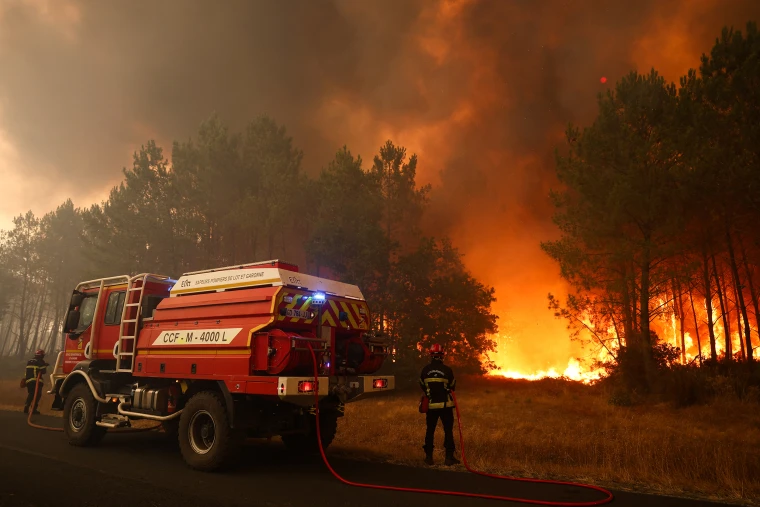
Europe Wildfires 2026 is facing its most severe simultaneous wildfire emergency in recorded history, with more than 220,000 people evacuated across France and Spain by Saturday morning, the French military mobilised to support firefighting operations around Bordeaux, and Spanish officials warning that three merged fire fronts west of Madrid have created a blaze that is "beyond the capacity" of firefighters to contain. The scale and pace of the crisis have overtaken the emergency management frameworks that both countries had in place, forcing escalations in military involvement, international assistance, and the geographic scope of evacuation orders that would have seemed improbable a week ago. France has now ordered the evacuation of seven towns in Bordeaux's western suburbs, including part of where the city's international airport is located, after fires that began in the Gironde's plantation pine forests changed direction and began moving east toward one of France's most significant urban.
In Spain, Madrid's regional president described events as "the worst fire in the history of the region," using the specific phrase "perfect storm" to capture the combination of high temperatures, relentless wind, and merging fire fronts that have overwhelmed the Madrid region's fire management capacity. The number of people evacuated in the Madrid region and Ávila province exceeded 60,000 by Saturday morning, with 25,000 specifically directed to evacuate and almost 40,000 more told to shelter in place rather than leave. The total figure across both countries, 220,000 people displaced or restricted, represents a humanitarian emergency of a scale that has prompted both countries to trigger the EU's Union Civil Protection Mechanism simultaneously, marking the first time in the mechanism's history that two major economies have activated it for the same category of crisis at the same moment.
What is happening in France and Spain this week is not simply a bad fire season. It is the visible, human consequence of a set of structural conditions, climatic, ecological, and political, that have been building for years and have now converged into a crisis that is rewriting what Europe understands as the outer boundary of its wildfire risk. The EU's Commissioner for Crisis Management, Hadja Lahbib, put it plainly: the wildfire season has "started earlier in the year," burns for a "longer period," and now occurs in a "broader area." Europe is the fastest-warming continent on Earth, with temperatures rising more than 0.5 degrees Celsius per decade since the 1990s, and the summer of 2026 is not an anomaly to be managed and set aside. It is the new baseline against which every future fire season will be measured.
From Forest Fire to Urban Threat in 72 Hours
The speed at which France spain wildfire emergency escalated from a forest fire in Saumos, in the Gironde department, to an imminent threat to Bordeaux's western suburbs represents one of the fastest and most dramatic fire progressions in modern French history. The initial fire, which began earlier in the week, was expected to be managed within the parameters of a significant but regionally contained event. The wind changed, the fire changed direction, and by 03:00 on Saturday morning local time, the Gironde prefect had ordered the evacuation of seven communities in Bordeaux's western suburbs, including part of , the location of Bordeaux- international airport. The fire was still 40 to 50 from Bordeaux's, but smoke was being carried directly toward the city and residents were reporting an acrid smell in the streets.
French President Emmanuel Macron's decision to the military reflects the scale of what is being asked of civilian emergency services across approximately 30 simultaneous fires burning across the country, a situation that the government has itself described as "totally unprecedented." Army reinforcements are being deployed to assist firefighters specifically with tasks that do not require specialist firefighting training, including clearing brush and creating firebreaks, the critical physical barriers that, if established early enough and in the right locations, can prevent fire from crossing into new terrain. The combination of civilian firefighters, military support, and EU aerial assets provides a substantially larger resource base than the initial response, but the fires are burning through the window in which preventative action is most effective.
At NASA's Deep Space Communications Complex in, approximately 37 miles west of central Madrid, the scale of Spain's emergency was made suddenly visible to a global audience. The facility, one of only three sites in the world through which NASA communicates with spacecraft in deep space, was directly affected by the fires. "Any potential damage will be assessed when it is safe to do so," NASA said, confirming that staff had been "safely evacuated" and that its two other sites, in California and Canberra, had taken over mission operations. The fact that a fire burning near a Spanish town could temporarily interrupt NASA's capacity to communicate with spacecraft exploring the solar system is a sharp illustration of how interconnected modern infrastructure is and how far-reaching the consequences of extreme fire events can extend beyond their immediate geographic location.
The Climate Science Behind Europe's Unprecedented Fire Season
The conditions that created this week's European wildfire crisis are explained by a convergence of meteorological and ecological factors that climate scientists have been documenting with increasing urgency for years. June 202 was the hottest June on record for western Europe, according to data from the EU's Copernicus Climate Change Service, the continent's authoritative climate monitoring. The months preceding the fires brought below-average precipitation across large areas of France and Spain, leaving vegetation moisture levels at their lowest recorded values for the time of year. And the winter before, in what fire ecologists describe as one of the cruellest ironies of climate variability, was unusually wet, promoting rapid and extensive growth of vegetation that dried out completely when summer heat arrived, creating an unusually abundant fuel load across precisely the landscapes now burning.
Fire does not start without ignition. The fires themselves, across 30 separate locations in France and multiple fronts near Madrid, did not all start from lightning or spontaneous combustion. Human activity, whether discarded cigarettes, sparks from equipment, fallen power lines, or in the worst cases deliberate arson, provides the ignition that weather and vegetation conditions then amplify into catastrophe. The European Environment Agency and national fire investigation authorities will examine ignition sources in the post-crisis period, but the critical analytical point is that ignition sources are always present in landscapes where humans live and work. What changes the consequence of ignition from a small controllable fire to a landscape-scale emergency is the condition of the vegetation, the temperature, the wind, and the humidity, and on all four of those variables, 2026 has produced the worst possible combination in southwestern Europe simultaneously.
Climate change's role is not speculative. Europe is, as Copernicus data and decades of meteorological research confirm, the world's fastest-warming continent, with average temperatures rising more than half a degree per decade since the 1990s. This warming is not distributed evenly across seasons: summer warming in southern and western Europe is among the most pronounced, and the frequency of conditions that produce extreme fire weather, defined as the combination of high temperatures, low humidity, and strong wind, has increased substantially. The EU's new approach to wildfire risk, reflected in comment about a Commissioner specifically responsible for preparedness rather than reaction, is an institutional acknowledgement that this is not a sequence of bad luck but a structural change in the continent's risk environment requiring structural adaptation in its response capacity.
The Escalating Crisis Hour by Hour
Tuesday — Wildfires begin in , Gironde, France. Two firefighters die near Bordeaux airport. Initial evacuations ordered. Spain's fires near Madrid begin in separate locations.
Wednesday to Thursday — French fires spread through Gironde plantation pine forests. The fire opens a second major front in the region, south of Gironde. Three separate fires near Madrid merge into a single blaze west of the capital.
Thursday evening — French Interior Minister confirms 40,000 evacuated from Cap Ferret peninsula. Macron describes situation as "very tense." Spain's Interior Minister Grande-Marlaska declares national emergency. Spanish evacuations pass 10,000.
Thursday night — French fire changes direction, begins moving east toward Bordeaux. Wind conditions deteriorate. Smoke reaches Bordeaux, ash falls on tourist areas 10km from the fire perimeter. Tourists describe acrid smell, ash covering pools and turning feet black.
03:00 Saturday, local time — Gironde prefect orders evacuation of seven towns in Bordeaux's western suburbs including part of , home of Bordeaux airport. Macron the military.
Saturday morning — Total evacuations across France and Spain exceed 220,000. Spanish evacuations in Madrid and Ávila exceed 60,000. NASA confirms Deep Space Communications Complex affected and evacuated. Spain says fires are "beyond the capacity" of firefighters. Isabel Díaz calls it "the worst fire in Madrid's history." Sánchez expected to visit emergency coordination. EU has dispatched aircraft, helicopters, satellite mapping support, and an on-ground expert to France.
Governments Under Pressure as Citizens Demand Answers
The political accountability questions generated by a crisis of this magnitude are already forming, even as the fires are still burning. In France, the decision to mobilise the military acknowledges, implicitly, that civilian firefighting capacity was insufficient for an emergency of this scale in this geographic spread. The government had known for years, from audits, from fire ecology research, and from the 2022 Gironde fires that consumed 26,000 hectares, that the de plantation pine ecosystem represented an extreme fire risk requiring substantial investment in prevention, firebreaks, and rapid response capacity. The question that parliamentary opposition and affected communities will press in the weeks ahead is whether the investments committed after 2022 were made at the pace and scale the risk warranted.
In Spain, the political intensity is sharpened by the historic framing that Díaz Ayuso has herself provided. Calling the Madrid fires "the worst in the region's history" is both a factual claim about the event's scale and a political declaration that establishes the standard against which the government's response will be measured. The "beyond the capacity" assessment from local officials, described in official communications to the BBC, removes any political cover for the adequacy of pre-crisis preparation: when professional emergency managers say publicly that the fires are beyond what firefighters can contain, the political conversation immediately shifts to why sufficient capacity was not available. Pedro Sánchez's planned visit to Madrid's emergency coordination on Saturday is as much a political act as a managerial one, designed to demonstrate presence and commitment at the moment the crisis is most visible.
The EU's crisis management response, coordinated by Commissioner, has moved more quickly in this cycle than in previous European wildfire emergencies, reflecting both the scale of the crisis and the institutional learning from previous seasons. The simultaneous triggering of the Union Civil Protection Mechanism by both France and Spain is, as Lahbib noted, a demonstration of the mechanism operating under conditions of simultaneous multi-country demand. But it also exposes a structural tension in the EU's emergency response architecture: a mechanism designed for sequential national emergencies faces real capacity constraints when the continent's two most fire-affected countries need aerial resources, expert support, and coordination assistance at the same time, in the same peak-demand week of the fire season.
Tourism Losses, Property Damage, and the Rising Cost of Climate Risk
The economic consequences of the 2026 spain wildfire emergency will be measured in multiple currencies. The most immediate, and most visible, is the destruction of residential property: homes in the Gironde confirmed destroyed or damaged, agricultural land burned in the Madrid region, and the infrastructure losses associated with fires that have affected Bordeaux airport's operational territory. Insurance claims from the residential and agricultural sector will be substantial, and the Spanish and French governments will face immediate political and financial pressure to provide disaster relief funding to affected households and businesses.
For the tourism economy, the crisis arrives at the worst possible moment. Both France and Spain are among the world's top tourism destinations by visitor numbers, and the southwest of France and the Madrid region are established summer tourism markets. The Cap Ferret evacuation, the campsite closures, and the broad advisory to tourists to avoid affected areas represent a direct revenue loss for hotels, rental accommodation owners, restaurants, and activity businesses during the peak season period. British tourists Maisie and Caleb, speaking to the BBC from their Bordeaux Airbnb, described spending their morning watching Shrek inside after cancelling most of their planned activities because of the fires, a human-scale illustration of the economic disruption multiplied across hundreds of thousands of visitors to the region.
The longer-term economic impact, which will prove more consequential than the immediate losses, is the repricing of wildfire risk in insurance, property markets, and infrastructure planning across fire-prone European regions. Insurance markets have already been tightening their terms for properties in the Gironde and for several years following the 2022 fires. This week's events will accelerate that repricing, potentially making cover prohibitively expensive or unavailable for properties in the highest-risk zones. Mortgage lenders will follow insurers. Property buyers will factor wildfire risk into valuations that had previously treated Atlantic coast pine forest locations as premium assets. The financial consequences of climate risk becoming visible, priced, and consequential for individuals, businesses, and financial institutions are among the most significant long-run economic effects of what is happening in France and Spain this week.
Airports, Energy, Space Operations, and the Campsite Economy Under Pressure
Bordeaux-Mérignac airport's location within the evacuation zone for Bordeaux's western suburbs creates an operational question that airport authorities and airlines will be managing in real time as Saturday develops. Airports in or adjacent to wildfire evacuation zones face the challenge of maintaining operations for passengers who need to leave the affected region while managing the safety implications of air operations in smoke-affected airspace. The disruption to airline schedules, the handling of stranded or redirected passengers, and the longer-term reputational question of whether Bordeaux remains a viable summer tourism hub in an era of more frequent fire emergencies are all business concerns that the airport's operators, airlines, and the tourism boards of the Gironde and regions will be managing in the aftermath of this week.
NASA's Deep Space Communications Complex disruption illustrates a dimension of wildfire risk that infrastructure planners rarely model: the vulnerability of critical international infrastructure located in fire-prone landscapes to events that were considered sufficiently low-probability to not require the kind of hardening that would have allowed the facility to remain operational through this week's fires. The fact that mission operations have been successfully transferred to California and Canberra demonstrates resilience in NASA's network design. But the disruption also highlights the broader question of how fire risk is incorporated into the siting, design, and operational planning of critical infrastructure in Europe and globally as fire weather conditions expand geographically.
For the campsite and outdoor leisure sector, the 2026 fires represent a structural business threat rather than an exceptional seasonal disruption. France and Spain both have enormous campsite industries that generate significant employment and economic activity in precisely the rural and semi-rural fire-risk zones that are now being evacuated. When campsite guests are evacuated in the middle of July, the economic loss for the sites is total for the duration of the closure, and the reputational damage, the question of whether fire-prone regions are appropriate summer camping destinations, will linger into future booking seasons. Campsite operators, their insurers, and the regional tourism authorities that promote their destinations are all working through the implications of a risk category that had been treated as manageable but is proving to be neither manageable at its current intensity nor exceptional enough to be dismissed as a once-in-a-generation event.
The European Wildfire Crisis as a Climate Emergency Signal
The simultaneous wildfire emergency in France and Spain is being monitored by climate scientists, emergency management agencies, and governments worldwide as a demonstration of what the European climate transition looks like at the point where it becomes a lived crisis rather than a modelled projection. The specific data points that establish this week as categorically different from previous European fire seasons, the 220,000 evacuees, the "beyond capacity" assessment, the military, the threat to a major European city's suburbs, the NASA facility disruption, are being collected and analysed by agencies including the World Meteorological Organization, the European Environment Agency, and the UN Office for Disaster Risk Reduction as evidence of the accelerating pace at which climate change is converting projected risk into actual emergency.
The EU's institutional response, and specifically comment about this being "the first time in history we have a commissioner responsible for preparedness," reflects an acknowledgement that the union's emergency management framework was designed for a climate risk profile that no longer corresponds to the current reality. The Civil Protection Mechanism is effective for sequential national emergencies, but simultaneous major events in two of the union's largest member states, occurring at the peak of the fire season when available aerial assets are already distributed across the continent, exposes a capacity gap that will need to be addressed through either increased EU-level investment in fire suppression resources or a rethinking of how member states coordinate and share national capabilities.
For governments outside Europe watching this week's crisis, the specific lesson is that fire risk can migrate from its historically zones into new geographic areas faster than infrastructure and emergency planning can adapt. Atlantic coastal France was not traditionally considered a high fire risk environment in the way that the Mediterranean south was. The plantation pine forests of the Gironde created a latent risk that the combination of climate change and seasonal weather conditions has now activated at scale. The equivalent latent risks exist in other temperate regions across the Northern Hemisphere, including parts of the United Kingdom, Canada, and the Pacific Northwest of the United States, where increasing temperatures and drought frequency are creating the conditions for fire events that have no precedent in those regions' historical experience.
What Scientists, Emergency Managers, and Tourism Officials Are Saying
EU Crisis Commissioner public assessment, provided directly to BBC Breakfast, is notable for its specificity and institutional . She named three structural changes in the European wildfire situation: earlier start to the fire season, longer duration of fire activity, and broader geographic area affected. Each of those changes is consistent with climate projections from the Copernicus data and the scientific literature, and her framing of them as characteristics of the current situation rather than exceptional events represents an important public communication shift from treating wildfires as weather anomalies to treating them as structural features of a changed climate risk environment.
Scottish tourist Robin Jamieson's description, speaking to BBC Radio 4's Today from north of the Gironde fire, of a "huge dark plume of smoke billowing out to sea" that by afternoon had "blackened out the whole sky" with ash "like shaved charcoal" falling from the air, captures the lived experience of these events in a way that hectare statistics and evacuation numbers cannot. His testimony, alongside that of the London couple spending their holiday morning watching Shrek with their windows closed and ash covering the pool, provides the human context that explains why 220,000 people accept the disruption and cost of evacuation rather than staying in place: when you cannot breathe outside and cannot see the sky, the calculation about whether to leave is not difficult.
Fire ecologists will note that the merging of three separate fires near Madrid into a single blaze, the event that prompted the "beyond capacity" assessment and the national emergency declaration, is one of the most dangerous fire phenomena in terms of its unpredictability and the scale of resources required to address it. Merged fire fronts create their own weather systems, generate spotting, and produce fire that individual suppression resources cannot contain from the flanks in the way that isolated fires can be managed. The progression to a merged fire complex in the Madrid region is a qualitative escalation in the threat, not merely a quantitative increase in burned area.
Containment, Recovery, and the Political Reckoning
Immediate 48 hours — Fire near Bordeaux's suburbs will be the critical variable of the next day. Wind conditions, humidity, and the effectiveness of military-assisted firebreak creation will determine whether the fires can be pushed back from their current eastward trajectory before they reach suburban areas. EU aircraft operating alongside French aerial assets will concentrate on this front.
Madrid region containment — Spain's national emergency declaration provides command authority over resources across multiple regions. The merged fire complex west of Madrid requires sustained aerial and ground resources applied simultaneously across a large perimeter. Pedro Sánchez's visit to the emergency coordination centre on Saturday will be followed by decisions about whether international assistance beyond the EU's current contribution is required.
Airport operations — The operational status of airport within a declared evacuation zone will be assessed and communicated as Saturday develops. Airlines serving Bordeaux are likely managing schedule disruptions and passenger accommodation in real time.
NASA assessment — Once it is safe to access the facility, NASA will conduct damage assessment. California and Canberra continue deep space communications in the interim.
Post-crisis political accountability — In both France and Spain, parliamentary inquiries, government audits, and media investigations will examine the pre-crisis state of fire prevention infrastructure, the staffing levels of firefighting services in affected regions, and the implementation record of post-2022 fire management commitments. The deaths of two French firefighters will be the subject of occupational safety investigations.
Insurance and climate risk repricing — The repricing of wildfire risk in insurance, mortgage, and property markets across the Gironde, Landes, and Madrid region will begin in the aftermath of the crisis. Properties in plantation pine forest zones and fire-prone Spanish landscapes will face systematically higher risk assessments that alter their insurability and market value.
What to Watch Next
Whether the fires threatening Bordeaux's suburbs are contained before they reach residential areas, and specifically whether the military-assisted firebreak creation proves effective enough to change the fire's trajectory.
The operational status of Bordeaux- airport and whether flights are disrupted as the evacuation zone overlaps with the airport's operational territory.
The evolution of the Madrid region's merged fire complex and whether Spain's national emergency declaration enables sufficient resource concentration to begin containment.
The NASA damage assessment at Robledo de once access is safely possible, and what the disruption reveals about the vulnerability of critical international infrastructure to climate-linked extreme events.
How European insurance markets, property valuators, and mortgage lenders begin repricing wildfire risk in Atlantic France and the Madrid region in the weeks and months following the crisis.