
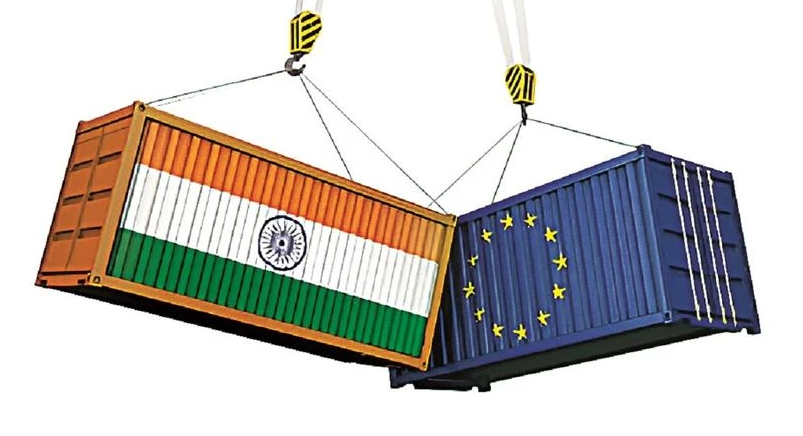
India - EU FTA talks entered a crucial phase as India and the European Union reaffirmed their commitment to a rules-based trading system and a modern economic partnership that protects farmers and MSMEs.
High-level discussions were held in Brussels between India’s Commerce and Industry Minister Piyush Goyal and EU Trade and Economic Security Commissioner Maros Sefcovic. The talks focused on advancing a mutually beneficial Free Trade Agreement while ensuring vulnerable sectors remain protected.
According to officials, the negotiations aim to align economic priorities and strengthen India’s integration into global supply chains without compromising domestic interests.
“We reviewed key areas of the proposed agreement and reaffirmed our commitment to a modern economic partnership that safeguards farmers and MSMEs,” Goyal said after the meeting.
Negotiations Enter a Critical Stage
The ministerial talks followed a week of intensive technical discussions in Brussels involving senior officials, including Commerce Secretary Rajesh Agrawal and European Commission Director-General for Trade Sabine Weyand.
So far, 16 rounds of India–EU FTA talks have been completed. Officials from both sides have described the current phase as the most challenging, with efforts underway to bridge remaining differences. The upcoming India–EU Summit later this month is expected to add momentum to the negotiations.
Key Trade Demands From Both Sides
India is seeking zero-duty access for labour-intensive sectors such as textiles, garments, and leather. These industries are vital for employment generation and export-led growth.
The European Union, meanwhile, is pushing for tariff reductions on automobiles, medical devices, wines, and spirits. The bloc is also seeking stronger commitments on intellectual property protection.
The proposed trade pact covers 23 policy areas, including goods and services trade, investment, rules of origin, customs facilitation, government procurement, dispute settlement, intellectual property rights, geographical indications, and sustainable development.
Why the India–EU Trade Relationship Matters
The economic significance of the India–EU relationship continues to grow. In 2024–25, bilateral trade in goods reached USD 136.53 billion, making the EU India’s largest trading partner in goods.
The EU accounts for nearly 17 percent of India’s total exports, while India has emerged as an important market for European manufacturers. Sectors such as pharmaceuticals, ready-made garments, steel, petroleum products, and electrical machinery are expected to gain competitiveness if the agreement is finalised.
Looking Ahead
India and the EU resumed FTA negotiations in 2022 after a nine-year pause caused by disagreements over market access. With global trade increasingly shaped by geopolitical shifts, supply chain realignments, and rising protectionism, both sides now see strategic value in concluding the deal.
If successful, the India–EU Free Trade Agreement could become one of the most significant trade pacts of the decade, reshaping economic ties between two of the world’s largest markets and setting new benchmarks for inclusive and sustainable trade.