
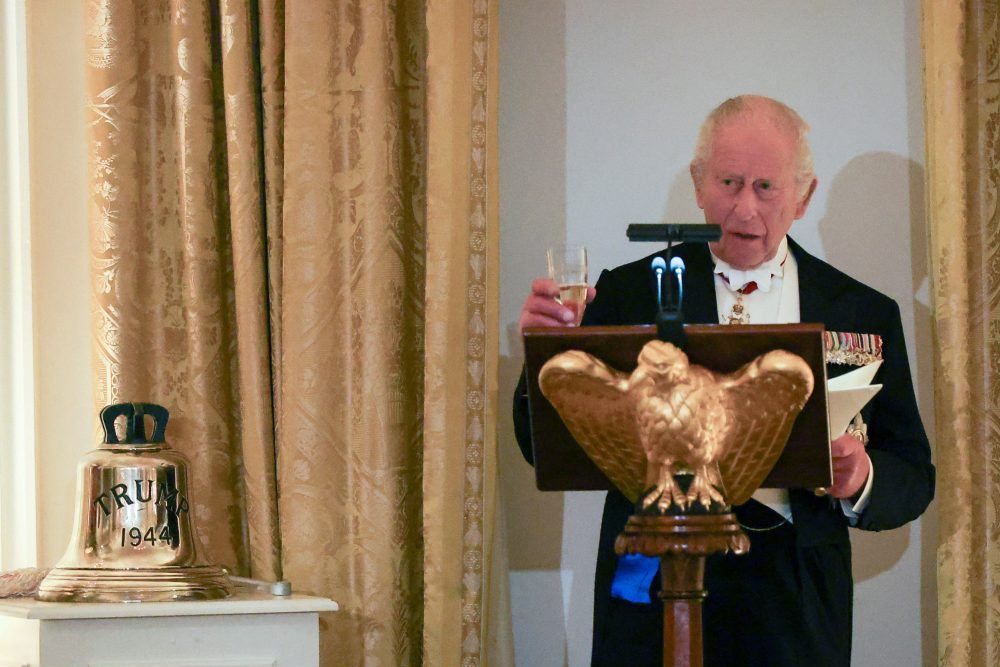
King Charles and Queen Camilla arrived in New York on Wednesday to commemorate the victims of the September 11, 2001 terrorist attacks as part of a four-day state visit to the United States that has already produced some of the most diplomatically significant and publicly watched royal engagements in recent memory, coming at a moment of genuine and visible tension in the relationship between Washington and London over the Iran war and the broader questions of Western military alliance solidarity that have become the defining geopolitical preoccupation of the current period in transatlantic relations. The King charles New York leg of the royal visit follows a packed and consequential day in Washington on Tuesday during which Charles delivered a speech to a joint meeting of the United States Congress, held private meetings with President Donald Trump at the White House, and sat down with leaders of America's technology industry in a schedule that reflected both the ceremonial weight of the visit and the serious diplomatic substance that the British government and royal household are clearly hoping to advance through the king's presence in the United States at this particularly sensitive moment in the two countries' relationship. The combination of a 9/11 memorial ceremony, a visit to a Harlem community farming initiative, and Queen Camilla's engagement celebrating the centenary of Winnie the Pooh gives the New York day a range of tones and purposes that reflects the breadth of royal soft power as an instrument of bilateral diplomacy and public engagement.
The day in New York begins at the September 11 memorial in lower Manhattan, on the site where the twin towers of the World Trade Center stood before al-Qaeda suicide bombers destroyed them on September 11, 2001 in an attack that killed nearly 2,800 people and permanently altered the trajectory of global geopolitics, American foreign policy, and the transatlantic security relationship that has been the foundation of the special relationship between Britain and the United States that Charles's speech to Congress worked so hard to reaffirm and strengthen. Charles is expected to meet New York City Mayor Zohran Mamdani at the ceremony, combining the solemn act of commemoration with the kind of official civic engagement that royal visits to major American cities traditionally incorporate. The decision to place the 9/11 memorial at the center of the New York itinerary is symbolically significant as a reminder of the moment when the special relationship between the United States and United Kingdom was at its most visible and emotionally intense, with Britain standing alongside America in the immediate aftermath of the attacks and in the military operations that followed, and as an implicit reference point for the kind of alliance solidarity that Charles was advocating in his Congress speech against what he described as the clarion calls to become ever more inward-looking.
A complication from Tuesday's White House state dinner has added an additional layer of diplomatic sensitivity to the royal visit that Downing Street and Buckingham Palace have not yet fully addressed. President Trump suggested at the dinner that Charles had told him he supported an end to Iran's nuclear program, a characterization that, if accurate, would represent an extraordinary departure from the constitutional convention that the British monarch does not express political positions on contentious foreign policy questions that are the responsibility of the elected government rather than the Crown. The king is not a spokesman for the UK government and cannot confirm the policy positions of His Majesty's government, and it could not be confirmed that Charles made the statement attributed to him by Trump. Both Downing Street and Buckingham Palace did not immediately respond to media requests for comment on the reported exchange, leaving the diplomatic ambiguity unresolved in a way that is uncomfortable for a visit whose official purpose of celebrating the 250th anniversary of American independence from British rule was always going to be complicated by the underlying tensions over the Iran war.
How Tuesday's Washington Engagements Set the Diplomatic Tone for the Royal State Visit
The speech that King Charles delivered to a joint meeting of the United States Senate and House of Representatives on Tuesday was the centerpiece of the Washington leg of the state visit and carried a level of diplomatic weight that went well beyond the ceremonial celebration of the 250th anniversary of American independence that provided its official occasion. Charles used the platform of the American legislature to stress the deep historical military and cultural ties between the United Kingdom and the United States in terms that were explicitly designed to reinforce the foundations of the special relationship at a moment when those foundations are under unusual strain from the Trump administration's frustration with British Prime Minister Sir Keir Starmer's approach to the Iran war and from the broader pattern of transatlantic tension that has characterized relations between Washington and several European capitals since Trump returned to the White House. The king's willingness to speak before Congress on these themes, and the warm reception his speech received, reflects the unique position of the British monarchy as a source of relationship continuity and historical depth that transcends the normal diplomatic cycle of changing governments and shifting bilateral relationships.
The most consequential and potentially controversial element of Charles's Congress address was his explicit defense of NATO and his warning against American isolationism at a moment when Trump has been publicly and repeatedly critical of the Western military alliance's reluctance to provide greater military support to the United States in its operations against Iran. Charles told the assembled senators and representatives that he prays with all his heart that the two countries will continue to defend their shared values with partners in Europe and the Commonwealth and across the world, and that they ignore what he specifically called the clarion calls to become ever more inward-looking, a formulation that is unmistakably directed at the isolationist and unilateralist tendencies in current American foreign policy thinking without crossing into the kind of direct political criticism that constitutional convention prohibits a serving British monarch from making. The speech was received with evident appreciation by many of those present and generated significant media commentary about the degree to which a foreign constitutional monarch had chosen to use an address to the American legislature to make an implicit but unmistakable case for a direction of American foreign policy different from the one the current administration is pursuing.
The private meetings between Charles and Trump at the White House, about which only limited information has been officially disclosed, clearly produced the exchange about Iran's nuclear program that Trump referenced at the state dinner and that has become the most diplomatically sensitive aspect of the entire visit. Trump's willingness to publicly attribute a specific political statement about Iran's nuclear program to the British monarch at a formal state dinner was an unusual move that may reflect genuine confusion about the king's constitutional role, a deliberate attempt to leverage the royal visit for domestic political purposes by associating a broadly respected international figure with the administration's Iran policy position, or simply the improvisational quality that often characterizes Trump's public statements about private conversations. Whatever Trump's intent, the effect has been to create a diplomatic complication that the British government and royal household need to navigate carefully given the sensitivity of the Iran question in UK politics and the constitutional importance of maintaining the monarchy's position above partisan political controversy.
What the New York Engagements Reveal About King Charles's Personal Passions and Royal Soft Power
Beyond the formal diplomatic dimensions of the state visit, the New York itinerary gives Charles the opportunity to pursue the grassroots community and environmental engagements that have been genuine personal passions throughout his public life and that represent a different and in some ways more authentic dimension of the royal visit than the congressional addresses and White House state dinners that dominate the diplomatic schedule. His visit to Harlem to meet with a community organization that has created a sustainable after-school urban farming initiative to combat food insecurity reflects a decades-long interest in sustainable agriculture, community food systems, and the kind of grassroots environmental action that Charles was advocating long before mainstream political and corporate opinion caught up with the urgency of these issues. The king's engagement with this kind of community-level sustainability initiative in one of New York City's historically significant and culturally rich neighborhoods represents exactly the kind of soft power royal visit engagement that generates genuine goodwill and human connection beyond the formal diplomatic protocol that governs the state visit's official elements.
Queen Camilla's separate engagement in New York, celebrating the centenary of A.A. Milne's beloved fictional character Winnie the Pooh on behalf of her charity The Queen's Reading Room, which Buckingham Palace described as a literary engagement event, reflects the way in which modern royal state visits are structured to deploy both members of the royal couple simultaneously in different settings to maximize the breadth of engagement and the range of communities and interests that the visit touches during its limited time. Camilla's Queen's Reading Room charity has focused on promoting reading and literacy as foundations of individual flourishing and social cohesion, and the Winnie the Pooh centenary provides a genuinely joyful and universally accessible occasion for an engagement that connects with the charity's core mission while also generating the kind of warm and widely appealing media coverage that contributes to the positive impression of the British royal family in American public opinion. The combination of Charles's farming initiative visit and Camilla's literary event ensures that the New York day of the state visit reaches beyond the commemorative solemnity of the 9/11 memorial ceremony into the full range of community, cultural, and personal engagement that gives royal visits their distinctive character as instruments of diplomatic relationship building.