
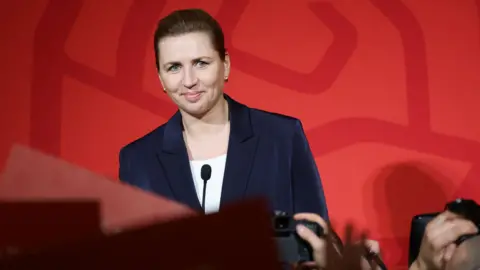
Denmark Frederiksen coalition talks are set to begin after Prime Minister Mette Frederiksen's Social Democratic Party suffered its most devastating election defeat in over a century, winning just 38 seats in the 179-seat parliament down from 50 seats four years ago amid widespread voter anger over migration, a deepening cost-of-living crisis, and concerns about welfare services that domestic voters placed far above any foreign policy consideration. Frederiksen is expected to hand in her coalition government's formal resignation on Wednesday, setting in motion a process of individual consultations with the king and party leader negotiations that could take weeks to produce a functioning government. Despite being Tuesday's biggest electoral loser, she remains the favourite to emerge as prime minister again a paradox that captures everything distinctive and complicated about Denmark's current political moment.
The result places Frederiksen in a position that has no clean precedent in modern Danish politics leading a party that just recorded its worst performance in 123 years while simultaneously being the most plausible candidate to form the next government. Her left-wing bloc won 84 seats against 77 for the right-leaning parties, with neither side reaching the 90-seat threshold required for a parliamentary majority. That arithmetic makes the 14 seats held by the unaligned Moderates Party of Foreign Minister Lars Lokke Rasmussen the decisive factor in government formation a centrist bloc with genuine kingmaker status whose preferences will shape what kind of coalition emerges and on what policy terms.
The election result delivers a clear message about what Danish voters prioritised at the ballot box and it was not Greenland, not Trump, and not foreign policy. Frederiksen's defiant stance toward U.S. President Donald Trump's repeated ambitions to acquire Denmark's semi-autonomous Arctic territory earned her international attention and domestic approval ratings that political analysts expected to translate into electoral reward. Instead, voters expressed their priorities through the issues that affect their daily lives directly the cost of groceries, the state of hospitals and schools, and the management of migration and judged her government's record on those domestic measures as insufficient. The international headlines did not save her majority; the supermarket price tag and the hospital waiting list did.
How Frederiksen Built Her Coalition and Why It Collapsed
Frederiksen entered her current term leading one of the most unusual governing arrangements in Danish political history a grand coalition that bridged the traditional left-right divide by combining her Social Democratic Party with the right-of-centre Liberal Party and the centrist Moderates. The coalition was constructed on the logic that the political centre could hold together long enough to govern effectively on defence, migration, and economic management even when the parties disagreed on social and welfare priorities. It was an arrangement that required constant negotiation and compromise, and its survival over three years represented a genuine political achievement in a parliamentary system where such cross-bloc arrangements are inherently fragile.
The Social Democrats' historic positioning in Danish politics has been as the party of the welfare state the architects and guardians of the universal healthcare, education, and social support systems that define the Nordic model and enjoy deep public attachment across the Danish electorate. Frederiksen's decision to govern with right-of-centre partners required accepting compromises on welfare spending and social policy that created tension with her party's traditional voter base. Those voters did not disappear or abandon their priorities they expressed them through Tuesday's ballot, withdrawing support from a party they felt had drifted too far from its foundational commitments in exchange for the access to power that coalition government provided.
The Liberal Party's decision, announced by Defence Minister Troels Lund Poulsen, to no longer pursue coalition government with Frederiksen removes one of the three pillars of the existing coalition and fundamentally changes the arithmetic of the next government formation. Poulsen's statement that he was no longer interested in coalition rule with Frederiksen is both a political calculation positioning the Liberals to maximise their influence in a new arrangement and a personal declaration that carries consequences for the negotiations ahead. Whether his rejection of Frederiksen specifically reflects policy disagreements, personal political ambition, or a reading of the electoral mood that sees greater opportunity in opposition or in a different coalition configuration will shape how the coming weeks of government formation unfold.
Migration, Cost of Living, and the Domestic Issues That Decided the Election
The Danish electorate's decision to punish Frederiksen's government on domestic policy grounds rather than reward her on foreign policy grounds reflects a pattern visible across European democracies in recent years voters consistently prioritise the immediate economic and social pressures they experience in daily life over the geopolitical narratives that dominate elite political conversation and international media coverage. Migration has been a defining issue in Danish politics for two decades, and Frederiksen's Social Democrats made a strategic decision in her first term to adopt a significantly stricter approach to asylum and immigration than the traditional centre-left position a move designed to neutralise the issue for right-wing parties by removing the policy differentiation that had driven voter migration to them.
Welfare concerns the condition of hospitals, the adequacy of elderly care, the quality of schools and childcare form the deepest layer of Social Democratic voter identity in Denmark, and it is on this terrain that the Tuesday result suggests the most serious disconnect emerged between the government's record and voter expectations. The paradox that analysts identified Frederiksen as the election's biggest loser who remains the favourite to be the next prime minister exists precisely because her party's weakness on these issues did not destroy it but merely reduced it, while the alternative blocs remain too divided and too short of seats to form a government without her. She is indispensable not because she won but because nobody else won either.
That strategy achieved its tactical purpose for a period but created its own contradictions. Social Democratic voters who supported the party for its welfare commitments found themselves governed by a migration policy that felt more consistent with the right than the left, while right-leaning voters who might have been attracted by the migration stance found no reason to abandon their natural parties when the policy was already being implemented. The cost-of-living crisis that spread across Europe following the energy shock and supply chain disruptions of recent years added another pressure point Danish consumers facing higher food, energy, and housing costs expected their government to prioritise the economic relief that makes the welfare state tangible and personal. Voter judgement on that front was clearly negative.
Denmark's Relationship With Trump and the Greenland Factor
Donald Trump's repeated assertion of U.S. interest in acquiring Greenland Denmark's semi-autonomous Arctic territory with enormous strategic, resource, and geopolitical significance dominated international coverage of Danish politics in the months before the election and gave Frederiksen a platform on which she performed consistently well. Her responses to Trump's statements were measured, firm, and internationally praised for maintaining Danish sovereignty without unnecessarily inflaming relations with Washington at a moment when European security depends on continued U.S. engagement with NATO. Danish voters approved of her tone and her substance on the Greenland question but they did not let that approval override their assessment of her domestic record.
The Greenland issue matters beyond its immediate electoral context because it will continue to shape Danish foreign and security policy regardless of who leads the next government. Any incoming prime minister must manage the ongoing tension between maintaining the U.S. relationship that Danish security requires and defending Danish sovereignty over a territory that Trump has repeatedly described as something the United States intends to have. Frederiksen navigated that tension with considerable skill and international credibility experience and capital that are not easily transferred to a new leader without the same established personal relationship with European counterparts and international institutions.
The defence dimension of the Greenland question connects to Denmark's broader NATO commitments and the significant increase in defence spending that European members of the alliance have undertaken in response to pressure from Washington and the security environment created by the Ukraine war. Defence Minister Troels Lund Poulsen the Liberal Party leader who has now said he will not continue in coalition with Frederiksen has been central to that defence policy management, creating an irony in which the person who helped deliver one of the coalition's most internationally recognised achievements is now the obstacle to its continuation. The incoming government, whatever its composition, will inherit both the foreign policy challenges and the defence spending commitments that the outgoing coalition established.
Resignation, Royal Consultations, and the Path to a New Government
Frederiksen's expected resignation submission on Wednesday initiates Denmark's constitutional process for government formation a process that begins with party leaders attending a traditional day-after parliamentary debate, then proceeds to individual meetings with King Frederik X, who has no formal executive powers but plays the ceremonial and consultative role of suggesting which party leader should be given the first mandate to attempt forming a government. The king's suggestion in a hung parliament like this one is shaped by the parliamentary arithmetic which bloc has the most seats, which party leader has the broadest cross-party support, and which candidate has the most plausible path to assembling a majority or a working minority government.
Given that Frederiksen's left-wing bloc holds 84 seats against the right's 77, and that the Social Democrats remain the single largest party with 21.9 percent support, the king is widely expected to suggest Frederiksen as the first candidate to attempt government formation. That mandate does not guarantee success it gives her the formal authority and the political moment to test whether she can assemble a workable coalition from the available parties, and other leaders will receive their own consultative meetings before and after that process. Political analyst Noa Redington captured the paradox succinctly, describing Frederiksen as the huge loser of the election who remains the favourite to become the next prime minister a formulation that is accurate, ironic, and entirely consistent with how parliamentary coalition systems produce their outcomes.
The timeline for government formation in Denmark following a hung parliament result of this complexity is measured in weeks rather than days. The 2022 coalition took several weeks of negotiation to finalise despite a clearer initial mandate, and the current situation with neither bloc at majority, the Liberals having explicitly ruled out governing with Frederiksen, and the Moderates holding kingmaker status is structurally more complicated. Each party entering negotiations carries its own voter expectations and red lines, and the policy compromises required to assemble a working majority across parties with genuinely different priorities on migration, welfare, and fiscal policy will require time, political capital, and creative institutional solutions that cannot be rushed without undermining their durability.
The Moderates as Kingmakers and Lars Lokke Rasmussen's Strategic Position
The Moderates Party's 14 seats represent the most consequential single bloc in Danish politics right now, and Foreign Minister Lars Lokke Rasmussen who founded the party and leads it finds himself in a position of extraordinary leverage that few Danish politicians have occupied. Both the left-leaning bloc led by Frederiksen and the right-leaning bloc need the Moderates to reach the 90-seat majority threshold, meaning Rasmussen can in theory choose which direction the next government tilts based on the policy concessions and ministerial positions he can extract from each side. His decision will shape not just the composition of the next cabinet but the policy direction of Danish governance on the domestic issues migration, welfare, fiscal management that the electorate identified as its priorities on Tuesday.
Rasmussen is not a straightforward right or left figure the Moderates were explicitly founded as a centrist alternative to the traditional bloc politics that has characterised Danish parliament for generations, and their positioning between the blocs is both a principled statement about political culture and a practical mechanism for maximising influence. His experience as a former prime minister and long-serving politician gives him a thorough understanding of how coalition negotiations work and what each party actually needs versus what it publicly demands. That knowledge makes him a sophisticated negotiating partner for Frederiksen or any right-leaning alternative, and his reading of what the electorate wants based on Tuesday's results will inform what conditions he sets for Moderates participation in any new government.
The Moderates' kingmaker status creates a specific incentive for both Frederiksen and the right-leaning bloc to offer Rasmussen policy concessions and portfolio positions that would not be available if either side had won an outright majority. For Frederiksen, the challenge is that the Moderates' centrist positioning makes them a more natural coalition partner than the further-left parties in her bloc, but their policy preferences on migration and fiscal conservatism may conflict with what those further-left parties need to justify their own participation. Assembling a majority that satisfies the Moderates, the Social Democrats, and the left-wing parties simultaneously without giving contradictory policy commitments to different partners is the central challenge of the government formation process that begins in earnest on Wednesday.
What Comes Next and What It Means for Danish Domestic Policy
The government that emerges from these coalition negotiations will inherit a domestic policy agenda shaped by the electoral verdict that welfare, migration, and cost-of-living management are the issues Danish voters care most about a mandate that cuts across traditional party lines and creates both opportunities and constraints for any governing combination. A Frederiksen-led government that emerges from these talks will need to demonstrate that it has heard the message embedded in her party's worst result in 123 years and recalibrated its priorities accordingly, or it will face the same voter judgement at the next election from a starting position of even greater weakness.
The Liberal Party's exit from potential coalition with Frederiksen does not foreclose all options for a broad centrist government other combinations involving the Moderates and selected parties from either bloc are possible if the policy arithmetic can be made to work. The key variable is whether Rasmussen and the Moderates conclude that their interests are better served by enabling Frederiksen to lead a left-leaning majority government with Moderates participation, or by supporting a right-leaning alternative that would require the Liberals and other right-wing parties to either set aside their own divisions or accept Moderates policy conditions as the price of power. Neither path is clean, and both involve compromises that will be tested by the first serious domestic policy crisis the new government faces.
Denmark's international profile its NATO commitments, its Greenland sovereignty challenge, its role in European Union policy will be managed during a period of domestic political transition that may last several weeks. Frederiksen's personal relationships with European leaders and her established credibility on defence issues represent continuity assets that matter during a period when European security architecture is under significant stress from multiple directions simultaneously. Whether those assets ultimately prove sufficient to carry her through the coalition negotiations and back to a third term as prime minister is the question that Danish politics will be answering in the weeks ahead — one conversation with the king, one party meeting, and one carefully crafted compromise at a time.