
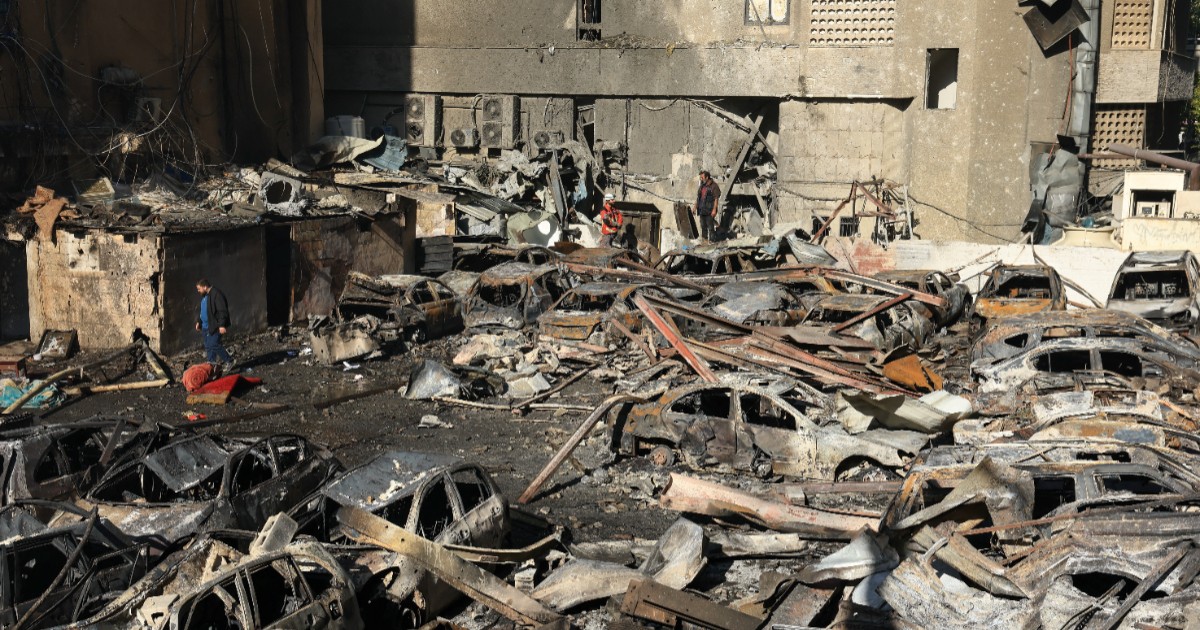
Israel Lebanon strikes ceasefire jeopardised in the most serious threat yet to Donald Trump's announced truce as Israel bombed additional targets in Lebanon on Thursday following its biggest attacks of the war on its neighbour, which killed more than 250 people in strikes on heavily populated areas without the customary warnings for civilians to flee that have been a standard feature of previous Israeli military operations. The attacks came even as Iranian negotiators prepared to leave for Pakistan on Thursday for the first direct peace talks of the war, where they are scheduled to meet a U.S. delegation led by Vice President JD Vance on Saturday in a diplomatic breakthrough that the ceasefire announcement was supposed to have facilitated. The contradiction between a ceasefire announced by Trump on Tuesday night and Israeli military operations that continued through Wednesday night and Thursday morning has created a diplomatic crisis at the very outset of the peace process, with Iran, Pakistan, Britain, France, and a host of other countries saying the truce should extend to Lebanon while Israel and Washington insist Lebanon is not covered by the deal.
The human cost of the Lebanon strikes is accumulating in ways that the diplomatic conversation cannot obscure. Naim Chebbo, a Beirut resident who has lived in his home for more than 51 years, swept shattered glass and debris from his house after Israeli strikes destroyed the building next door, telling reporters simply: this is my place, this is my house, see what is destroyed. Rescuers across Lebanon worked through the night to pull wounded people from the rubble of destroyed buildings hit in heavily populated areas, and Lebanese state media reported strikes on Beirut's southern suburbs before midnight and at dawn and attacks on towns across the south through Thursday morning. The Israeli military confirmed it had killed the nephew of Hezbollah Secretary-General Naim Qassem, who had served as the leader's personal secretary, and struck river crossings used by the group in overnight operations.
The physical oil market has delivered its own verdict on the ceasefire's fragility. While futures contracts for May and June oil delivery have eased since Trump's Tuesday announcement on expectations that blocked Gulf oil would soon resume flowing, the price of physical oil for immediate delivery has shot up to record levels near $150 a barrel as refineries across Europe and Asia struggle to meet demand with a fifth of global supply knocked out for a month and a half. The gap between futures prices reflecting ceasefire optimism and physical prices reflecting the actual supply crisis that has not yet been resolved is one of the clearest market signals available about the gap between Trump's declared victory and the operational reality of a war whose core disputes remain entirely unresolved.
The Ceasefire Announcement, Lebanon's Disputed Status, and the War's Unmet Objectives
Trump announced the ceasefire on Tuesday night, hours before a deadline he had set for Iran to unblock the Strait of Hormuz or face what he threatened would be attacks to destroy Iran's whole civilisation, a rhetorical escalation that had created intense pressure on all parties to find some form of diplomatic pause before the threatened military action materialised. The announcement came in the form of a declared truce that Trump characterised as a victory for American diplomacy and military pressure, pointing to the Pakistan-mediated diplomatic process that had produced Iran's willingness to send negotiators to the Saturday talks as evidence that his maximum pressure strategy had achieved its objectives. The Tuesday night announcement was designed to be the turning point in a six-week war that had created the worst global energy supply disruption in history, and for approximately twelve hours it appeared to have achieved that status.
The immediate complication was that Israel, which had invaded Lebanon in parallel with the war on Iran to root out the Iranian-backed Hezbollah movement, immediately declared that the Lebanon theatre of operations was not covered by the ceasefire and launched its biggest attacks of the war on the country within hours of Trump's announcement. Washington backed Israel's position, with U.S. officials confirming that the truce applied to the Iran conflict but not to Lebanon, a distinction that Iran, Pakistan as mediator, and a wide range of international observers rejected as inconsistent with their understanding of what had been agreed. The competing characterisations of what the ceasefire covered were not a minor interpretive dispute but a fundamental disagreement about whether the deal had actually been struck or whether one party was already in material breach of it before the ink was dry.
Iran's Iranian deputy foreign minister Saeed Khatibzadeh described the Israel Lebanon attacks as a grave violation and a catastrophe that could end in more catastrophe, using BBC Radio to characterise Israel's behaviour across the Middle East as the rogue behaviour of a state whose actions threatened to undermine the diplomatic process at its earliest and most vulnerable moment. His comments reflected Iran's official position that Lebanon is explicitly part of the ceasefire deal and that Israel's attacks constitute a breach that Tehran cannot ignore, while simultaneously maintaining that Iran would proceed with the Pakistan peace talks despite the provocation, threading the needle between expressing outrage and abandoning the diplomatic process that both sides had agreed to enter. That needle threading represents the diplomatic tightrope that Iran's negotiators will walk in Islamabad as they engage with Vance's delegation while Israeli operations in Lebanon continue.
The Six-Week War and What Washington Did and Did Not Achieve
The conflict that began on February 28 with U.S. and Israeli strikes on Iran and has now entered its seventh week has produced extraordinary human, economic, and geopolitical consequences while falling short of the stated objectives that Washington articulated at its outset. Trump had justified the war with three specific aims: eliminating Iran's ability to attack its neighbours, destroying Iran's nuclear programme, and creating conditions that would make it easier for Iranians to topple their government. None of these objectives have been fully achieved, and the ceasefire announcement came without any verified mechanism for ensuring that the war's core purposes had been accomplished before the military pressure was paused.
Iran still possesses missiles and drones capable of targeting its neighbours, demonstrated throughout the conflict's six weeks by sustained strikes on Israeli cities, U.S. military bases, and Gulf Arab energy infrastructure. The nuclear programme has been damaged by the June 2025 U.S. strikes and by additional attacks during the current conflict, but Iran retains more than 400 kilograms of highly enriched uranium, enough material for multiple nuclear devices if further enriched to weapons grade, and the institutional and human capital of its nuclear programme cannot be eliminated by airstrikes regardless of how effectively they damage physical facilities. The clerical government, which had faced a mass uprising just months before the war began, survived the superpower military assault with no sign of organised domestic opposition, its legitimacy among its core constituencies consolidated by the narrative of resistance that the war had enabled.
The Strait of Hormuz closure, which has caused the worst disruption to global energy supplies in recorded history and sent physical oil prices to near $150 a barrel, has not been formally lifted as of Thursday despite the ceasefire announcement. Iran has demonstrated through six weeks of war its ability to exert control over the strait despite the massive U.S. military presence in the region that was built specifically to prevent exactly this kind of energy supply disruption. The strait's status as the world's most critical energy chokepoint, through which a fifth of global oil and gas supply normally transits, remains the central economic lever of the conflict, and Iran's control over its reopening is the primary bargaining chip Tehran carries into the Pakistan talks.
Iran's Domestic Mourning and the Political Context for the Peace Talks
The enormous crowds that turned out in Tehran and across Iran on Thursday for the commemoration marking 40 days of mourning for Supreme Leader Ayatollah Ali Khamenei, killed on the war's first day, provide a specific window into the domestic political context within which Iran's negotiators will engage with Vance in Pakistan. The 40-day mourning commemoration is a deeply significant ritual in Shia Islamic tradition, and the mass participation in the ceremonies across Tehran, Kermanshah, Yazd, and Zahedan signals both genuine popular grief for the fallen leader and the regime's successful channelling of that grief into a narrative of sacrifice and resistance that has consolidated rather than fractured its domestic political position. State television showed crowds carrying Iranian flags and portraits of both Ali Khamenei and his son and successor Mojtaba, with a large Hezbollah flag visible on one building, the Shia solidarity message of the commemoration extending explicitly to Lebanon.
The funeral procession in Shiraz for Revolutionary Guards' intelligence chief Majid Khademi, killed in an Israeli strike in his home province of Fars, added another dimension of sacrifice and loss to the commemoration day, with the mourning for individual IRGC officers killed in the conflict being integrated into the broader narrative of national resistance that the regime has successfully cultivated throughout six weeks of unprecedented military pressure. Iranian officials including atomic chief Mohammad Eslami and roads minister Farzaneh Sadeq attended the Tehran commemoration events, demonstrating institutional continuity and government solidarity at a moment when the regime was simultaneously preparing to send negotiators to Pakistan for talks whose outcome could define Iran's strategic position for a generation.
The commemoration's scale and emotional intensity matters for the Pakistan peace talks because it establishes the domestic political baseline from which Iran's negotiators must operate. A negotiating team that returns from Islamabad with a deal that Iranian public opinion reads as capitulation to the enemies who killed the Supreme Leader and bombed Iranian cities for six weeks would face a domestic reception very different from one perceived as having achieved an honourable outcome that ends the war while preserving Iran's core strategic interests. The ceremonial mourning that fills Iranian streets on Thursday is the political context that Khatibzadeh and his colleagues carry with them to Pakistan, and it constrains the concessions they can make while creating the political space for an agreement that Iran's leadership can present as a principled diplomatic outcome rather than a defeated nation's surrender.
The Pakistan Talks, Lebanon's Burning, and the Oil Market's Signal
The Saturday meeting in Pakistan between Iranian negotiators and the U.S. delegation led by Vance represents the highest-level direct diplomatic contact between Washington and Tehran since before the war began, and its significance extends beyond whatever specific agreements it might produce to the simple fact of its occurrence. For six weeks, the two countries have communicated primarily through military operations, official denials of negotiations, and back-channel communications whose existence both parties maintained varying degrees of deniability about. The Pakistan framework, mediated by Prime Minister Shehbaz Sharif who has cultivated relationships with both sides, has created the institutional structure for a direct conversation about how the war ends and on what terms.
The core issues that Saturday's talks must address are precisely the ones that remain most contested between the parties. The 15-point U.S. proposal, whose terms include Iran's enriched uranium removal, enrichment halt, missile programme curbs, and effective Hormuz control transfer, represents Washington's stated position, but the gap between those demands and what Iran can accept domestically while maintaining any credibility with its own population is the negotiating terrain that Vance and his Iranian counterparts must traverse. Iran's position that it will not negotiate under military pressure, and that the Lebanon attacks by Israel constitute a breach of the ceasefire conditions under which it agreed to attend the talks, adds a procedural complication to the substantive negotiations that must be resolved before either side's core demands can be seriously addressed.
Pakistan's role as host and mediator gives Islamabad a specific diplomatic significance in Saturday's talks that goes beyond protocol. Pakistan's ability to maintain the trust of both parties simultaneously, to manage the communication channels that brought both delegations to Islamabad, and to provide the political cover that allows both Iran and the United States to engage in direct talks without either side being seen as capitulating to a meeting demanded by the other, makes the Pakistani mediation infrastructure as important as any specific proposal either delegation brings to the table. Prime Minister Sharif's investment in this process reflects Pakistan's genuine national interest in a resolution that ends the energy crisis devastating its own economy while demonstrating that Islamabad can play a constructive regional diplomatic role that enhances its strategic standing with both the United States and Iran.
Lebanon's Status, Hezbollah's Response, and the Ceasefire's Contested Scope
Hezbollah's announcement on Thursday morning that it was resuming attacks on Israel, firing once across the border and twice at Israeli forces in southern Lebanon, followed its initial statement that it would pause attacks in line with the ceasefire and represents the armed group's response to the continuation of Israeli military operations in Lebanon that the ceasefire was supposed to have halted. The resumption of Hezbollah attacks and Israel's continuing Lebanon operations create a feedback loop of military action that threatens to escalate beyond the Lebanon-specific context into the Iran-Israel and Iran-U.S. dimensions of the conflict that the ceasefire was supposed to be addressing. If Hezbollah attacks Israeli territory in ways that Israel then uses to justify expanded military operations, and if those operations produce Iranian reactions that Tehran characterises as incompatible with the peace talks proceeding, the Pakistan diplomatic process could collapse before it produces anything substantive.
Britain and France's condemnation of Israel's Lebanon attacks, joined by a host of other countries, reflects the international community's reading that the ceasefire's credibility requires a consistent geographic scope that Israel's Lebanon operations are destroying. U.S. allies who publicly contradict Washington's position that Lebanon is not covered by the truce are sending a signal that the diplomatic coalition that would need to sustain any peace agreement is not aligned on the basic terms of what has been agreed, a fragmentation that weakens the pressure on both Israel and Iran to deliver on the ceasefire's promise. The willingness of Britain and France to publicly contradict the U.S. position on Lebanon's coverage reflects the depth of European concern about an extended conflict whose energy market consequences they are bearing directly in the form of physical oil prices near $150 a barrel.
The physical oil market's record prices for immediate delivery, reaching near $150 a barrel as European and Asian refineries struggle with six weeks of Hormuz closure, are the economic pressure that makes the Saturday Pakistan talks more urgent than any diplomatic preference for engagement would alone produce. Futures markets have eased on ceasefire optimism, but the physical market is reflecting the operational reality that the Hormuz blockade has not been lifted and that the global supply crisis continues regardless of what diplomatic announcements have been made. Iran's continued control over the strait, and its explicit statement that there would be no deal as long as Israel was striking Lebanon, means that the economic relief that markets have begun to price in depends on a diplomatic resolution that the Lebanon situation is actively threatening to prevent.