
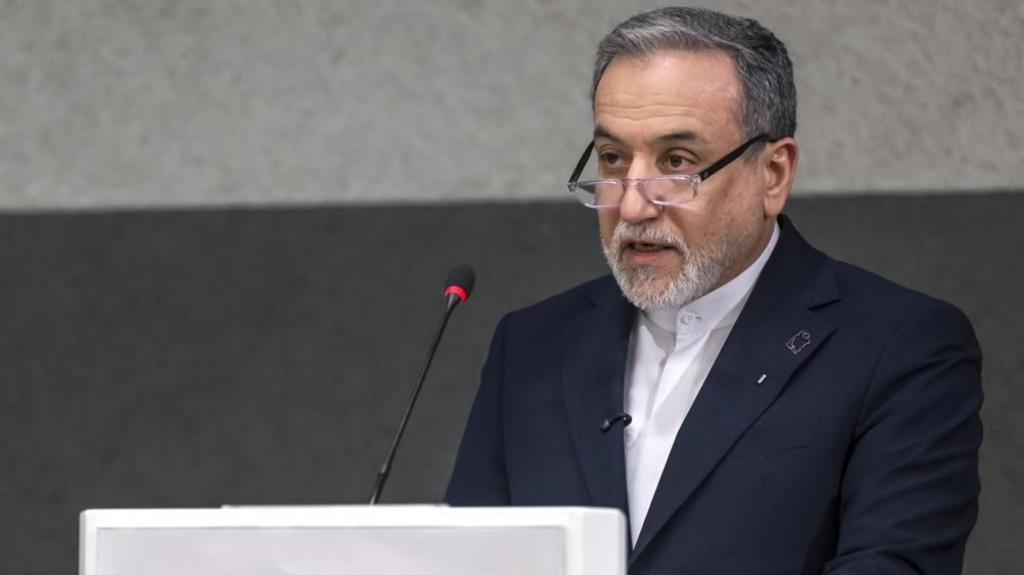
Iran talks rejected trump Blackout by Tehran's leadership on Wednesday even as President Donald Trump claimed publicly that Iran was afraid to admit the two sides were already in dialogue a direct and striking contradiction between what Washington is saying and what Tehran is prepared to acknowledge in public. The standoff over whether negotiations are actually happening has become its own front in the war, with Trump asserting that conversations are underway and Iranian officials flatly denying any dialogue exists while simultaneously managing a 27-day government-imposed internet blackout that has cut the country off from the global internet for 624 continuous hours. The digital silence inside Iran confirmed by internet monitoring group NetBlocks as an unbroken state-imposed isolation since February 28 means that the Iranian public is receiving only state-approved information about a conflict that is reshaping their country and their lives in real time.
The internet blackout, which NetBlocks describes as granting access only to those on a state-approved whitelist while rights monitors, independent media, and the public are entirely sidelined, creates a information environment in which the Iranian government controls every domestic narrative about the war, the strikes, the casualties, and the diplomatic situation. Despite that digital wall, the BBC has been able to speak to some Iranians about their experiences including a young Iranian man who described his fears of being conscripted into military service and the recent loss of a close friend killed in an airstrike. That human account, reaching the outside world through whatever channel remained available, puts a personal face on a conflict whose diplomatic and energy market dimensions have dominated international coverage.
The missiles have not stopped. Israel's military reported detecting further missiles fired from Iran toward its territory on Wednesday the sixth time in a four-hour window it had reported incoming strikes. Earlier the same day, Israel's emergency services confirmed that six people were transferred to hospital after a missile struck near the centre of the country. Iran's capacity to continue launching missile attacks into Israel in the war's fifth week, through a period of the most intensive U.S.-Israeli bombardment of the conflict, is itself a strategic message and it is a message that is reaching Israeli civilians, global energy markets, and the G7 foreign ministers meeting in France simultaneously.
How Iran's Internet Blackout and Strait Strategy Were Built
Iran's government-imposed internet blackout that began on February 28 the same day U.S. and Israeli strikes launched Operation Epic Fury was not an improvised response to the outbreak of conflict. It drew on a well-established playbook that Iranian authorities had deployed during previous periods of domestic unrest, most notably during the 2019 and 2022 protest movements when internet shutdowns were used to limit the coordination capacity of demonstrators and prevent real-time documentation of security force actions from reaching international audiences. The technology for implementing nationwide internet restrictions at short notice was already in place because it had been built, tested, and used before the wartime application of that infrastructure required a decision rather than a construction project.
NetBlocks, the international internet monitoring group that tracks connectivity disruptions globally, confirmed in its daily update that Iran had been isolated from the global internet for 624 hours 27 continuous days with access restricted to a state-approved whitelist of domestic services. The practical consequences of that isolation extend beyond political information control to the economic and social fabric of daily life in a country where internet connectivity underpins banking, commerce, communication, and access to information about basic services. Businesses cannot operate normally. Families cannot communicate with relatives abroad. Students cannot access educational resources. The blackout imposes costs on ordinary Iranians that accumulate with each day it continues, creating a form of collective punishment that falls most heavily on the civilians least responsible for the government decisions that triggered the conflict.
The information environment the blackout creates inside Iran is precisely what the clerical establishment needs to manage domestic political pressure during the most intensive foreign military campaign in the Islamic Republic's history. Without access to international media, social platforms, or uncensored information sources, Iranian citizens depend entirely on state television and state-approved domestic news outlets for their understanding of what is happening in the war, how many casualties have been suffered, what the government's diplomatic strategy is, and what conditions would constitute an acceptable end to the conflict. That dependence gives the government extraordinary narrative control at a moment when the ground truth of burning cities, civilian casualties, and economic disruption might otherwise generate public pressure for a negotiated end to the fighting.
Iran's Approach to the Strait of Hormuz as a Selective Weapon
Iran's Foreign Minister Abbas Araghchi provided the clearest public articulation yet of Tehran's Strait of Hormuz strategy in a televised state TV interview, stating directly that from Iran's perspective the strait is not completely closed but closed to enemies. That formulation selective closure based on political alignment rather than blanket prohibition reveals the strategic logic guiding Iran's maritime policy and explains the selective passage that Iran has already granted to vessels from China, Russia, Pakistan, Iraq, and India. The strait is being used not as a binary open-or-closed weapon but as a precision diplomatic instrument rewarding countries that maintain relationships with Tehran and punishing those aligned with Washington and Jerusalem.
The countries granted passage rights by Iran represent a significant portion of global energy demand and a carefully chosen diplomatic signal. China and India together consume enormous volumes of Gulf crude, and granting them passage while denying it to vessels from Western-aligned nations creates an immediate economic incentive for both powers to resist U.S. pressure for tougher action against Iran. Russia, already in a strategic partnership with Tehran through the Ukraine-era realignment of Russian foreign policy, receives passage as confirmation of that alliance. Pakistan and Iraq, both of which maintain complex relationships with multiple regional powers, receive passage as diplomatic encouragement toward neutrality or tacit support. The list of who gets through the strait is a map of Iran's diplomatic priorities.
The Iranian parliament's reported consideration of legislation to levy tolls for passage through the Strait of Hormuz adds another dimension to Tehran's maritime strategy moving from selective closure toward a formal monetisation of the waterway that would institutionalise Iranian control over the strait's use as a permanent feature of international maritime law rather than a wartime emergency measure. The head of the parliament's construction committee acknowledged that a draft has been prepared but has not yet reached the stage of a full bill, and that the stated aim is to provide security for passing vessels. The toll mechanism, if enacted, would represent a fundamental assertion of Iranian sovereignty over an internationally recognised shipping lane that would face immediate legal challenge from the United States, European Union, and international maritime bodies.
How US-Iran Diplomatic Contradiction Became Its Own Battleground
The contradiction between Trump's assertion that Iran is afraid to admit to ongoing talks and Tehran's flat denial of any dialogue represents a specific and consequential diplomatic battleground that has opened alongside the military one. Trump's claim made to reporters and framed around Iranian fear rather than American engagement serves a domestic political purpose by allowing him to project diplomatic momentum without committing to a specific negotiating framework or acknowledging the significant gap between what Washington is demanding and what Tehran is prepared to accept. The framing of Iran as afraid rather than refusing positions the absence of acknowledged dialogue as Iranian weakness rather than Iranian resistance.
Iran's categorical rejection of the negotiations narrative serves an equally important domestic political function. For a revolutionary government whose legitimacy is built on resistance to American power, acknowledging dialogue with an enemy that has been bombing Iranian cities for twenty-seven days would require managing accusations of capitulation from within the clerical establishment, the Revolutionary Guards, and the domestic political factions whose support the government needs to maintain. Iranian Foreign Minister Araghchi's state TV interview the most detailed public statement from a senior Iranian official in days addressed the Strait of Hormuz and passage rights without acknowledging any diplomatic engagement with Washington, a careful omission that maintains the government's official posture while allowing back-channel processes to continue without public acknowledgment.
UK Defence Secretary John Healey's comments to BBC Radio 4 offered the most candid external assessment of where the diplomatic situation actually stands, acknowledging directly that the plans for ending the war are being developed but that there is not granular detail at the moment. That phrase no granular detail is a diplomatic admission that the end-state planning which should precede or accompany a military operation of this scale has not yet been completed, four weeks into a conflict that has closed the world's most important energy corridor. Healey framed the positive element as the fact of conversations happening between the U.S. and Iran at all, describing that development as something that has got to be welcome regardless of what those conversations are producing in concrete terms.
Missiles, Tolls, and the Diplomacy of a Fractured Strait
Wednesday's missile exchange between Iran and Israel reached an intensity that the Israeli military's reporting rhythm made viscerally clear six separate notifications of incoming Iranian missiles in a four-hour window, each requiring alert activation, interception attempts, and damage assessment across a country whose population has been living under missile threat for five weeks. The six people hospitalised after a missile struck near Israel's centre represent the human cost visible in a single incident, and that incident was one of six reported in four hours on a single Wednesday of a conflict that has been running for nearly a month. The cumulative physical and psychological toll on Israeli civilians of sustained missile bombardment is not captured by any single day's casualty count.
Iran's continued capacity to launch multiple missile waves against Israeli territory in the war's fifth week challenges the Israeli and U.S. narrative that the strikes constituting Operation Epic Fury have significantly degraded Iran's offensive weapons capability. The Pentagon described its Tuesday strikes as the most intensive of the war so far, and Israel has struck cruise missile production facilities in Tehran specifically to reduce Iran's capacity to sustain this kind of sustained offensive. Wednesday's six-wave missile barrage suggests that either Iran's stockpiles remain larger than U.S. and Israeli intelligence assessed, that production has continued despite the strikes on manufacturing facilities, or that Iran had dispersed and concealed sufficient weapons before the war began to sustain a prolonged campaign regardless of what strikes on known production sites can achieve.
UK Defence Secretary Healey's call for creating options beyond the military reflects a growing European and international consensus that the military track alone is not producing a resolution at a pace that the global energy crisis can sustain. His statement that bringing shipping back to the Strait of Hormuz requires a path to ending the conflict rather than purely military pressure acknowledges what ING analysts and energy economists have been saying since the closure began that the economic problem is inseparable from the political one, and that strategic reserve releases and demand reduction measures buy time without addressing the fundamental supply disruption. The options beyond the military that Healey referenced are diplomatic by definition, and their development is the work of the G7 meeting in France this week.
Iran's Internet Blackout and the Human Stories Breaking Through
Despite 27 days of government-imposed internet isolation, the BBC's ability to reach some Iranians inside the country provides fragmentary but humanly significant windows into how the war is being experienced by ordinary citizens with no say in the decisions that started it. The young Iranian man who described his fears of military conscription and the loss of a close friend in an airstrike represents a generation of Iranians whose lives have been fundamentally disrupted by a conflict between their government's revolutionary ideology and the military power of the United States and Israel. His fears about conscription are not abstract Iran's military has the legal authority to mobilise civilian men, and the five-week duration of an intensive war creates pressure on military manpower that the regime may eventually choose to address through expanded conscription.
The information that does reach the outside world from Iran is almost entirely mediated through state television and state-approved outlets, creating a systematic distortion in the available picture of what the war looks like from inside the country. State media reports the strikes, the casualties, and the military operations through a frame that emphasises resistance, sacrifice, and the injustice of foreign attack a frame designed to consolidate domestic support for continued fighting rather than to inform the public about the diplomatic options that might end the conflict. The 624-hour blackout means that Iranians cannot access the same international reporting about what the 15-point U.S. plan contains, what the G7 foreign ministers are discussing, or what back-channel diplomatic processes may be underway information that might shift public opinion on whether continued resistance or negotiated resolution better serves Iranian interests.
The parliament's movement toward Hormuz toll legislation, even at the draft stage, suggests that Iranian institutions are beginning to plan for the medium-term management of the strait's status rather than treating the closure as a temporary wartime measure that ends when the fighting stops. If the Majlis were to enact a toll regime for passage through the strait, it would create a permanent institutional structure for Iranian control over what international maritime law treats as a shared international waterway and dismantling that structure after a ceasefire would require a separate diplomatic negotiation beyond whatever ends the immediate military conflict. The shift from tactical closure to legislative institutionalisation represents a strategic escalation in Iran's Hormuz posture that has not yet received the international attention it deserves.
UK Seeks Options Beyond Military as Path to Hormuz Resolution
Defence Secretary Healey's BBC interview framed the UK's current diplomatic role as working to bring nations together and create options beyond the military a description that positions Britain as an active facilitator of the diplomatic architecture that a conflict resolution would require rather than simply an observer of American and Israeli military decisions. The UK has the advantage of maintaining relationships with parties across the conflict's diplomatic landscape as a NATO ally with deep ties to Washington, as a member of the G7 meeting in France, as a permanent UN Security Council member, and as a country with historical relationships in the Gulf that give it access to conversations not available to the direct belligerents.
Healey's acknowledgment that he does not know what the U.S. is planning to do to end the war saying that plans are being developed but that granular detail is not yet available is the most honest senior official statement about the end-state planning deficit that has characterised the conflict from its beginning. A war that was launched with the stated objectives of destroying Iran's nuclear programme and missile capabilities but that has expanded to include demands for unconditional surrender and regime change has not yet produced a defined political objective that a successful military campaign could achieve and that a ceasefire agreement could institutionalise. Without that defined objective, the development of diplomatic options beyond the military lacks the political endpoint that gives those options meaning and direction.
The commitment from multiple countries that they are ready to contribute to options that could lead to the strait being opened to more shipping represents the beginning of a coalition-building process for post-conflict maritime security arrangements the kind of international framework that would need to be in place before tanker operators and insurance markets would be willing to resume normal transit. Building that coalition, defining its mandate, and negotiating its relationship with Iranian passage conditions is work that must happen in parallel with the diplomatic process aimed at ending the military conflict itself. Healey's framing suggests that the UK sees these tracks as connected rather than sequential that building the post-conflict maritime framework creates incentives for diplomatic resolution by making a viable pathway to economic normalcy visible to all parties, including Iran.