
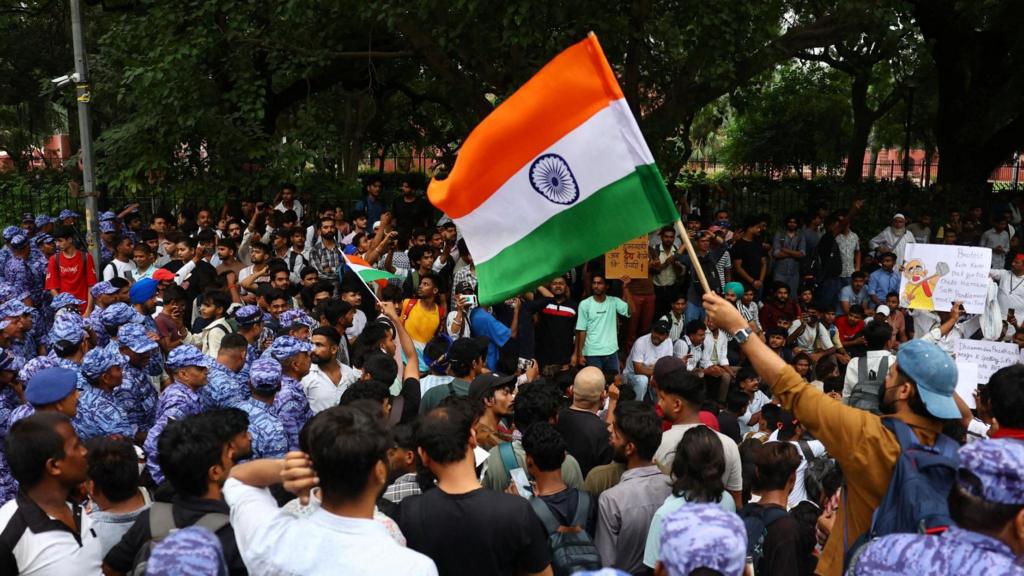
Thousands of young demonstrators marched toward India's parliament in New Delhi on Monday after the Cockroach Janta Party called for a mass protest demanding India education reform reforms to the country's education system. Delhi Police confirmed the march had not been granted permission, but CJP leaders said they would proceed regardless. Hundreds of police officers and paramilitary personnel were deployed around the protest site at Jantar Mantar, forming barricades to contain the crowds. The sheer size of the gathering quickly overwhelmed the venue, with thousands crammed inside and more waiting outside, unable to enter.
The scene at Jantar Mantar was one of controlled tension and enormous energy. CJP founder Abhijeet Dipke was urging protesters to stay put and sit by the police barricades rather than push forward toward parliament. Smaller groups peeled away from the main crowd and used alternate routes through the web of narrow lanes around the site, attempting to get closer to parliament while the organisers and police held the larger crowd in place. Minor scuffles were reported at several points as officers struggled to contain the size of the gathering. The crowd became so dense that even leaving the protest site had grown difficult for those inside.
The protest carries significance beyond its immediate political demands. Large mobilisations converging on the national capital's power centre have become relatively uncommon in India in recent years, amid tighter policing, restrictions on public gatherings, and a fragmented opposition. Mass protests in central Delhi have historically accompanied moments of major political upheaval, from anti-corruption campaigns to the farmers' protests. Monday's march on parliament represents one of the biggest public displays of dissent against Prime Minister Narendra Modi's government seen in the capital in recent years, regardless of its immediate political outcome.
Who are the Cockroach Janta Party and why did India's young people adopt an insult as their symbol of resistance
The Cockroach Janta Party is not a political party despite its name. It is a student-led satirical collective founded by activist Abhijeet Dipke that emerged from widespread anger over alleged paper leaks and irregularities in India's highly competitive national entrance examinations. The movement grew rapidly on social media before translating into street-level organising that culminated in Monday's march on parliament. Its core demands centre on accountability and systemic reform of India's education and examination system, which millions of young people depend on as a pathway to university, employment, and economic stability.
The name has its roots in a remark made by India's Chief Justice during a court hearing, in which the judge compared sections of unemployed young people to "cockroaches." The comment drew immediate public criticism and was later withdrawn. Rather than allowing the insult to pass, CJP founder Dipke seized on it and adopted the cockroach as the movement's mascot, turning a derogatory comparison into a tongue-in-cheek symbol of resilience and defiance. What began as a satirical social media campaign quickly resonated with young Indians who recognised the frustration behind it and the target it had identified.
"You can try to ignore us, but we'll keep coming back."
The message of the Cockroach Janta Party movement, as described by its supporters
The movement's appeal reflects a genuine crisis of confidence in India's examination system. The CJP and affected families have alleged that at least 20 students died by suicide after a key medical entrance examination called NEET was cancelled over accusations of a paper leak. Those allegations have not been independently verified across all cases, but the scale of the claimed toll and the families who have spoken publicly about their losses gave the movement moral weight that transformed it from a social media satirical campaign into a serious political force capable of putting thousands of young people on the streets outside parliament.
Sonam Wangchuk's forced hospitalisation on day 21 of his hunger strike triggered a fresh escalation that brought the protest to its peak
Tensions in the protest movement escalated sharply on Saturday when police forcibly hospitalised Sonam Wangchuk, an activist and educator who had been on a 21-day hunger strike in support of the CJP's demands. Wangchuk's forced removal from his hunger strike site drew immediate condemnation and galvanised the movement's supporters in ways that the protest's organisers had not anticipated. The CJP's call for Monday's march on parliament came directly in the context of that escalation, and the size of the crowd that responded reflected how widely the treatment of Wangchuk resonated among the movement's base.
Dipke himself began a hunger strike on Saturday in response to Wangchuk's hospitalisation, adding another layer of public attention to the protest's leadership. He ended his fast on Monday, CJP said, after being persuaded by the parent of a student who had allegedly died by suicide following the NEET cancellation. The decision to end the strike, framed as a response to a grieving parent's appeal, was consistent with the movement's effort to keep the human cost of the examination system crisis at the centre of its public narrative rather than allowing the protest's procedural aspects to dominate the coverage.
Three students from the All India Students' Association who had been fasting alongside Wangchuk for 23 days also ended their hunger strike on Monday. The students, named as Neha, Manish and Aameen, ended their fast after appeals from political activists, civil society members and Bollywood stars. The AISA confirmed its protest in support of the CJP's demands would continue despite the end of the hunger strikes, making clear that the movement intended to sustain its pressure through street-level action even as the specific tactic of hunger striking was wound down.