
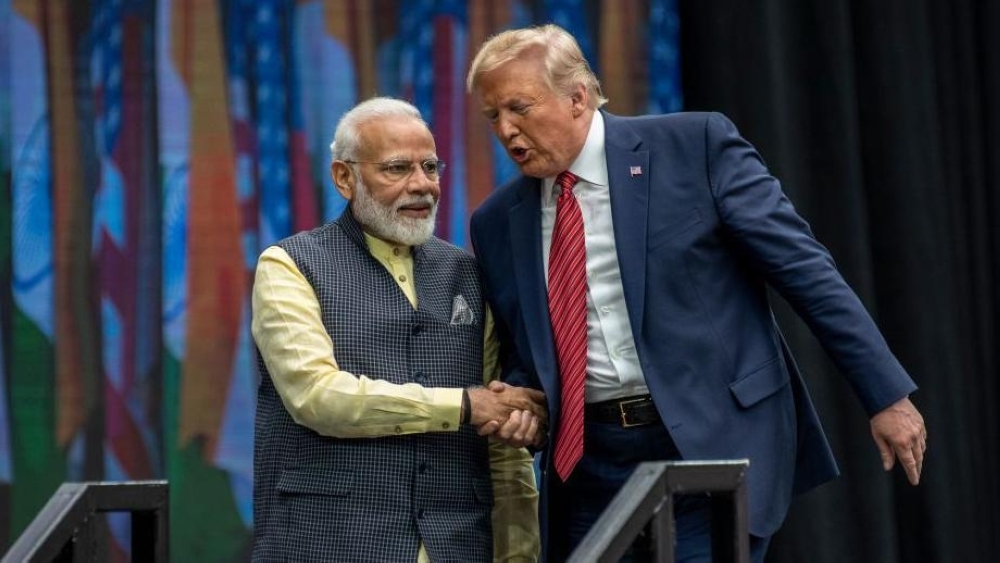
Indian Prime Minister Narendra Modi is expected to hold bilateral talks with President Donald Trump on the sidelines of the G7 summit in Evian-les-Bains, France, with trade, H-1B visas, and energy cooperation set to dominate an agenda that reflects both the depth of the two countries' economic entanglement and the persistent friction that has characterised their diplomatic relationship since Trump returned to power. An Indian government source with direct knowledge of the planning confirmed the likely Modi Trump G7 Meeting to Reuters, describing a three-part agenda covering trade ties, energy cooperation, and the issue of H-1B visa restrictions that affect hundreds of thousands of Indian nationals working in the United States. The June 15 to 17 summit, which brings together leaders from the world's major economies, gives Modi and Trump a high-profile multilateral setting in which to advance a bilateral conversation that both governments have been building carefully since Rubio's India visit last month.
The diplomatic timing of the encounter is carefully calibrated but genuinely delicate. US-India ties have been running through a turbulent period shaped by multiple overlapping friction points: Trump's tariffs on Indian goods, Washington's assertion that Trump personally intervened to end India's brief military conflict with Pakistan last year, a claim New Delhi has consistently and firmly rejected, and the tightening of H-1B visa requirements that has created direct economic anxiety for Indian technology workers and the Indian IT sector that depends heavily on American work authorisation. Against that backdrop, the G7 sideline meeting is not a routine diplomatic courtesy call but a substantive attempt to use the momentum generated by Rubio's visit and the ongoing trade negotiations to lock in progress on issues that carry significant political weight on both sides.
Trade Minister Piyush Goyal's public statement last week that talks are moving toward the first tranche of a bilateral trade agreement potentially concludable by mid-July provides the clearest marker of where the diplomatic effort currently stands. That timeline, if met, would represent a significant achievement for both governments: a concrete deliverable in a relationship that has generated considerable goodwill rhetoric without always producing matching results. India is pushing for preferential tariff treatment as part of an interim deal, and Washington has simultaneously proposed an additional 12.5 percent tariff on Indian imports alleging forced labour practices, a charge India has rejected. The G7 meeting gives Modi the opportunity to press both the tariff relief case and the forced labour allegation directly with Trump at the highest possible political level.
How Tariffs, Pakistan Claims, and Visa Tightening Have Strained the US-India Partnership
The current state of US-India trade and diplomacy cannot be understood without examining what went wrong in the relationship over the preceding months and why both sides are now working to repair it through sustained high-level engagement. Trump's imposition of tariffs on Indian goods was the first and most economically significant source of strain, applied without the kind of carve-out or preferential treatment that India, as a major strategic partner and a country that Washington has been trying to pull closer for decades, had reason to expect. The tariffs landed as a shock in New Delhi, where officials had invested significant political capital in framing the relationship with the Trump administration as one built on convergent strategic interests and mutual economic benefit. The message that India was being treated like any other trading partner rather than as a privileged ally forced a recalibration of expectations on the Indian side.
The Pakistan intervention claim added a politically toxic dimension that touched Indian national pride in a way that trade disputes, however damaging, rarely do. Trump's assertion that he personally brokered an end to the India-Pakistan conflict of last year has been flatly rejected by Indian officials, who have described it as inconsistent with the factual record of how the situation was resolved. For a country that places enormous importance on its strategic autonomy and its right to manage its own regional security relationships, the suggestion that an external actor determined the outcome of a military confrontation on the subcontinent carries implications that go well beyond the specific facts of the claim. India's foreign policy establishment has been notably firm in its rebuttal, and the diplomatic management of that disagreement has required careful handling on both sides to prevent it from becoming a more durable obstacle to bilateral progress.
Rubio's India visit last month served as the first major attempt to begin rebuilding the relationship's operational infrastructure after those overlapping disruptions. The visit covered trade, visas, maritime security, energy supplies, and the Middle East, establishing the working-level framework that a Modi-Trump bilateral at the G7 can now build on. The fact that both sides chose to describe the Rubio visit as productive and to use it as a platform for confirming the trade negotiation timeline suggests a deliberate diplomatic sequencing: create momentum at the ministerial level, then use a leader-level meeting to convert that momentum into decisions that require political authority to finalise. The G7 sideline conversation, if it proceeds as expected, is the next step in that sequencing.
What the Trade Deal Timeline, H-1B Pressure, and Venezuela Energy Angle Mean for the Bilateral Agenda
The trade negotiation timeline that Goyal outlined represents the most immediately consequential diplomatic deliverable currently on the table between Washington and New Delhi. A mid-July conclusion for the first tranche of a bilateral agreement, if achieved, would give both governments a tangible outcome to point to as evidence that the relationship is producing results rather than simply managing friction. India's push for preferential tariff treatment reflects its desire to lock in competitive rates before the Trump administration's ongoing investigations under unfair trade practices legislation restore some or all of the tariff levels that were temporarily reduced earlier in the year. Every week without a concluded deal is a week in which India's competitive position in the US market remains uncertain, and the G7 meeting gives Modi the political opportunity to accelerate the timeline by committing Trump personally to the mid-July target.
The H-1B visa issue carries a different kind of political weight, one that is simultaneously a trade and diplomacy question and a domestic political matter with significant implications for Indian public opinion and the Indian diaspora in America. The tightening of H-1B requirements under the Trump administration has created genuine anxiety among Indian technology workers and the families and communities that depend on their earnings. India sends more H-1B visa holders to the United States than any other country, and changes to the programme's requirements, processing times, or approval rates have immediate ripple effects across the Indian IT sector, Indian universities, and the broader ecosystem of professional migration that has been one of the most durable features of the US-India economic relationship for three decades. Modi's decision to put the visa issue directly on the G7 bilateral agenda is a signal that the political pressure from this constituency is significant enough to require leader-level attention, not just technical-level negotiation.
The energy cooperation dimension of the expected discussion includes a notably specific element: the potential for a US-India arrangement involving Venezuela. That detail, confirmed by the first Indian government source, suggests the two sides are exploring whether the partial normalisation of US-Venezuela relations that has occurred under Trump's approach to the region creates an opening for India to access Venezuelan oil supplies through a framework that has Washington's involvement or approval. India has been a major buyer of Russian oil since Western sanctions created a supply and pricing opportunity, a purchasing pattern that the US has viewed with varying degrees of tolerance at different points in the relationship. A Venezuela energy cooperation arrangement that involves both Washington and New Delhi would potentially offer India an alternative supply channel that carries far less diplomatic friction than Russian oil, while giving the US a way to use India's energy demand as leverage in its own Venezuela policy. Whether that idea is at an exploratory or substantive stage will be one of the more closely watched elements of whatever emerges from the G7 sideline conversation.