
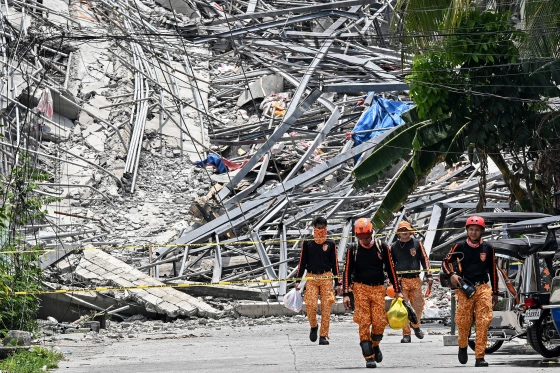
Search and rescue operations have officially ended at the site of a building collapse in Angeles City, north of Manila, after life-detection equipment confirmed there were no longer any signs of life beneath the rubble. Philippines building collapse Authorities called off the rescue effort on Monday evening, and by Tuesday the focus had shifted to the grim work of recovering the remains of the victims. At least four people have been confirmed dead, including a Malaysian national whose body was retrieved from a neighbouring hotel that was also damaged in the collapse, while 16 others remain missing, the majority of them construction workers who had been staying in on-site barracks when the structure came down at dawn on Sunday.
For the families gathered at the perimeter of the collapsed site, the end of rescue operations brought with it a devastating finality. Lea Casilao, 47, had been waiting anxiously since Sunday morning when her husband Joselito stopped replying to her texts. The two had been messaging the night before, and she knew he had been staying at the workers' barracks on the site. When she could not reach him on Sunday and later saw the collapsed structure, she went straight to the scene. "I kept calling his number, but nothing," she said, sitting in a makeshift tent near the rubble as a bulldozer worked to clear debris from the road. "My hope of still finding him alive has collapsed."
Maria Leah Sajili, information officer at the regional Bureau of Fire Protection, addressed the assembled families at a press briefing on Tuesday with words that acknowledged the weight of the moment. "We know how hard this is for you. We sympathise with what you are going through. Rest assured, we did everything we could to save lives, and now we have to move forward," she said. Her words offered little comfort to those still waiting for news of the missing, but they drew a formal line under the rescue phase and signalled the beginning of what will be a lengthy and painful process of recovery, accountability, and investigation.
Safety Violations, Permit Breaches, and the Night the Building Came Down
The collapse did not occur without warning signs that something was wrong at the construction site long before Sunday's disaster. The Philippine labour agency had issued a stop-work order at the site back in September 2025 over documented safety violations, a significant step that reflects a formal determination that workers on the site were at risk. That order was lifted approximately one month later after the construction company indicated it had complied with the required regulations, and work resumed. The fact that the building collapsed months after that compliance declaration will now be central to the investigation authorities have launched.
Investigators are also examining whether the building's construction exceeded the terms of its approved permit. The structure had received approval for nine storeys, but at the time of the collapse a swimming pool was actively under construction on a tenth floor that was never part of the original permitted plan. Building an additional storey beyond what has been structurally approved and permitted introduces risks that are not accounted for in the original design, and that unapproved expansion is now a key focus of the official inquiry into what caused the structure to give way. Whether the additional load, compromised structural integrity, or other factors contributed to the collapse will be determined through forensic investigation.
The human cost of the collapse crystallised painfully in the account of 19-year-old Evelyn Alicaway, whose father was among those who died. She said she first learned of the accident from her uncle, and that after seeing a video circulating on social media she immediately recognised her father despite his face being blurred in the footage. "Even with his face blurred, I knew right away it was him. It hurt me so much to see my father like that," she said through tears at his funeral. Her mother Rosenda called on the building's owner to take responsibility and coordinate with the affected families, voicing what dozens of grieving relatives left at the site also want answered: who is accountable, and what comes next for those left behind.
What the Investigation Is Examining and What Families Are Demanding
The investigation now underway is expected to examine several overlapping questions simultaneously. The first is structural: what specifically caused the building to collapse, whether it was related to the unapproved tenth floor construction, pre-existing safety deficiencies, or a combination of factors. The second is regulatory: how a site that received a stop-work order for safety violations in September was cleared for resumption of work in October and then suffered a catastrophic collapse months later. The third is legal: whether the building owner, the construction company, or the regulatory officials who lifted the stop-work order bear criminal or civil liability for the deaths and disappearances.
For the families still camped outside the collapse site, waiting for remains to be recovered, the investigation is not an abstract exercise. Rosenda Alicaway, speaking for many of the families who have gathered in makeshift tents near the rubble, put the demand plainly. "We hope the owner will take responsibility and address what happened to the workers. The families are also suffering. This is not what we wanted, but they need to coordinate with us." Her statement reflects the gap that often exists in industrial accident cases between the scale of the human loss and the pace of the institutional response that follows it.
The broader context of construction safety in the Philippines has been brought sharply into focus by the collapse. The country's building sector has seen rapid growth in recent years, with construction activity accelerating across urban centres north of Manila including Angeles City, which is home to significant commercial and residential development tied to both domestic demand and overseas Filipino worker remittance investment. That growth has at times outpaced the regulatory capacity to monitor compliance, and cases where stop-work orders are issued and then lifted without independent third-party verification of actual remediation have drawn criticism from labour advocates. Whether the Angeles City collapse becomes a turning point for how construction safety violations are treated will depend heavily on what the investigation concludes and whether the findings lead to meaningful enforcement changes.