
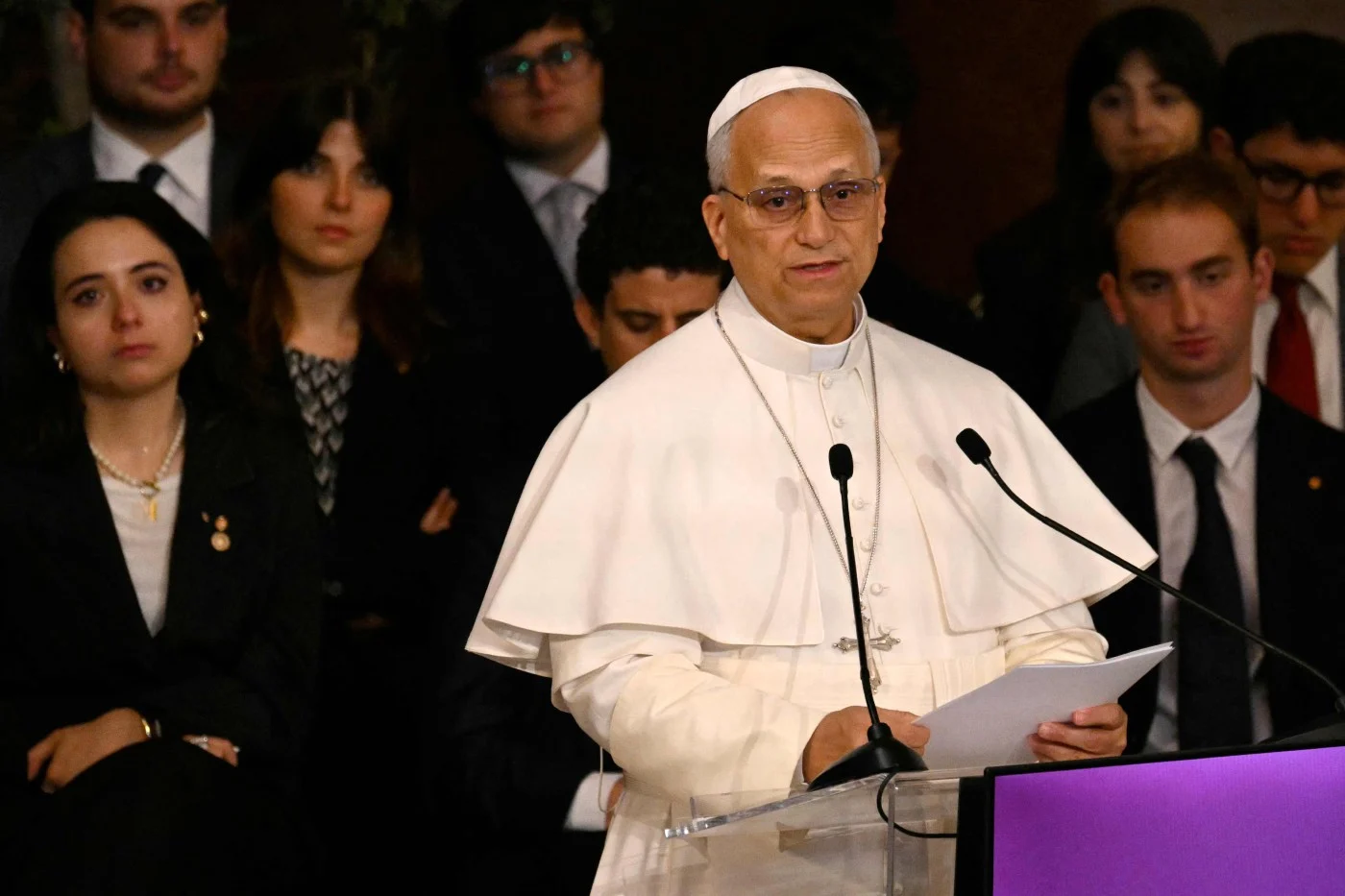
Pope Leo has delivered one of his most direct and politically charged speeches since assuming the papacy, condemning the surge in European military spending as a betrayal of diplomacy and calling on young people to resist the pull of nationalism and ideology in favor of building genuine peace. Speaking to students at Rome's Sapienza University on Thursday, one of the largest institutions of higher learning in Europe with approximately 110,000 enrolled students, the pontiff challenged the language used to justify rearmament across the continent, arguing that calling it defence spending disguises its true costs to society and its corrosive effect on the international trust that diplomacy requires. The speech adds to a pattern of increasingly outspoken papal commentary on global affairs that has already drawn a sharp response from US President Donald Trump, who publicly criticized Leo in recent weeks following the pope's condemnation of the Iran war.
The timing and venue of Pope Leo's remarks were clearly deliberate. Addressing a vast student audience at one of Europe's most prestigious academic institutions gave the pontiff a platform that extended well beyond a church congregation, placing his critique of militarism directly in front of the generation that will live longest with the consequences of the security decisions being made today. Leo's choice to speak at Sapienza rather than through a formal Vatican document or diplomatic channel reflects a pastoral and communicative strategy that seeks to engage civil society and younger audiences rather than restricting papal commentary to traditional ecclesiastical formats. The message he delivered was unambiguous and challenging: that the billions being directed toward weapons and military capacity are simultaneously being diverted from education, healthcare, and the human investments that actually build stable and peaceful societies.
European military spending rose by 14 percent in 2025 to reach 864 billion dollars, according to the Stockholm International Peace Research Institute, the largest single-year increase since the end of the Cold War. The surge has been driven by a combination of the ongoing Russia-Ukraine war, which has fundamentally altered the security calculations of European governments, and sustained pressure from Trump on NATO allies to dramatically increase their defence contributions. Trump signed an executive order in February that would reprioritize the customer list for American weapons sales in favor of countries with higher defence spending, a move widely interpreted as a commercial and political incentive for European governments to accelerate their military budgets. At Trump's urging, NATO in 2025 adopted a new defence spending target of 5 percent of GDP for its members, a threshold that would require most European allies to more than double their current military expenditure.
Pope Leo's Challenge to the Language of Defence and the Moral Cost of Rearmament
The most striking element of Pope Leo's Sapienza address was his explicit challenge to the terminology used to frame European military spending as an act of defence rather than a choice with profound ethical and social consequences. His words were precise and pointed: let us not call defence a rearmament that increases tensions and insecurity, impoverishes investments in education and health, betrays trust in diplomacy, and enriches elites who care nothing for the common good. By insisting on a distinction between genuine defensive security and what he characterizes as a spiral of militarism driven by elite commercial interests, Leo was doing something popes have historically done at their most prophetic moments, naming a systemic wrong in terms that cut through political euphemism and demand a moral response.
In previous papal statements on war and peace, the Catholic Church has consistently maintained that legitimate defence is a moral right under just war principles while simultaneously warning against the arms race dynamics that can make conflict more rather than less likely. Leo's framing at Sapienza sits within that tradition but pushes it further into the realm of structural economic critique, explicitly connecting rising military budgets to reduced investment in the social goods that sustain human flourishing. The argument that rearmament impoverishes education and health spending is not merely rhetorical. European governments that have committed to significant increases in defence budgets are simultaneously facing fiscal constraints that make it genuinely difficult to maintain existing levels of social investment without either raising taxes or cutting programs in other areas. Leo is naming that trade-off and asking whose interests it ultimately serves.
The reference to elites who care nothing for the common good introduces a class dimension to the papal critique that is unusual in its directness and that connects the military spending debate to broader questions about economic power and whose interests drive security policy. Defence industry companies are among the largest beneficiaries of increased military budgets, and their shareholders, executives, and lobbyists have strong financial incentives to support policies that expand government arms procurement. Leo is not making an argument that national security is unimportant but that the interests driving rearmament decisions are not always aligned with the interests of ordinary citizens who bear both the tax burden of increased military spending and the human cost of the conflicts that such spending is meant to address or deter.
Warning on Artificial Intelligence in Warfare and the Call for a New Generation of Peacemakers
Beyond his critique of military spending levels, Pope Leo used the Sapienza address to raise an alarm about what he described as the inhumane evolution of the relationship between war and new technologies. Citing ongoing conflicts in Ukraine, Gaza, Lebanon, and Iran as contemporary evidence of how artificial intelligence is being integrated into military operations in ways that escalate rather than limit human suffering, Leo warned that the combination of advanced technology and armed conflict was creating a spiral of annihilation whose humanitarian consequences demand urgent moral attention. The specific naming of four active conflict zones gave his warning a grounded immediacy rather than the abstracted character of generalized technological concern, connecting the philosophical argument about AI in warfare to real human tragedies unfolding in real time.
The use of artificial intelligence in military applications has been one of the most rapidly developing and least publicly debated areas of contemporary defence technology. Autonomous weapons systems, AI-assisted targeting, drone swarm technology, and algorithmic surveillance tools are being developed and deployed by multiple parties across active conflict zones at a pace that has significantly outrun the development of international legal frameworks, ethical guidelines, and accountability mechanisms. Leo's choice to raise this issue before a student audience was strategically significant because the generation currently in university is the one that will both develop these technologies professionally and live with their strategic and humanitarian consequences. Urging students to think critically about the relationship between technological capability and human dignity in the context of warfare is an educational intervention as much as a moral one.
The concluding appeal of Leo's address, his invitation to students to be artisans of true peace alongside him and many brothers and sisters, deliberately framed peacemaking as an active craft requiring skill, commitment, and collaboration rather than a passive hope or a utopian aspiration. His urging of students not to close themselves within ideologies and national borders echoed the universalist tradition of Catholic social teaching while also speaking directly to a political moment in which nationalism, ideological polarization, and border-focused politics are gaining ground across Europe and globally. For a pope who has already drawn the public ire of one of the world's most powerful political leaders by speaking out against the Iran war, the Sapienza address represents a continued and deliberate choice to engage the most contested political questions of the moment from the perspective of a moral authority that transcends national interest.