
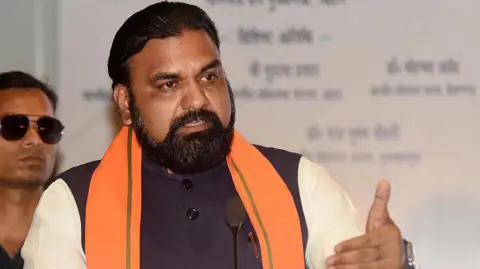
Bihar has entered a new political chapter with the swearing-in of Samrat Choudhary Bihar Cm as the eastern state's first ever chief minister from Prime Minister Narendra Modi's Bharatiya Janata Party, marking a historic milestone for a party that has governed at the national level for over a decade but had never managed to place its own leader at the top of one of India's most politically significant and electorally consequential states. Choudhary, who was serving as deputy chief minister under the outgoing Nitish Kumar, took his oath of office after the veteran politician resigned from the chief minister's post on Tuesday, paving the way for a transition that had been anticipated for some time given Kumar's deteriorating health and his recent election to the Upper House of parliament last month. The moment was described by senior BJP leader Ravi Shankar Prasad as big and historic, a characterization that reflects the genuine significance of what has changed in Bihar's political landscape with this single transfer of power.
Bihar is not just any state in the context of Indian politics. With more than 74 million voters, it is one of the most electorally important states in the country, and its political outcomes have consistently shaped the arithmetic of national coalition governments in ways that states with smaller voter bases simply cannot. It is also India's poorest state by most measures, with millions of its residents migrating to other parts of the country in search of employment opportunities that their home state has not been able to generate in sufficient numbers despite decades of political attention and development spending. The combination of enormous electoral weight and persistent developmental challenges makes Bihar a state where political leadership carries consequences that extend well beyond its own borders, and the transition from Nitish Kumar's long dominance to the BJP's first direct control of the chief ministership is a development that will be studied and analyzed by political observers across the country for what it signals about the future direction of both state politics and national coalition dynamics.
Choudhary, who is 57 years old, steps into a role that carries the weight of enormous expectations and the shadow of a predecessor whose hold on Bihar's political identity was so complete and so enduring that separating the state's recent political history from Kumar's personal biography is almost impossible. Kumar served as Bihar's chief minister for most of the past two decades, a tenure defined as much by his strategic and sometimes dizzying shifts in political alliance as by his administrative record and development agenda. His ability to remain politically relevant and in power through multiple changes of coalition partners earned him a reputation as one of India's most skilled political operators, and it is against that standard of political durability and institutional knowledge that Choudhary will inevitably be measured, fairly or otherwise, as he begins to establish his own identity and record in the chief minister's office.
How Bihar's Political Landscape Evolved Under Nitish Kumar's Two-Decade Dominance
Nitish Kumar's political journey in Bihar is a story of extraordinary longevity and tactical flexibility that left a deep imprint on the state's institutions, its development trajectory, and its political culture in ways that will continue to shape Bihar's governance long after his departure from the chief minister's office. Kumar came to power at a time when Bihar's reputation for lawlessness, administrative dysfunction, and chronic underdevelopment had made it something of a byword for governance failure in the Indian political imagination, and his early years in office were defined by visible and credible efforts to restore basic administrative order, improve the state's infrastructure, and create at least the foundations of a more functional public administration than his predecessors had managed to deliver.
His record on development during his peak years in office earned him genuine credit from voters, civil society organizations, and national commentators who had written Bihar off as a state beyond redemption by conventional governance methods. Improvements in road connectivity, electricity access, law and order, and women's participation in local governance were among the achievements that built Kumar's reputation as a serious administrator rather than merely a skilled political survivor. These accomplishments were real enough to sustain his electoral appeal through multiple election cycles even as questions about the pace and depth of Bihar's development relative to faster-growing Indian states remained persistent and legitimate concerns for the tens of millions of Bihari workers who continued to leave the state in search of economic opportunity they could not find at home.
The political alliance management that characterized Kumar's tenure was as remarkable in its own way as any of his governance achievements. Over two decades, Kumar aligned with and separated from virtually every significant political force in Bihar and at the national level, including the BJP, the Rashtriya Janata Dal, and various other regional formations, always managing to position himself as the indispensable figure around whom governing coalitions had to be organized regardless of which ideological direction the political winds were blowing. His election to the Upper House of parliament last month, combined with the health challenges that had become increasingly visible to political observers and the public, signaled that this extraordinary run of political dominance at the state level was drawing to a close, and the transition to Choudhary represents the formal acknowledgment of that reality.
Who Is Samrat Choudhary and What Shaped His Path to Bihar's Top Office
Samrat Choudhary's journey to the chief minister's office is a political biography that spans more than three decades, multiple party affiliations, significant ideological repositioning, and a family background in Bihar's legislative politics that gave him an early and formative understanding of how power operates in one of India's most complex political environments. He comes from a political family in the most direct sense possible. His father Shakuni Choudhary served as a legislator in Bihar for more than two decades beginning in the mid-1980s, giving Samrat a front-row education in the mechanics of Bihar's political culture during a formative period for the state. His mother Parvati Devi was a social activist who also entered politics and was elected as a legislator, adding a dimension of community engagement and public service to the family's political identity that shaped Choudhary's own approach to building his political base.
His career path through Bihar's political parties is a reflection of the fluidity and pragmatism that characterizes political life in the state more broadly. Choudhary was once a member of the Rashtriya Janata Dal, the party now led by Tejashwi Yadav that serves as Bihar's main opposition force, before joining Nitish Kumar's Janata Dal United in 2014. He left the JDU in 2017 to join the BJP at precisely the moment when Kumar himself was realigning his own alliances with the BJP after breaking with his previous coalition partners, a timing that reflected Choudhary's acute reading of where Bihar's political center of gravity was moving. When Kumar switched alliances again in 2022 and moved away from the BJP, Choudhary remained with the saffron party and became one of the veteran leader's most vocal public critics, a period that established his credentials as a committed BJP voice rather than a political opportunist simply following whoever held power.
The renewal of the BJP and JDU alliance in 2024 required Choudhary to patch up his relationship with Kumar, a reconciliation that demonstrated the pragmatic flexibility that Bihar's coalition politics demands from all serious participants. His appointment as deputy chief minister in Kumar's government and his concurrent role as home minister, overseeing Bihar's police force and internal security apparatus, gave him significant executive experience and administrative visibility in the period immediately preceding his elevation to the top role. These positions allowed him to demonstrate governance competence in substantive portfolios rather than arriving at the chief ministership purely on the basis of political loyalty or caste arithmetic, a distinction that matters for establishing the credibility needed to lead a state with Bihar's scale and complexity.
What Choudhary's Elevation Means for BJP's Strategy in Bihar and Beyond
Choudhary's rise to the chief ministership carries clear strategic significance for the BJP's efforts to deepen its political roots in Bihar beyond its existing base and to establish itself as a governing force in its own right in a state where it has historically needed alliance partners to share executive power. He is widely identified as a prominent leader from an Other Backward Class community, a designation that covers communities identified by the government as socially and economically disadvantaged and that represents a substantial and electorally decisive share of Bihar's voter base. The BJP's ability to project an OBC leader as chief minister of Bihar is a deliberate and carefully considered signal about the party's social coalition ambitions in a state where caste remains the most powerful organizing principle of electoral politics at every level from village panchayat to state assembly.
The reactions within the ruling coalition to Choudhary's elevation have been mixed in ways that reflect the genuine complexity of his political positioning and the questions his rapid rise has generated among those who have watched his career closely. Some political observers and party insiders see his elevation as a strategically astute move by the BJP's central leadership to broaden the party's social base in Bihar and position it for stronger independent performance in future state assembly elections where it may not be able to rely on Kumar's personal appeal to consolidate the coalition vote. His OBC credentials, his administrative experience as home minister, and his three-decade political career are cited as genuine assets that make him a credible choice for the role beyond the immediate political arithmetic.
Others within and around the ruling coalition have raised questions about whether Choudhary's path to the BJP's organizational ranks through multiple party affiliations rather than through the party's traditional grassroots structure makes him a sufficiently rooted BJP figure to command the full loyalty and enthusiasm of the party's cadre in Bihar. Leading a state government with Bihar's challenges requires not just political skills but the ability to mobilize party machinery effectively, manage coalition partners with their own ambitions and constituencies, and build the administrative relationships needed to actually deliver governance outcomes. Whether Choudhary can establish himself as an effective chief minister in his own right, rather than simply as a transitional figure following Kumar's long tenure, will be determined by the decisions and results that accumulate in the months and years ahead as he confronts Bihar's formidable developmental challenges with a state that is watching with high expectations and a long institutional memory.