
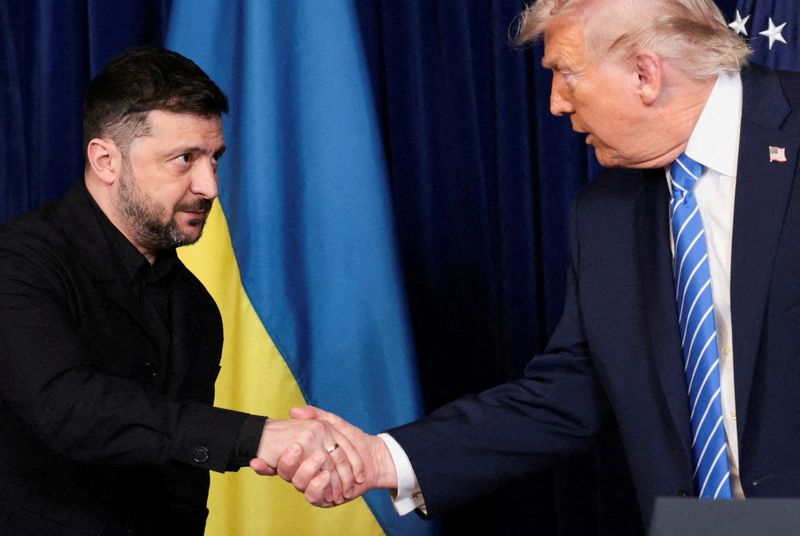
President Donald Trump hosts Netanyahu and Zelenskyy two foreign leaders on Tuesday whose presence in Washington on the same day is less a coincidence than a reflection of how entangled American foreign policy has become across two simultaneous active wars. Israeli Prime Minister Benjamin Netanyahu and Ukrainian President Volodymyr Zelenskyy are both in Washington to attend the memorial service for Senator Lindsey Graham, the hawkish Republican who was one of Trump's closest allies and who made it his business throughout his career to press Trump for stronger support for both Israel and Ukraine. The memorial is the occasion. The bilateral meetings that follow are the substance.
The backdrop for both meetings is one of genuine military and diplomatic urgency. In Iran, Trump has paused US airstrikes to give diplomacy another chance following the collapse of the June ceasefire that was broken three weeks after it was signed. In Ukraine, the war has reached a stage where Ukraine has blunted Russian advances and achieved recent successes, most notably increased attacks on Russia's oil infrastructure, but faces a critical shortage of the air defense interceptors it needs to protect civilian infrastructure from daily Russian missile and drone strikes. The two conflicts have different geographies, different protagonists, and different outcomes that Trump wants, but they share a common feature: both are at stages where decisions made in Washington in the next few weeks will materially affect their trajectory.
The relationship dynamics heading into Tuesday's meetings are strikingly different for each pair. Trump and Zelenskyy clashed repeatedly in the early months of Trump's second term, with a notorious Oval Office confrontation in which Trump and Vice President JD Vance appeared to lecture Zelenskyy publicly in front of cameras. Those relations have since "warmed," in the language of the source reporting, as Ukraine's military performance improved and as Zelenskyy adopted a more deferential posture toward Washington. Trump and Netanyahu, by contrast, have a longer and more combustible personal history that culminated in the now-confirmed phone call in June during which Trump called the Israeli prime minister "fucking crazy," a level of interpersonal tension that makes Tuesday's meeting considerably more charged than the choreography of a White House photo opportunity would suggest.
Why Netanyahu is in Washington the October election and the Iran deal
Netanyahu's primary domestic objective for Tuesday is to generate images and statements that support his re-election campaign ahead of an October 27 Israeli election. He is struggling in opinion polls at home, and a visible, warm meeting with a US president whom his base regards as Israel's most important international ally is exactly the kind of political asset that domestic campaign managers deploy in the final weeks before a vote. Netanyahu's own framing of the visit, delivered in a video statement before his departure, focused on Iran and security in language calculated to resonate both with Trump and with the Israeli security-conscious electorate.
"In these complex times, you need to act with both great determination and great wisdom. We will discuss all the issues on the agenda, primarily Iran. Of course, our goal is to protect our security and also to expand the circle of peace around us."
Israeli Prime Minister Benjamin Netanyahu, video statement before departing for Washington
The White House official's description of the agenda, covering Iran, Lebanon tensions, and the Abraham Accords, reflects the full range of issues Netanyahu needs to address. On Iran, Netanyahu's fundamental objective is to ensure that any deal Trump reaches with Tehran constrains Iran's nuclear programmer and its ability to support regional proxies, including Hezbollah in Lebanon, in ways that genuinely reduce the security threat to Israel. The risk, from Netanyahu's perspective, is that Trump negotiates a deal that trades short-term diplomatic achievement for long-term Iranian capability, as Netanyahu argued was the case with the 2015 JCPOA. Making that argument to a president who has paused airstrikes to give diplomacy a chance, and who wants a deal as his Iran war exit strategy, requires Netanyahu to navigate between publicly supporting Trump while privately pressing for conditions that tighten rather than loosen the framework.
The Abraham Accords dimension adds commercial and geopolitical complexity. Trump wants to add Saudi Arabia to the normalization framework he brokered in his first term, and conditioned a civilian nuclear cooperation deal with Riyadh last week on the Saudis signing the accords. Saudi Arabia has consistently said it will not normalize with Israel without a credible path toward Palestinian statehood, a condition that Netanyahu's government has not been willing to accept. Tuesday's discussions on the accords will therefore involve Trump pressing Netanyahu on Palestinian statehood, Netanyahu pressing back on security conditions, and both men trying to find language that advances Trump's Saudi goal without requiring Netanyahu to make a commitment his governing coalition could not survive.
Why Zelenskyy is in Washington: Patriot missiles, $400 million in frozen aid, and the peace process
Zelenskyy's agenda for Tuesday is more operationally urgent and less politically theatrical than Netanyahu's. A Ukrainian source was direct about the immediate priority: "We're experiencing strikes every day so we need Trump's and his team's 'okay' to let us buy missiles for Patriots. It's a top priority to save lives." Patriot surface-to-air missile interceptors are the most effective available defense against the Russian ballistic missiles that have been hitting Ukrainian cities, power infrastructure, and civilian sites on a daily basis. Ukraine has Patriot systems but is running critically low on the interceptors those systems fire. Without resupply, the systems become inoperative, leaving Ukrainian cities without the air defense cover that has been protecting them.
The $400 million in authorized Ukraine aid that the Pentagon has not spent, and has told Congress it will not spend until fiscal year 2029, is the second urgent issue. A Pentagon letter to lawmakers confirmed the delay, which has drawn criticism from both Democrats and some Republicans who supported the aid package last year. Zelenskyy will press Trump to release the funds within a timeframe that actually helps Ukraine in the current phase of the war, rather than in fiscal year 2029 when the military situation may have changed entirely. The political dynamics here are awkward: it is the Trump administration's own Pentagon that delayed the funds, putting Trump in the position of either defending that delay to Zelenskyy or overriding his own department.
The peace process dimension of Zelenskyy's visit is diplomatically the most consequential for the long term but the least immediately actionable. Zelenskyy spoke last week with US envoys Steve Witkoff and Jared Kushner about the prospects for renewed peace talks with Russia, and the White House official confirmed Trump "will discuss the ongoing peace process between Russia and Ukraine" and that "Now is the time to end the war." Ukraine's position on what an acceptable peace looks like, specifically the refusal to cede territory Russia has occupied but not yet fully captured in the Donbas, remains incompatible with Russia's stated territorial demands. The White House's "now is the time to end the war" framing reflects Trump's desire for a conclusion but does not resolve the question of whose terms would form the basis of any settlement.
From the June Iran MOU to Tuesday's White House meetings
June 2026
US and Iran sign 14-point Memorandum of Understanding. Trump pauses airstrikes. Three weeks later, Iran attacks ships in the Strait of Hormuz. Trump declares ceasefire "over."
June 2026
Trump calls Netanyahu "fucking crazy" in an acrimonious phone call, later publicly confirmed by Trump himself. Relations between the two leaders visibly strained.
Recent weeks
Ukraine achieves military successes including increased attacks on Russian oil infrastructure. Trump-Zelenskyy relations warm. Zelenskyy speaks with Witkoff and Kushner on peace prospects.
Last week
Trump hosts Lebanon's president. Trump conditions Saudi civilian nuclear deal on Saudi Arabia joining Abraham Accords. Pentagon letter confirms $400 million Ukraine aid delayed to FY2029.
Monday July 28
Trump tells reporters on Air Force One: "Bibi's been great. He was a wartime prime minister. We did very well together." Trump has also paused US airstrikes on Iran to give diplomacy another chance.
Tuesday July 29
Memorial service for Senator Lindsey Graham. Trump meets Netanyahu separately. Trump meets Zelenskyy in a short private session. After White House, Zelenskyy meets all 100 US senators at the Capitol.
The Trump Netanyahu tension and what it reveals about the Iran deal space
The June phone call in which Trump called Netanyahu "fucking crazy" is the most revealing data point about the current state of US-Israel relations, and it is essential context for understanding what Tuesday's meeting is actually about beneath the photo opportunities. The call occurred in the context of Trump trying to rein in Israeli military action, specifically against targets in Lebanon connected to Hezbollah. Netanyahu's instinct, as evidenced throughout the Iran conflict, is to push for deeper and more permanent degradation of Iran's military and proxy network capacity. Trump's instinct, particularly as White House frustration with the lack of progress toward a broader Iran settlement has grown, is to pursue a deal that ends the conflict and allows him to claim victory. Those instincts are not currently compatible, and the June call made that incompatibility public.
Sources familiar with the matter say Netanyahu's primary objective for the visit is to secure Trump's support for his October 27 re-election campaign. That electoral framing is critical to interpreting everything Netanyahu does and says in Washington on Tuesday. His public statements will be calibrated for the Israeli domestic audience as much as for the White House meeting room. The photographs and videos produced from the meeting will be used in Israeli campaign materials. The language he uses about Trump, and any positive Trump language about him, will circulate on Israeli social media within hours. Netanyahu is not just a foreign leader attending diplomatic meetings. He is a candidate managing an international trip for domestic political impact.
For Trump, the political calculus is different but equally present. Some of his supporters, particularly within the non-interventionist wing of the Republican Party, oppose deeper US involvement in the Middle East and have been critical of the Iran war's conduct and costs. The pausing of airstrikes to give diplomacy a chance is partly a gesture toward that constituency. At the same time, Trump needs to demonstrate to Israel's supporters within his coalition that the relationship with Netanyahu remains fundamentally strong, even after a phone call that used language that would have ended most diplomatic relationships. The "Bibi's been great" comment on Air Force One is designed to perform exactly that reassurance while the underlying tensions continue.
Patriot missiles, Ukraine aid, and the Abraham Accords' Saudi dimension
The economic dimensions of Tuesday's meetings are concentrated in three areas. The first is the US defense industry's exposure to the Patriot interceptor request. A Trump approval for Ukraine to purchase Patriot interceptors unlocks revenue for Raytheon (RTX), the primary manufacturer, and for the US defense industrial base more broadly. Ukraine's air defense requirements have been one of the most significant drivers of US defense procurement demand in the current war, and the Patriot interceptor specifically has become a critical strategic commodity whose production timeline and supply allocation have direct commercial consequences for the defense sector.
The $400 million in frozen Ukraine aid is a fiscal policy question as much as a military one. Congressional authorization for the aid exists. The Pentagon's decision to delay obligation of those funds until FY2029 is an administrative choice that bypasses Congressional intent and has drawn bipartisan criticism. If Trump overrides that delay, it creates a precedent about executive control over congressionally authorised military assistance. If he does not, it raises questions about the reliability of US aid commitments that will affect not just Ukraine's planning but the planning of every US ally that depends on authorized but as-yet unspent US security assistance.
The Abraham Accords and Saudi Arabia dimension has the largest potential long-term economic impact of any item on Tuesday's agenda. A Saudi normalization with Israel, if it were to occur, would create the conditions for massive Saudi and Israeli commercial and investment exchanges, integrate Israeli technology companies into Gulf state development programmer, and reshape the commercial geography of the Middle East in ways that would generate significant business opportunities for US companies positioned to facilitate those relationships. The current obstacle is the Palestinian statehood condition that Saudi Arabia has attached to any normalization, and nothing that happens in Tuesday's White House meetings is likely to resolve that fundamental disagreement in a single afternoon.
What the outcomes mean for Iran, Russia, and the international order
The global significance of Tuesday's meetings extends far beyond the bilateral relationships being managed. For Iran, the combination of Trump meeting Netanyahu while a diplomatic pause in US airstrikes holds is a signal about the conditions under which a deal might be possible. Iran's calculation about whether to accept a deal that constrains its nuclear programmer will be shaped by its assessment of how united Trump and Netanyahu are on what those constraints must include. If Netanyahu appears to have secured Trump's alignment on tough conditions, Iran's deal calculus hardens. If the meeting produces visible tension or ambiguity about Israeli influence over US deal terms, Iran may read more room to maneuver.
For Russia, Zelenskyy's White House visit and the Senate meeting that follows are an opportunity for Ukraine to demonstrate that it retains US political and military backing at a moment when Moscow has been publicly asserting that American support for Kyiv is weakening. The $400 million delay story, which has been widely reported in Russia, has been used by Moscow as evidence that the US is backing away from Ukraine. A Trump approval of Patriot interceptor purchases and a positive signal on the delayed aid would directly counter that narrative, providing Ukraine with both material support and the political signal that US backing remains firm.
For US allies watching the meetings, the question is whether the Trump administration's dual-war engagement demonstrates the capacity to manage two simultaneous critical conflicts or reveals the limits of a foreign policy apparatus stretched across commitments that pull in different directions. NATO allies in particular will be tracking what Zelenskyy obtains from the White House meeting and what the Senate meeting produces in terms of visible bipartisan commitment to Ukraine, given ongoing European concerns about US reliability as a security partner. The outcomes of Tuesday's meetings will be analyzed in European capitals within hours of the press readouts being issued.
Trump's two-war problem and the limits of personal diplomacy
Tuesday's back-to-back meetings with Netanyahu and Zelenskyy illustrate both the centrality of Trump's personal relationships to his foreign policy approach and the structural limitations that personal diplomacy faces when the underlying conflicts are driven by forces that personal chemistry cannot resolve. Trump's relationship with Zelenskyy has warmed because Ukraine's military performance improved, not because Trump decided to be more accommodating. His relationship with Netanyahu has frayed because the two men's strategic objectives in the Iran conflict genuinely diverge, and no amount of "Bibi's been great" language changes the fact that Netanyahu wants deeper Israeli military action while Trump wants a deal.
The Lindsey Graham memorial is an appropriate setting for this diplomatic moment, not only as a logistical occasion but as a political metaphor. Graham spent years trying to coax Trump into providing more support for Ukraine's war. He was the figure in Trump's circle who most consistently argued for American engagement in precisely the conflicts that Tuesday's meetings are trying to manage. His death removes the most effective internal advocate for sustained US support for Ukraine and Israel within the Trump orbit, at exactly the moment when both relationships require sustained engagement. The meeting his memorial occasion has enabled may be, in an irony Graham would have appreciated, more diplomatically productive than many of the conversations he spent years engineering.
Netanyahu needs Trump for an election. Zelenskyy needs Trump for missiles. Trump needs both wars to end before the 2026 midterms. The intersection of those three imperatives, and not any single bilateral agenda, will determine what actually comes out of Tuesday's meetings.
What happens next
The most consequential immediate outcome to watch is whether Trump approves Ukraine's purchase of Patriot interceptors during or immediately following the Zelenskyy meeting. That decision can be made without Congressional approval and would provide Ukraine with both the military asset it most urgently needs and the political signal about US backing that it wants to send to Moscow. A refusal or deferral would create a significant problem for Ukraine's air defence capability in the near term and would reinforce the narrative, useful to Russia, that US support is conditional and unreliable.
The Netanyahu meeting's outcome will be harder to read immediately, because what Netanyahu actually obtains from Trump on Iran deal terms, Israeli security conditions, and Abraham Accords progress will emerge over days and weeks rather than in a single press readout. What the Israeli domestic political campaign will immediately use is the visual product of the meeting: photographs, video, tone, and any positive Trump statements about Netanyahu that can be deployed in campaign materials before October 27. That is a deliverable Netanyahu can obtain from a meeting regardless of whether the substantive policy discussions produce anything concrete.
Zelenskyy's subsequent meeting with all 100 US senators is the other major event of the day. A bipartisan, full-Senate engagement with Ukraine's president, at a moment when the Pentagon has frozen $400 million in authorized aid, creates political pressure on the administration that individual White House meetings cannot replicate. If senators from both parties emerge from that meeting publicly calling for the delayed aid to be released, it creates a congressional pressure point that the Pentagon's administrative delay will have difficulty withstanding. That is the leverage Zelenskyy is seeking from the Capitol visit, and whether he gets it depends on how many Republican senators are willing to publicly break with the administration's aid delay on the same day they attend a memorial for the colleague who spent his career arguing exactly that position.