
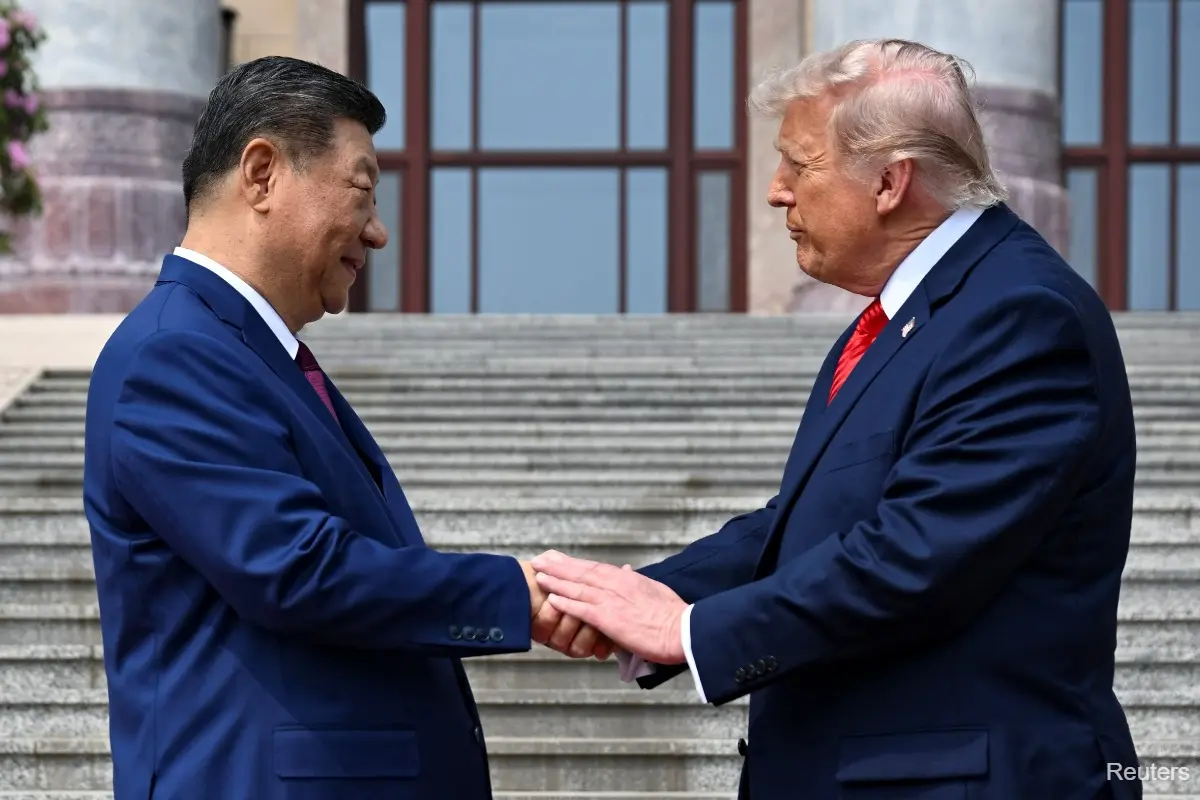
Xi Trump Beijing summit trade Taiwan Iran 2026 began with ceremony, cautious optimism, and strategic tension on Thursday as Chinese President Xi Jinping opened the two-day meeting at Beijing's Great Hall of the People by telling President Donald Trump that trade negotiations were making progress while simultaneously warning that disagreement over Taiwan could send the relationship down a dangerous path toward conflict. Xi told Trump that stable relations between the world's two biggest economies benefit the entire world and that when the two sides cooperate both benefit, while when they confront each other both suffer, setting the philosophical framework for a summit that must navigate trade truce maintenance, Iran war diplomacy, Taiwan arms sales, and AI governance discussions across two days of meetings, state banquets, and cultural visits. Trump responded by calling Xi a great leader and echoing the claim that the summit might be the biggest ever, a characterisation that reflects both the genuine strategic significance of the first U.S. presidential visit to Beijing since Trump's own 2017 trip and the public relations instincts of a president whose approval ratings have been dented by the Iran war and whose domestic political position makes a foreign policy success genuinely valuable.
Behind closed doors, Xi told Trump that the economic and trade team negotiations conducted on Wednesday had reached an overall balanced and positive outcome, according to China's Xinhua news agency readout of the talks, which concluded after just over two hours. The Wednesday negotiations aimed to maintain the October trade truce in which Trump suspended triple-digit tariffs on Chinese goods and Xi backed away from restricting global supplies of rare earths, and to establish mechanisms to support future trade and investment between the world's two largest economies. The technology dimension of the summit was underscored by the presence of Elon Musk, Nvidia CEO Jensen Huang as a late addition to the delegation, and Apple's Tim Cook during the opening talks between the leaders, with Musk telling reporters the discussions were wonderful as he left the Great Hall, a characterisation whose brevity matched the commercial executives' interest in signalling positive momentum without committing to specific outcomes.
Taiwan emerged as the summit's most geopolitically charged agenda item, with Xi explicitly telling Trump that Taiwan was the most important issue in U.S.-China relations and that poor handling of the issue could lead to conflict and an extremely dangerous situation. China reiterated its strong opposition to U.S. arms sales to Taiwan on Wednesday, with the status of a 14 billion dollar package awaiting Trump's approval still unclear. The U.S. is legally bound to provide Taiwan with the means to defend itself despite the absence of formal diplomatic relations with the democratically governed island that Beijing claims as Chinese territory, creating the structural tension between U.S. legal obligations and Chinese strategic red lines that Taiwan policy has long embodied and that the Beijing summit must navigate without resolving.
How US-China Relations Reached This Summit Moment
Trump's 2017 Beijing visit occurred in a fundamentally different strategic environment from the one that defines the 2026 summit, with China in 2017 going out of its way to lavish Trump and commit to purchasing billions in U.S. goods in a relationship where Beijing understood itself as the party seeking to manage an unpredictable American president through accommodation and economic incentives. Senior adviser Ali Wyne of the International Crisis Group noted the power dynamic shift precisely: this time around it is the United States that is, unprompted and of its own volition, acknowledging China's status as an equal superpower, a recognition Trump had signalled when he revived the term G2 to describe the U.S.-China relationship at their October APEC meeting in South Korea. The G2 framing, which China had historically sought to promote and the Obama and first-term Trump administrations had resisted, represents a significant symbolic concession about the nature of the bilateral relationship that shapes the context in which the Beijing summit's substance is negotiated.
The trade conflict that has defined much of the U.S.-China relationship since 2018 has produced a complex and layered tariff architecture whose management has consumed enormous diplomatic energy and whose economic consequences have been felt across both economies and through the global supply chains that connect them. Trump's first-term tariffs on Chinese goods, followed by Biden's maintenance and expansion of those tariffs, followed by Trump's second-term escalation to triple-digit levels and their subsequent suspension in the October trade truce, have created a volatile trading environment in which both sides have incentives to maintain the current pause while neither has resolved the underlying economic and strategic disputes that produced the tariff conflict in the first place. The October trade truce's fragility is the implicit backdrop against which both sides are measuring the summit's success, with maintaining the truce and establishing clearer mechanisms for its extension being the minimum acceptable outcome that business communities on both sides are watching for.
U.S. courts' restraint on Trump's ability to levy tariffs at will on Chinese and other countries' exports, stemming from the Supreme Court's February ruling that struck down the emergency tariff authority, has altered the negotiating environment by reducing the credible threat of immediate tariff escalation that had been one of Trump's primary leverage tools in trade negotiations. Trump enters the Beijing summit with a weaker hand than he held in October, both because of the tariff authority constraint and because the Iran war's inflation impact and approval rating damage have increased the domestic political value of a successful trade summit, making Xi aware that Trump needs a win more than he did previously. The power dynamic shift that Wyne identified is therefore not merely symbolic but reflects real changes in both sides' negotiating leverage and domestic political constraints.
The Iran War's Shadow Over the Beijing Summit Agenda
Trump's hope of enlisting Chinese pressure on Iran to facilitate a peace deal represents the most uncertain element of the summit's diplomatic agenda, because China's strategic interests in the Iran conflict run directly counter to the U.S. objectives that a successful diplomatic intervention would serve. China has been benefiting from discounted Iranian oil throughout the war period, with Iran providing a strategically valuable energy supply relationship that reduces Chinese dependence on Gulf producers whose supplies transit the Hormuz corridor that Iran controls. China also values Iran as a strategic counterweight to American power in the Middle East, making active Chinese pressure on Tehran to accommodate U.S. demands fundamentally contrary to Beijing's regional strategic interests regardless of the economic costs that the Hormuz closure imposes on Chinese shipping and exporters.
Secretary of State Marco Rubio's argument aboard Air Force One that it was in China's interest to help resolve the crisis because many of its ships are stuck in the Gulf and global economic slowdown would hurt Chinese exporters frames the Iran issue as a convergence of interests rather than a conflict of them, an argument that has some economic validity but that understates the strategic value China derives from the U.S. being tied down in a Middle East military commitment. A China that helps the United States resolve the Iran conflict quickly frees American military attention and resources to focus on the Indo-Pacific strategic competition that Beijing considers its primary long-term concern, while a China that allows the conflict to continue benefits from American strategic distraction regardless of the economic costs of elevated energy prices. Analysts' doubts that Xi will push Tehran hard or end support for Iranian military capabilities reflect this strategic calculus rather than any assessment of Chinese diplomatic good faith.
What the Summit Must Deliver and What Each Side Needs
Washington's specific trade objectives at the Beijing summit, selling Boeing aircraft, agricultural products, and energy to China to reduce the trade deficit that has long been a Trump political priority, require Chinese purchasing commitments that Beijing has historically been willing to make in sufficient quantities to produce political optics without fundamentally restructuring the trade relationship's underlying dynamics. China's reciprocal objective of obtaining eased U.S. restrictions on exports of chipmaking equipment and advanced semiconductors addresses the technological containment strategy that the Biden administration established and that Trump has maintained, seeking access to the cutting-edge semiconductor technology that China needs for its AI development and military modernisation programmes. The presence of Nvidia's Jensen Huang at the summit underlines the semiconductor export control question's centrality, given that Nvidia's most advanced AI chips are precisely the export-controlled products that China most wants access to and that the U.S. has most consistently denied.
The AI dialogue that both sides are expected to discuss at the Beijing summit represents a relatively new addition to the U.S.-China diplomatic agenda, reflecting the rapid emergence of artificial intelligence as both an economic competitiveness dimension and a potential military and security concern whose management requires at minimum communication between the two powers most capable of developing advanced AI systems. The framework for AI discussions between the U.S. and China is less developed than the nuclear arms control frameworks that governed Cold War great power management of their most dangerous competitive capabilities, and the Beijing summit offers an opportunity to establish at least the basic communication channels and shared conceptual vocabulary that more substantive AI governance dialogue requires. The involvement of technology executives including Musk and Huang in the summit delegation signals that the private sector's perspective on AI governance and U.S.-China technology relations will be represented in the discussions, though whether that representation produces policy outcomes depends on the formal negotiations between the two governments' trade and technology officials.
Xi's tentatively planned reciprocal visit to the United States later this year, which would be his first visit since Trump returned to office in 2025, provides the forward diplomatic horizon that gives both sides incentive to ensure the Beijing summit produces sufficient progress to justify the continuation of the engagement framework it represents. A failed Beijing summit that produces no trade progress, no movement on Iran, and a Taiwan arms sales confrontation would make a Xi U.S. visit politically difficult for both sides, while a summit that maintains the trade truce and establishes the dialogue mechanisms that both sides say they want creates the positive momentum that a follow-up visit can build on. The staging of the two-day summit, with formal talks followed by the Temple of Heaven cultural visit and state banquet Thursday and tea and lunch Friday, reflects an investment in the personal relationship between Xi and Trump that both sides have consistently identified as the primary stabilising mechanism in a bilateral relationship that faces structural tensions the diplomatic relationship can manage but cannot resolve.