
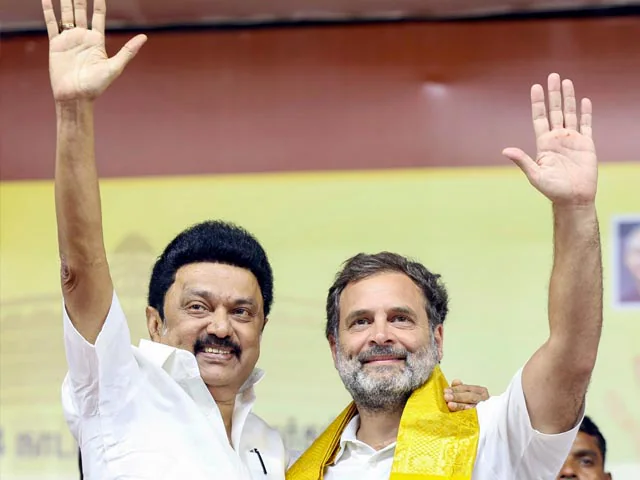
Stalin Rahul Gandhi Puducherry campaign on the same day but without sharing a stage has triggered immediate speculation about the coordination and cohesion within the INDIA bloc alliance as both leaders conducted separate election meetings in the Union Territory on Monday, just days before voting in Puducherry and Kerala is scheduled for April 9. Tamil Nadu Chief Minister MK Stalin and Congress leader Rahul Gandhi were simultaneously holding campaign meetings in the same territory without appearing together on a common platform, an optic that raised questions among political observers about whether the absence of a joint appearance reflects a substantive internal disagreement within the alliance or a straightforward scheduling decision that has been overread in the pressure-cooker atmosphere of the final campaign days. With campaigning set to conclude by Tuesday evening and the final phase of high-voltage canvassing underway across multiple states simultaneously, the logistics of coordinating senior leaders across Kerala, Puducherry, Assam, Tamil Nadu, and West Bengal in a compressed timeline are genuinely complex, but the optic of two alliance pillars campaigning separately in a single small territory is difficult to explain away as purely logistical.
Rahul Gandhi and Priyanka Gandhi arrived in Chennai from Delhi on Monday morning in a special aircraft, landing at the old terminal of Chennai airport around 10 am in a transit halt that underlined the pace and scale of the Congress campaign mobilisation across multiple poll-bound states. Senior Tamil Nadu Congress leaders including former TNCC presidents Thangabalu and Krishnasamy were present to receive the Gandhi siblings, though TNCC president Selvaperuthagai was notably absent from the airport reception, an absence that generated its own sub-narrative about intra-Congress dynamics in Tamil Nadu. After a brief halt at the VIP lounge, Rahul Gandhi departed for Puducherry in a smaller chartered aircraft around 10.30 am, while Priyanka Gandhi left for Kannur in Kerala on the aircraft that had brought them from Delhi, splitting the Congress's two highest-profile campaign assets across two different states in a single morning.
The absence of any campaign event in Tamil Nadu by either Gandhi despite their Chennai transit is itself a data point that Congress sources explained with the assurance that both leaders would return for dedicated Tamil Nadu campaign engagements in the coming days, suggesting the Chennai stop was genuinely a transit arrangement rather than a planned campaign visit. The broader picture that Monday's travel pattern creates is one of an INDIA alliance in the final days of a multi-state election campaign trying to maximise the presence of its most recognisable leaders across the maximum number of competitive constituencies simultaneously, a logistical challenge that necessarily produces some coordination gaps and some optics that are less than ideal. Whether the Stalin-Rahul separate campaign appearances in Puducherry represent one of those unavoidable gaps or something more significant is the question that alliance-watchers are asking as voting day approaches.
The INDIA Bloc Alliance Architecture and Its Puducherry Dimension
The INDIA bloc alliance, whose full name is the Indian National Developmental Inclusive Alliance, was constructed as a broad opposition coalition specifically designed to present a united front against the BJP-led NDA in the 2026 state assembly elections across multiple states where the constituent parties have agreed to seat-sharing arrangements and cooperative campaign strategies. The alliance's architecture varies significantly by state, reflecting the different strengths, histories, and competitive landscapes of the partner parties in each regional context, and the Congress-DMK relationship in Tamil Nadu and Puducherry is one of the alliance's most developed and historically rooted partnerships, built on decades of electoral cooperation between the two parties that goes back well before the formal INDIA bloc framework was established.
The DMK-Congress alliance in Tamil Nadu, where Stalin's party is the dominant partner, has been one of the most stable and consistently productive electoral partnerships in South Indian politics, consistently outperforming the combined vote shares of its constituent parties through the synergies of their complementary voter bases and organisational networks. In Tamil Nadu, where the DMK governs and holds legislative dominance, the Congress plays a junior but important role as the partner that brings its own voter base and the national party's organisational resources to strengthen the alliance's overall reach. In Puducherry, whose political dynamics are distinct from Tamil Nadu despite the geographic and cultural connections, the alliance's relative positioning is somewhat different given the Congress's own direct organisational presence and electoral history in the territory as a standalone political force with its own chief ministerial ambitions.
Puducherry's status as a Union Territory with its own assembly gives it a political significance beyond its small geographic and demographic size, both as a direct legislative contest where the alliance parties seek seats and as a symbolic electoral arena where the quality of alliance coordination is visible to observers tracking the INDIA bloc's operational effectiveness. A joint appearance by Stalin and Rahul Gandhi in Puducherry would have demonstrated both the personal warmth between the DMK and Congress leaderships and the operational capacity of the alliance to coordinate its highest-profile assets for maximum campaign impact. The absence of that joint appearance, whatever its actual cause, deprives the alliance of that demonstration at precisely the moment when the campaign is seeking to project unified strength in its final days.
The Congress Campaign Infrastructure and the Gandhi Siblings' Role
The Congress party's deployment of Rahul Gandhi and Priyanka Gandhi as its primary national campaign assets across multiple state elections simultaneously represents both the party's greatest electoral advantage and its most acute resource constraint, given that the party's ability to draw large crowds and generate national media attention is concentrated in a handful of leaders whose physical presence can only be in one place at any given time. The strategy of using the two Gandhi siblings in complementary geographic deployments, Rahul to Puducherry and Priyanka to Kannur in Kerala on the same day, reflects an attempt to maximise the aggregate campaign impact of their combined presence across two different electoral theatres simultaneously rather than combining their presence in one location at the cost of the other.
The presence of former TNCC presidents Thangabalu and Krishnasamy at the Chennai airport reception, alongside the absence of current TNCC president Selvaperuthagai, created an internal Congress optic that is difficult to interpret definitively from outside the party but that is consistent with the intra-party dynamics that have periodically complicated the Tamil Nadu Congress's electoral effectiveness. The TNCC presidency's absence from a reception for the party's national leadership could reflect a scheduling conflict, a protocol misunderstanding, or a more substantive signal about the relationship between the state unit leadership and the national party structure, and Congress sources would be expected to provide the benign explanation regardless of the actual cause. What is certain is that in the hyper-scrutinised environment of final campaign days, every optic is interpreted and every absence noted.
The Congress's decision not to hold any campaign events in Tamil Nadu despite the Gandhi siblings' Chennai transit speaks to the party's assessment of where its most urgent campaign investments should be made in the final days before voting. Tamil Nadu votes on April 23, providing two more weeks of campaign opportunity, while Puducherry and Kerala vote on April 9, making those territories the immediate priority for leader deployment regardless of the sub-optimal optics created by passing through Chennai without campaigning. The return commitment for dedicated Tamil Nadu engagements that Congress sources communicated is the standard response to this kind of scheduling explanation, and its credibility will be tested by whether those Tamil Nadu visits actually materialise in the days between Monday's transit and the April 23 voting date.
Puducherry's Political Landscape and Alliance Dynamics in the Territory
Puducherry's political history is characterised by closely contested elections between the Congress-led alliance and the AIADMK-led NDA alliance, with the BJP having a small but influential presence that has grown with the national party's expansion. The territory's small size, with 30 assembly seats, makes it a high-density campaign environment where senior leader visits have disproportionate impact relative to the logistics required, and where the visibility of intra-alliance coordination, or the lack thereof, is amplified by the compressed geographic canvas in which all campaigning happens. A joint Stalin-Rahul appearance in Puducherry would have dominated the territory's final campaign news cycle; the separate appearances have instead generated a narrative about alliance questions that partially overshadows both leaders' individual campaign messages.
The DMK's organisational presence in Puducherry, which shares a border and extensive cultural and economic ties with Tamil Nadu, has historically been a significant asset for the alliance's campaign in the territory, with Tamil-speaking voters in Puducherry's mainland areas being a natural constituency for DMK-aligned political messaging. Stalin's personal appearance in Puducherry signals the DMK's serious investment in the alliance's Puducherry campaign, and the content of his campaign meeting would be expected to focus on the development achievements and welfare programmes of the DMK government in Tamil Nadu as a model for what INDIA alliance governance could deliver in Puducherry. That substantive campaign message is undermined in its presentation when the alliance's coordination appears incomplete, as the separate-stage appearances suggest.
The speculation about whether the separate appearances reflect an internal rift or a scheduling decision is ultimately impossible to resolve from the available public information, and both characterisations fit the observable facts. Alliance partners in a multi-state election campaign regularly campaign in the same territory on the same day without sharing a stage for reasons of scheduling, logistics, and the optimal deployment of limited senior leader time. But alliance partners who are seeking to project unified strength also regularly create joint appearance opportunities precisely because the optic of unity has independent political value beyond the sum of the individual appearances. The absence of that deliberate joint appearance decision in Puducherry, at this point in the campaign, is what has generated the speculation that the Monday campaign pattern is now required to address.
The Final Campaign Push, April 9 Voting, and What the Alliance Must Demonstrate
The simultaneous assembly elections across Tamil Nadu, Puducherry, Kerala, Assam, and West Bengal that have compressed multiple state electoral contests into a single campaign window create coordination demands for both the INDIA bloc alliance and its constituent parties that have no equivalent in single-state election management. Each state election requires dedicated senior leader presence at critical moments in the campaign cycle, customised policy messaging appropriate to the specific competitive dynamics of each state, and operational synchronisation between national party structures and state party organisations that have their own internal priorities and relationship dynamics. Managing all of these requirements simultaneously for five states while also maintaining the visible solidarity of a multi-party alliance is a logistical and political challenge of genuine complexity that inevitably produces some coordination gaps and some optic compromises.
The April 9 voting date for Puducherry and Kerala creates a specific urgency that makes the final days of campaigning in those territories the highest priority for senior leader allocation regardless of what it costs in terms of presence elsewhere. With campaigning concluding by Tuesday evening, Monday was the last full day of campaign activity available in both territories, making it the most important day for deploying the party's most impactful assets. The Gandhi siblings' distribution across Puducherry and Kerala on this critical final Monday reflects a rational allocation of scarce high-value campaign resources, but the rationality of the allocation does not automatically resolve the optic problem created by the absence of a joint Stalin-Rahul appearance in Puducherry when both leaders were in the territory simultaneously.
Rahul Gandhi's expected travel to Kochi later in the day to continue his Kerala campaign schedule underlines the pace of the final campaign period and the physical demands it places on the party's most visible leaders. The transit pattern of Monday, Delhi to Chennai to Puducherry to Kochi for Rahul Gandhi, and Delhi to Chennai to Kannur for Priyanka Gandhi, represents a schedule that is designed to extract maximum campaign value from a single day across multiple geographies in a way that is only possible with dedicated aircraft and the kind of precise scheduling that senior political campaigns require. That the schedule left no time or space for a joint Stalin-Gandhi appearance in Puducherry despite both being in the territory is a fact that the alliance's communication strategy will need to address in how it presents the day's campaign activity to the media and to voters.
What Alliance Buzz Means Politically and How the Parties Are Responding
The alliance buzz triggered by the separate Puducherry campaign appearances is a specific type of political narrative that opposition alliances find particularly damaging in the final days before voting, because it shifts media attention from the alliance's campaign messages to internal coordination questions at precisely the moment when the campaign needs to be projecting unified strength and electoral confidence. The BJP and NDA opposition will amplify any coverage of alliance coordination questions as evidence of the INDIA bloc's internal divisions, while the alliance partners will seek to minimise the narrative by providing logistical explanations and by pointing to the substantive content of both leaders' campaign meetings as evidence of aligned messaging if not aligned staging.
Congress sources' explanation that both Gandhi leaders would return for dedicated Tamil Nadu campaign engagements represents the party's attempt to manage the narrative about the Chennai transit without campaign events, reassuring the Tamil Nadu Congress organisation and its allied partner the DMK that the absence of Tamil Nadu events on Monday reflects scheduling rather than strategic de-prioritisation. The credibility of that reassurance depends on whether the promised Tamil Nadu returns materialise on a timeline that allows meaningful campaign impact before the April 23 Tamil Nadu voting date, and the Tamil Nadu Congress's own political standing within the alliance depends partly on demonstrating that the national party leadership treats Tamil Nadu as a serious campaign investment rather than as a territory to be managed with minimal direct engagement.
The larger question that Monday's Puducherry campaign pattern raises, about the operational maturity of the INDIA bloc alliance's multi-state coordination mechanisms, is one that will be answered more definitively by the election results on May 4 than by any explanation offered in the campaign's final days. Alliance coordination is ultimately measured by electoral outcomes, and the five state elections of April 2026 will provide the clearest available evidence of whether the INDIA bloc's component parties are genuinely aligned in their electoral strategies or whether the visible coordination gaps reflect deeper strategic divergences that affect the alliance's collective performance. The Puducherry optic of Monday is one data point in that larger assessment, and its significance will be calibrated against whatever the votes reveal.