
The United States Treasury Department has issued a 60-day emergency licence temporarily waiving sanctions that have historically choked off US Eases Iran economy, allowing Tehran to sell oil in US dollars for the first time in decades. The waiver, announced on Monday, authorises the production, sale, and delivery of Iranian crude and petrochemicals until August 21, and goes further than many analysts expected by permitting Iranian oil to be imported directly into the United States. It also unlocks banking transactions, insurance, and transportation services tied to Iranian energy trade, effectively dismantling the complex financial workarounds Tehran has historically relied upon to move oil through intermediaries.
Treasury Secretary Scott Bessent framed the waiver as an exchange rather than a concession, saying that in return for the 60-day relief, Tehran had committed to keeping the Strait of Hormuz open and allowing IAEA nuclear inspectors back into the country. Those two commitments would carry enormous trade and diplomatic weight if fulfilled: the Strait of Hormuz handles roughly 20 percent of global oil trade, and its closure during the recent war contributed directly to the energy price surge that strained G7 economies and triggered central bank tightening in Japan and the European Union. Resuming IAEA access would represent the most significant transparency step on Iran's nuclear programme since the UN watchdog pulled its remaining inspectors from the country in the months following the 12-day war.
For global energy markets, the significance of the sanctions waiver is immediate and substantial. Iranian crude returning to legal international markets, even under a temporary licence, increases global supply and puts downward pressure on oil prices that have been elevated throughout the war period. The waiver's explicit permission for Iranian oil to enter the US market directly is especially striking given the decades-long embargo, and signals the degree to which Washington is prepared to use economic concessions as leverage to secure a diplomatic framework within the 60-day window before the licence expires and the full pressure of sanctions returns.
Iran denies committing to nuclear inspectors despite US claims, creating the deal's first public contradiction
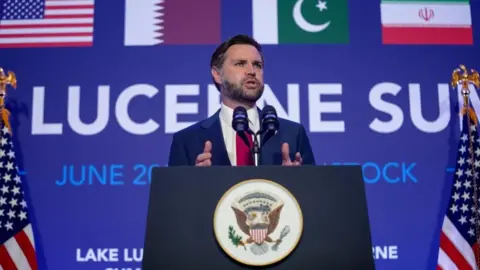
The most significant diplomatic fracture to emerge from the Switzerland talks surfaced immediately after they concluded. Vice-President JD Vance told reporters that nuclear inspector access would begin "at a minimum this week" and that conversations with IAEA inspectors "could happen as soon as today," a statement that framed the inspection commitment as settled and imminent. US President Donald Trump amplified the message on social media, posting that Iran "will agree to have Major Weapons Inspections." Treasury Secretary Bessent had already stated it as a concluded exchange, saying inspection access was one of two Iranian commitments made in return for the sanctions waiver.
Iran's foreign ministry directly contradicted that account. Speaking to Iranian state news agency IRNA, foreign ministry spokesman Esmail Baqai said Tehran had made "no new commitments" on nuclear inspectors, and insisted that any future IAEA engagement would take place "under existing procedures set by Parliament and the Supreme National Security Council." That statement draws a clear boundary: Iran is not acknowledging any new obligation to the US or to the IAEA arising from the Switzerland talks, and it frames whatever discussions may follow as Iran's sovereign decision rather than an externally agreed condition of the sanctions relief.
The IAEA did not immediately comment on either the US claims or Iran's denial, leaving the question of inspection access unresolved in public. Iran suspended IAEA access to sites bombed by Israel and the US during the 12-day war, and the UN watchdog subsequently withdrew its remaining inspectors from the country. Restoring that access is central to any credible final nuclear deal, making the public disagreement between Washington and Tehran over whether a commitment has actually been made one of the most consequential unresolved points heading into the 60-day negotiating window. If Iran maintains that no new inspection commitment exists while the US continues to assert one was made, the gap between the two positions could threaten the framework before the next formal round of talks begins.
How the Switzerland talks produced a 60-day roadmap and what the mediators' joint statement actually commits
The first round of post-ceasefire US-Iran talks took place at the Swiss resort of Burgenstock, with Qatar and Pakistan serving as mediators, and concluded with a joint statement from both mediating countries that was notably precise about what had been agreed and careful not to overclaim. The statement said the two sides had agreed to "a roadmap towards reaching a final deal within 60 days," a framing that describes a process rather than a concluded agreement, and confirmed that negotiating groups covering nuclear issues, sanctions, and reconstruction would be established to carry forward the technical work. Vance described the foundation as "very good."
On the Strait of Hormuz, the mediators' statement confirmed that a "communication line" had been established between the parties "to avoid incidents and miscommunication with the aim of safe passage for commercial vessels." That language is significant for global trade because it creates a direct diplomatic channel designed to prevent the kind of escalation that closed the strait during the war and sent global energy prices sharply higher. Both sides also agreed to the creation of a "de-confliction cell" between the US, Iran, and Lebanon, facilitated by Qatar and Pakistan, to end military operations in Lebanon, where fighting between Israel and Hezbollah has abated since Saturday night with a fragile ceasefire holding.
Iran's Foreign Minister Seyed Abbas Araghchi signalled where Tehran is placing its near-term diplomatic focus, saying the first "real test" of the emerging framework would be Lebanon. That framing suggests Iran sees the Lebanon ceasefire as a credibility benchmark for the broader process, one that must hold before deeper commitments on nuclear access or long-term sanctions relief become politically viable at home. For US negotiators, Lebanon represents a parallel track that intersects with the 60-day nuclear and sanctions timeline but operates on its own logic, adding complexity to a diplomatic process that is already managing contradictory public statements on the nuclear inspection question.
What the nuclear inspection dispute and past deal history mean for the 60-day deadline
The current diplomatic moment cannot be separated from the history of how the previous US-Iran nuclear agreement collapsed. In 2015, Iran and six world powers, the US, China, France, Russia, Germany, and the UK, struck a deal allowing IAEA inspections of Iranian nuclear sites in exchange for sanctions relief. That agreement held until 2018, when Trump in his first term withdrew the US from the deal, describing it as a "bad deal" and reimposing the sweeping sanctions architecture that the current 60-day waiver is now temporarily dismantling. That withdrawal, and the years of economic pressure that followed, shaped Iran's current negotiating posture and explains the foreign ministry's insistence that no new inspection commitments have been made outside of existing parliamentary and security council frameworks.
The tensions that nearly derailed the Switzerland talks before they concluded illustrate how fragile the current framework remains. Vance acknowledged that Iranian negotiators threatened to walk out on Sunday after Trump posted on Truth Social that the US could "hit Iran very hard again," a statement Iran's delegation interpreted as a threat during active negotiations. Vance said he told Iranian negotiators that Trump was merely responding to Iranian "trash talk," a characterisation that reflects the informal and volatile communication dynamic running alongside the formal diplomatic track. On Monday, Trump issued another public warning from the Oval Office: "If Iran doesn't live up to their agreement, or if they're not behaving, I will do what I have to do."
For trade and financial markets, the 60-day countdown to August 21 is now the central timeline to watch. If the two sides can resolve the nuclear inspection dispute, formalise the Hormuz communication channel, and make progress in the working groups on sanctions and reconstruction within that window, the conditions for a more durable oil trade normalisation and a permanent diplomatic framework become possible. If the talks stall, the sanctions waiver expires, and the full weight of the US embargo returns to Iran's economy, the economic disruption for global energy markets could intensify again at the precise moment when commodity prices have only just begun to reflect the prospect of a lasting diplomatic resolution.