
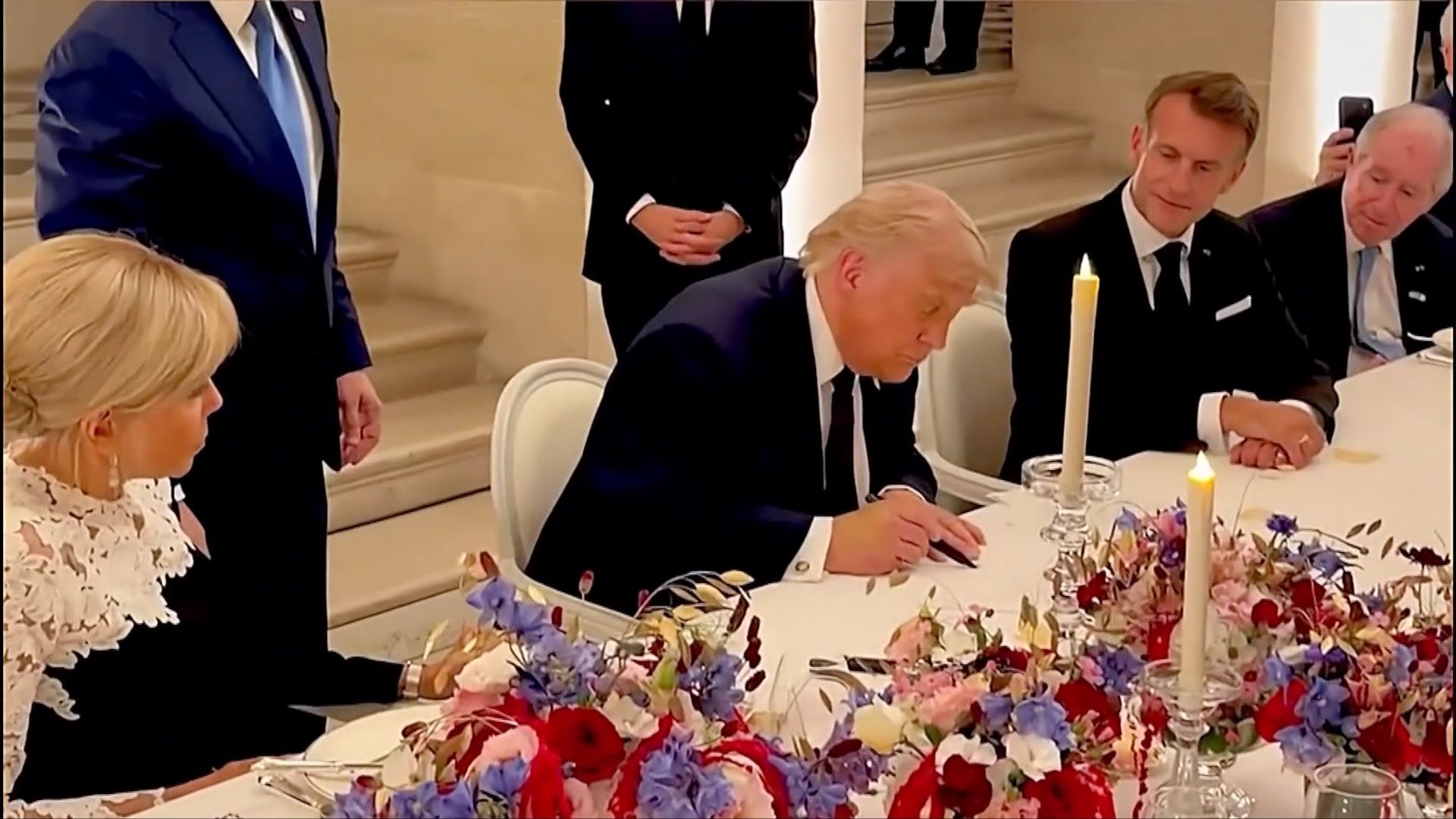
US Iran ceasefire agreement signed Trump Versailles G7 2026 has been formally released with both presidents having digitally signed the 14-point memorandum of understanding in English and Farsi, with the agreement including an immediate end to the war on all fronts, the full resumption of maritime traffic with no charge in the Strait of Hormuz, the lifting of the U.S. blockade of Iranian ports, the waiving of U.S. sanctions on Iran, the unfreezing of Iranian assets, and a $300 billion investment fund for the Islamic Republic's post-war reconstruction, while simultaneously Trump threatened at a G7 press conference to bomb the hell out of Iran if they violate the agreement and withdraw his previously stated goal of obliterating Iran's ballistic missiles as unfair, creating the specific diplomatic paradox of a historic agreement announced alongside resumption-of-war threats that drove oil prices briefly back up after they had fallen below $80 a barrel for the first time since the conflict began. Trump signed the agreement just before a grand dinner with French President Macron at the Palace of Versailles, the site of the treaty that formally ended World War One, connecting the diplomatic moment to the most historically resonant peace-making venue in European history while the agreement's specific terms document that Iran appears much closer to sanctions relief worth billions of dollars than before it was attacked and that Trump appears to have achieved little of what he publicly stated as his war objectives.
The agreement's 14 points represent the most detailed public documentation of the deal framework whose announcement earlier this week drove oil markets and diplomatic celebrations, and their specific content creates the accountability baseline against which both sides' compliance will be measured and against which Trump's war rationales can now be directly compared. Iran undertakes not to build nuclear weapons, reaffirming a vow it has made for decades rather than making a new commitment, and agrees to the on-site down-blending of its enriched uranium stockpile under IAEA supervision, which falls short of the removal from the country that Trump had wanted and which Iran had rejected, creating the specific nuclear provision whose compromise between American maximum demands and Iranian minimum concessions represents the deal's most consequential technical accommodation. Iran's lead negotiator Mohammad Baqer Qalibaf told Iranian state television that everything they sought to achieve through military action was obtained several times over through negotiation, and that it was not even comparable, a characterisation that the deal's terms on sanctions relief, asset unfreezing, and reconstruction funding appears to support from the Iranian perspective.
The trade and diplomacy assessment of the deal must confront the specific gap between the war's stated objectives and its negotiated outcome directly: Iran's theocratic government remains in place, its stockpile of highly enriched uranium has not been surrendered, its ballistic missile capabilities have not been destroyed, it has not ended its support for anti-Israel militias like Hezbollah in Lebanon, and Trump has now recanted his February promise to destroy all of Iran's missiles and raze their missile industry to the ground, saying instead that it would be unfair for Iran not to have some missiles given that other countries have them. This represents a diplomatic outcome whose beneficiaries, in terms of concrete material gains from the war's settlement, appear more clearly on the Iranian side than the American, raising the specific diplomatic accountability question that European leaders' concerns about Iran having gained leverage by withstanding the superpower onslaught and asserting control over the strait have been raising since the deal's framework emerged.
What the War's Objectives Were and What the Agreement Delivers on Each
The war that began on February 28 with joint U.S.-Israeli strikes on Iran that assassinated Supreme Leader Ayatollah Ali Khamenei on the conflict's first day was justified by Trump through a series of stated objectives that the 14-point agreement's terms must now be evaluated against, including the destruction of Iran's nuclear weapons programme, the obliteration of its ballistic missile industry, the removal of its regional proxy network starting with Hezbollah in Lebanon, and the regime change that the assassination of the supreme leader's successor was implicitly designed to facilitate. The conflict quickly spiralled into a regional war that killed more than 7,000 people mostly in Iran and Lebanon, drove up energy prices through the Hormuz closure, renewed inflationary pressures across the global economy, and sparked concerns about major food supply crises in developing countries whose fertiliser and food import access was disrupted by the energy and supply chain consequences of a war that affected commodity markets well beyond the Middle East.
The 60-day negotiation period that the memorandum opens for a permanent truce will need to address the specific gaps between the agreement's current provisions and the war's originally stated objectives, but the direction of those gaps is now clearly established by the signed text: the nuclear weapons undertaking is a reaffirmation of an existing vow rather than a new verifiable commitment, the ballistic missile programme has been explicitly acknowledged by Trump as something Iran is entitled to have, the Hezbollah support relationship is not addressed in the 14 points, and the Iranian government's composition is unchanged by a war that began by assassinating its supreme leader. The $300 billion reconstruction fund and the sanctions waiver represent the positive inducements that the deal provides to Iran as the incentives for its compliance with the ceasefire framework, and the scale of these benefits relative to the concessions Iran has made creates the Iranian perception that Qalibaf expressed, that negotiation yielded more than military action would have.
Trump's withdrawal of the ballistic missile objective is the most direct and specific recantation of a publicly stated war aim, because his February declaration of intent to raze Iran's missile industry to the ground was an explicit and concrete military objective whose reversal cannot be characterised as a reinterpretation or a strategic evolution but only as a withdrawal of the commitment under pressure from the specific reality that Iran's missiles remain and that achieving their destruction would have required a level of military escalation that the ceasefire framework has been designed to avoid. The unfairness framing through which Trump justified the reversal, saying it would be unfair for Tehran not to have ballistic missiles if other countries have them, represents the most revealing diplomatic statement of the entire war, because it applies the reciprocity logic that Trump consistently uses to justify his bilateral policy preferences to an adversary whose weapons programme he had just spent four months bombing and blockading to destroy, creating the cognitive dissonance that the deal's terms make unavoidable.
The Historical Significance of the First US-Iran Presidential Signature
The photographs released by Iran of what is believed to be the first agreement signed by both a U.S. and Iranian president since the Islamic Republic's founding in 1979 represent a diplomatic milestone whose historical significance transcends the specific terms of the current memorandum, documenting the first direct presidential-level formal commitment between the two countries across the 47 years of official enmity that began with the 1979 revolution and the hostage crisis that embedded the mutual hostility in both countries' political cultures. The 14-point memorandum signed digitally in both English and Farsi creates the specific bilateral document that gives both governments a formal shared text to reference, dispute, and build upon in the 60-day negotiations, replacing the pattern of competing characterisations of the war's status that has complicated every previous ceasefire announcement with a jointly signed authoritative document whose text neither side can unilaterally revise. Trump signed at Versailles, with the palace's World War One peace treaty association providing the historical framing that the occasion's diplomatic architects presumably chose deliberately, while Iran's foreign ministry spokesperson Baghaei's statement that no Switzerland signing ceremony would be held because the presidents had already signed documents the Iranian side's preference for recognising Wednesday's digital signature as the agreement's conclusive moment rather than the originally announced Friday ceremony.
The G7 leaders' joint statement demanding an immediate ceasefire in Lebanon alongside their welcoming of the U.S.-Iran agreement creates the multilateral accountability framework that the agreement's Lebanon provisions require, because the memorandum's call for a halt to hostilities between Israel and Hezbollah cannot be enforced by either the U.S. or Iran alone and requires the broader international community's pressure on Israel, which was not part of the negotiations and whose military is occupying southern Lebanon, to translate the text's Lebanon commitment into the operational reality that the ceasefire requires. Israel's assertion that it retains the right to use force, the fresh Israeli air strikes and artillery fire reported in southern Lebanon on Wednesday, and the Hezbollah drone attacks that injured five Israeli soldiers in the south, document that Lebanon's fighting has abated but not ceased despite the agreement, creating the most immediate test of whether the 14-point memorandum's Lebanon provisions can be implemented in the face of two parties whose military engagement the agreement did not include in its negotiation.
Oil Markets, Lebanon's Continued Fighting, and the 60-Day Negotiation Ahead
Brent crude falling below $80 a barrel for the first time since the war began represents the market's assessment of the Hormuz reopening's full economic significance, translating the agreement's text into the energy price consequence whose magnitude documents the economic cost that the four-month closure imposed on the global economy. Oil prices' subsequent recovery of more than 1 percent after Trump threatened renewed violence captures the specific market dynamic that the agreement's tone creates, where the deal's economic benefits are genuine and the Hormuz reopening is real, but the resumption-of-war threats that accompany the announcement create the risk premium that prevents the full adjustment to the pre-war energy price baseline that the deal's implementation would otherwise justify. The $80 price level represents a significant reduction from the conflict-period highs above $100 that characterised the Hormuz closure's peak pressure, providing the immediate consumer relief from fuel price inflation that has been the most politically damaging domestic consequence of the war for Trump and his Republican allies ahead of the November midterms.
The $300 billion reconstruction fund for Iran's post-war rebuilding is the most financially significant bilateral commitment in the 14 points and the one whose implications extend furthest into the future relationship between the two countries, because the scale of reconstruction investment it implies requires the kind of sustained bilateral economic engagement that the war's four months and the previous decades of hostility have made essentially impossible. The fund's structure, whether it involves direct U.S. government contributions, private American investment facilitated by sanctions relief, or international financing from the Gulf Arab states and other parties, was not specified in the publicly released text, creating the specific implementation question that the 60-day negotiations must resolve before the reconstruction commitment can be operationalised. Iran's own economic priority in the settlement, combining sanctions relief, asset unfreezing, and the reconstruction fund, suggests that the economic dimension of the agreement may prove more durable than the security dimension whose gaps between Trump's stated objectives and the negotiated terms have been most visible in Wednesday's press conference exchanges.
Trump's chiding of Netanyahu over Lebanon, telling reporters that Netanyahu is a good man who gets a little excited and suggesting a softer touch rather than knocking down buildings every time someone from Hezbollah walks into one, represents the most direct public U.S.-Israel friction produced by the agreement's Lebanon provisions, whose implementation depends on Israeli military restraint that Netanyahu has not committed to and that Trump appears unwilling to firmly demand. The we have a little dispute over Lebanon formulation acknowledges the Israeli-American divergence without resolving it, creating the specific ambiguity that Lebanon's continued fighting makes operationally consequential, because the memorandum's Lebanon ceasefire commitment cannot be implemented while Israel asserts the right to use force and continues striking Lebanese targets. The European leaders who demanded an immediate Lebanon ceasefire in their G7 joint statement have added their institutional voice to this demand, but the enforcement mechanism that translates the demand into Israeli compliance remains undefined.