
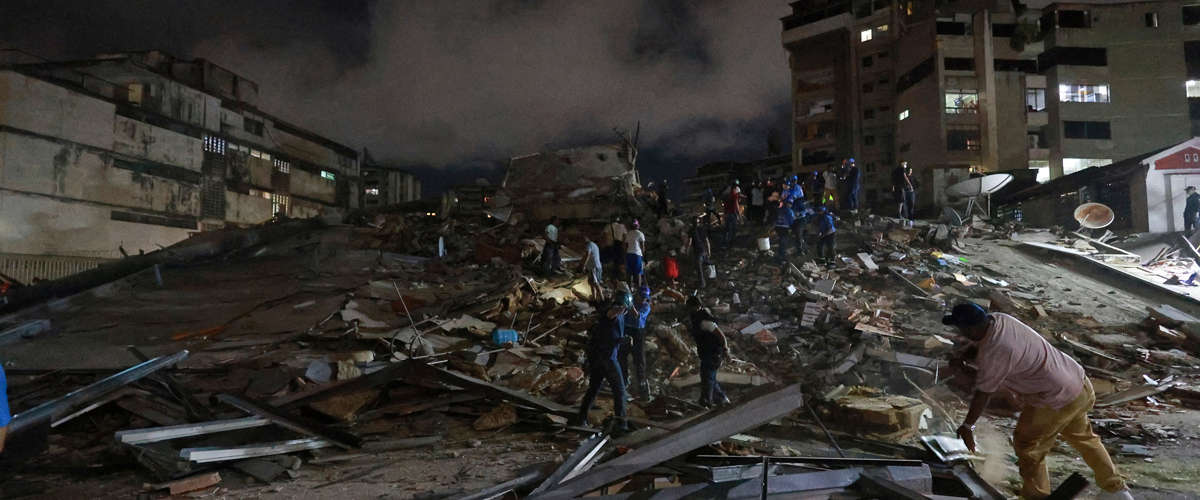
Venezuela earthquake dead 164 Caracas La Guaira rescue 2026 toll has risen to at least 164 confirmed fatalities as acting President Delcy Rodriguez delivered an early Thursday update that excluded any figures from La Guaira state, which she declared a disaster zone where dozens of buildings including a collapsed hotel have fallen and whose casualty numbers had not yet been fully counted into the national total, meaning the confirmed death count significantly understates the actual human cost of Wednesday's double earthquake sequence whose magnitudes of 7.2 and 7.5 struck less than a minute apart in the strongest seismic event to hit Venezuela since 1900. Rescuers are working through rubble in Caracas where people have been heard calling for help from under collapsed structures, with hundreds of residents spending the night on the streets of Los Palos Grandes and other affected residential districts, sleeping on the ground with sheets they managed to carry from their homes, holding pets, and watching rescue operations while waiting for news about family members who may still be trapped. Internet connectivity fell to 59 percent of normal capacity shortly after the earthquakes before partially recovering to 77 percent by early Thursday morning according to monitoring group NetBlocks, which attributed the disruption to power cuts and infrastructure damage and warned it was hindering rescue efforts and limiting visibility into events on the ground.
The crisis impact picture that emerges from the first twelve hours combines the acute human emergency of search and rescue operations in multiple collapsed building sites across Caracas and La Guaira with the systemic crisis of a country whose pre-existing infrastructure weaknesses have been catastrophically exposed by the seismic event. Venezuela's chronically failing electric network, which one BBC Mundo correspondent described as producing power outages almost every day in normal conditions, has been further destabilised by the earthquake's infrastructure damage, creating the specific information blackout that compounds the physical destruction's human consequences by preventing residents from accessing emergency guidance, preventing diaspora Venezuelans from reaching family members, and preventing rescue coordination from functioning at the speed and precision that urban search operations require. The UN's Independent International Fact-Finding Mission on Venezuela specifically called on the country's telecommunications regulator to fully unblock social media and all media outlets, adding that access to information will be a matter of life and death, connecting the pre-existing Venezuelan media freedom crisis to the earthquake emergency in terms that document how governance failures multiply disaster consequences.
The political context that frames the crisis response is as significant as the physical one. Rodriguez's government, managing the country since the U.S. military intervention removed Nicolas Maduro in January, operates a Venezuelan state whose oil revenues are effectively controlled by Washington and whose institutional capacity has been described by analysts as unlikely to be well-equipped to deal with a disaster on this scale. The U.S. Congress's complaints about transparency over Venezuelan oil revenue management, combined with the absence of clear democratic transition progress, creates the specific political fragility that the earthquake emergency arrives into, making this both a humanitarian crisis and a governance test whose outcome will shape the trajectory of Venezuela's post-Maduro political transition at its most vulnerable moment.
How Venezuela's Compounding Crises Created Maximum Earthquake Vulnerability
Venezuela's vulnerability to the earthquake's consequences extends far beyond the ground shaking intensity that the 7.2 and 7.5 magnitudes produced, because the compounding effect of a decade of economic crisis, infrastructure disinvestment, institutional degradation, and mass emigration of skilled workers has created a country whose resilience to any major external shock has been progressively depleted to the point where the earthquake's physical damage is being absorbed by systems already operating near or beyond their functional limits. The electric grid that was failing before the earthquake, producing the daily power outages that residents described as normal life in Venezuela, has no reserve capacity with which to manage the additional load that earthquake damage creates, meaning that the power restoration challenge facing authorities is not the typical post-disaster infrastructure repair task but the repair of a damaged system whose pre-damage state was already inadequate for the population it serves.
The building stock vulnerability that produced the multiple collapses in Caracas and the dozens of fallen buildings in La Guaira reflects the specific consequence of economic crisis on urban construction maintenance and earthquake preparedness, with buildings whose structural maintenance has been deferred through years of economic impossibility presenting the specific combination of pre-existing damage and new seismic stress that produces collapse when the same buildings might have survived in better-maintained condition. The Chacao district mayor's report of at least 11 fatalities in his municipality alone, combined with the La Guaira disaster zone declaration whose casualty count had not been included in Rodriguez's 164 total at time of early Thursday reporting, suggests that the building collapse mortality is distributed across multiple districts in ways that the national total number will progressively accumulate over the coming days as rescue teams reach areas whose damage was known but unquantified.
The millions of Venezuelans living abroad who were unable to contact family members as of early Thursday document the human extension of the crisis beyond the country's borders into the diaspora communities whose separation from Venezuela during the economic crisis years has made earthquake uncertainty a specific form of anguish. The BBC Mundo correspondent's account of having chatted with Caracas friends who cannot sleep out of fear captures the subjective experience of the millions inside Venezuela who survived the initial quakes but whose ongoing exposure to aftershock risk, building instability uncertainty, and lack of reliable information creates the sustained psychological crisis that follows major earthquakes in cities whose residents cannot be sure their remaining homes are safe to re-enter.
The Seismic Geology and Why Venezuela's Double Shallow Quake Was Catastrophic
Northern Venezuela's position on the boundary between the Caribbean and South American tectonic plates creates the specific geological setting that has produced the country's most destructive earthquakes throughout its recorded history, with the plate boundary's complex interaction geometry generating both the frequency and the magnitude potential that Wednesday's event expressed at its most extreme level in more than a century. The shallow depth of both earthquakes, less than 30 kilometres below ground, is the specific geological characteristic that amplified the surface shaking intensity beyond what the magnitude readings alone would suggest to non-specialists, because shallow earthquakes deliver their energy to the surface across a shorter travel distance that concentrates rather than dissipates the ground motion. The 1812 earthquake that killed approximately 30,000 people was similarly a shallow event on the same plate boundary, making the comparison that the 80-year-old resident drew between Wednesday's quake and the 1967 event reflect the lived experience dimension of a seismic legacy whose historical depth documents the consistent vulnerability of Venezuelan cities to this specific type of geological event.
The double earthquake sequence's specific destructive mechanism involves the structural exhaustion that the sequential shaking produces, with buildings that survive the initial 7.2 with structural damage then subjected to the 7.5's energy before any safety assessment or stabilisation has occurred. Structural engineering assessments of earthquake sequences consistently document higher collapse rates in double events than in single events of equivalent maximum magnitude, because the first shock's damage propagation through structural members reduces the second shock's resistance threshold in ways that produce collapses that the individual events' magnitudes would not predict. The USGS's estimate that thousands of people could have been killed in total, a range that current confirmed figures have not yet approached but whose possibility the La Guaira disaster zone's undocumented casualties leave open, reflects this assessment methodology applied to a densely populated capital and coastal state with the building stock vulnerability and pre-existing infrastructure weakness that Venezuela's crisis years have produced.
The Overnight Streets, Internet Blackout, and What the 72-Hour Window Demands
The scene in Los Palos Grandes at 5 a.m. Thursday, with hundreds of people sleeping on streets and in parked vehicles or not sleeping at all out of fear, captures the specific human experience of the earthquake's aftermath in a residential Caracas district where building collapses have made home re-entry impossible or too frightening even for those whose structures remain standing. The woman sitting on the steps of a square who says how do you go back to living like this and describes the scene as like something out of a movie she has never seen in her life articulates the psychological rupture that major urban earthquakes impose on their survivors, whose relationship with the physical environment of their daily lives has been fundamentally destabilised by the ground's betrayal of its assumed solidity. The families holding pets, the people watching rescue operations for news of trapped loved ones, and the cars blocked in by rubble collectively paint the specific geography of a neighbourhood transformed overnight from residential normalcy into disaster site.
The internet connectivity data, falling from 100 percent to 59 percent immediately after the earthquakes before partially recovering to 77 percent by early Thursday according to NetBlocks, creates the information environment within which every aspect of the crisis response is operating at degraded effectiveness. Rescue coordination that depends on mobile communications to direct teams to active survivor signals, family members attempting to account for relatives across the city, international organisations trying to assess where aid should be directed, and journalists attempting to report the scale of damage across multiple districts are all operating with 23 percent less connectivity capacity than normal at a moment when the demand for information exchange has multiplied many times over its normal level. The UN's specific call to unblock social media and all media access, framed as a matter of life and death, connects the information access dimension to the physical survival dimension in terms that make Venezuela's media freedom ranking of 159 out of 180 countries not an abstract press freedom statistic but a specific crisis response impediment whose consequences are being measured in rescue delays.
The 72-hour survival window that international disaster response doctrine identifies as the critical period for finding earthquake survivors alive creates the specific temporal urgency that the overnight operations must be understood against, with every hour of darkness and degraded connectivity that passes reducing the probability of finding survivors in the rubble of Caracas and La Guaira buildings. Rodriguez's foreign ministry coordination of international aid offers, the U.S. State Department's mobilisation of assistance, and the UN Office for Project Services director's description of significant loss to life and severe damage to vital infrastructure collectively document the international response architecture activating around a crisis whose domestic response capacity is constrained by the same infrastructure failures that make the earthquake's consequences so severe in the first place.