
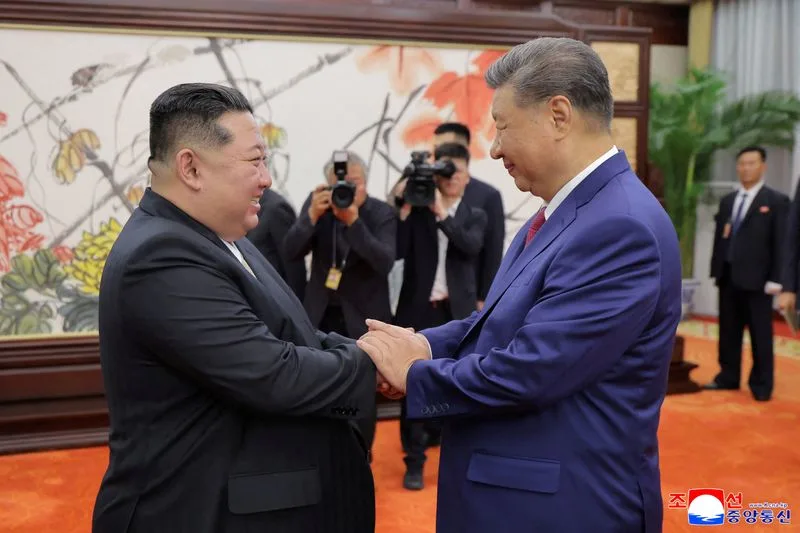
Chinese President Xi Jinping North Korea Visit arrived in capital Pyongyang on Monday for a two-day state visit and summit with leader Kim Jong Un, his first trip to the country in seven years and, significantly, his first international visit of 2026. That choice of destination is itself a calculated political signal. In a year when tensions between China and the United States remain elevated across multiple fronts, Xi's decision to open his international travel calendar with a visit to one of Washington's most persistent adversaries sets a clear tone for Beijing's foreign policy posture in the months ahead.
The welcome was deliberately ceremonial and visually powerful. Kim Jong Un and his wife Ri Sol Ju met Xi and his wife Peng Liyuan on the tarmac with a full red-carpet reception, a guard of honour, and children presenting bouquets of flowers. At Kim Il Sung Square, a military band played both national anthems and a 21-gun salute was fired as spectators beneath large portraits of both leaders chanted slogans and released balloons. The staging was designed to project the vitality and warmth of the bilateral relationship to domestic audiences in both countries and to international observers watching from Washington, Seoul, and Tokyo.
Xi wasted no time in framing the visit's political purpose. In remarks published in North Korea's state newspaper Rodong Sinmun ahead of his arrival, he declared that ties between China and North Korea are at a "new historical starting point" and pledged to strengthen exchanges across all areas. He also made a pointed reference to opposing "hegemony, authoritarianism and all attempts and conspiracies to revive militarism," language that Beijing routinely deploys as implicit criticism of US military alliances in Asia, including the deepening security partnerships between Washington, Seoul, and Tokyo that have accelerated over the past two years.
What the summit reveals about the China-North Korea-Russia strategic alignment taking shape
The Pyongyang summit does not exist in diplomatic isolation. It is the most visible recent expression of a broader strategic convergence between China, North Korea, Russia, and Iran, four countries that share a common interest in reducing US global influence, straining Washington's alliance networks, and building alternative economic and security arrangements that operate outside Western-dominated institutions. Craig Singleton, a senior China fellow at the Foundation for Defense of Democracies, described the Xi-Kim summit plainly: "Beijing still sees Pyongyang as a strategic asset." That framing captures both the transactional and the structural dimensions of the relationship.
North Korea's economy has been materially strengthened over the past two years by growing trade and military ties with Russia, a relationship that accelerated dramatically following Russia's full-scale invasion of Ukraine in 2022 and the subsequent Western sanctions regime that isolated Moscow economically. Pyongyang has supplied artillery shells and other munitions to Russia's war effort in exchange for economic support, technology transfers, and diplomatic backing. That arrangement has reduced North Korea's dependence on China as its sole economic lifeline, giving Kim Jong Un more confidence and leverage heading into the summit with Xi than he possessed during their last meeting seven years ago.
Xi also hosted Kim and other world leaders at a major military parade in Beijing last year, alongside Russian President Vladimir Putin, and since then Pyongyang has resumed crossings at the Chinese border and stepped up exchanges that were frozen during the COVID-19 pandemic. Air China restored direct flights between Beijing and Pyongyang in March of this year. John Delury, a senior fellow of the Asia Society, noted that "his visit is about keeping the tradition alive in very different conditions than his last trip" — a characterisation that acknowledges both the continuity of the relationship and the significantly changed geopolitical environment in which it is now operating.
North Korea's nuclear arsenal has grown and a new destroyer was unveiled the day before Xi arrived
The timing of North Korea's military disclosures on the eve of Xi's arrival was clearly deliberate. Pyongyang unveiled plans for a 10,000-ton naval destroyer and reaffirmed its constitutional status as a nuclear-armed state, two announcements that together project a message of growing conventional and strategic military capability. A 10,000-ton destroyer would represent a significant expansion of North Korea's blue-water naval ambitions, placing it in a class of warship capable of extended ocean operations and long-range strike missions well beyond the Korean Peninsula.
The nuclear picture is equally significant. The Stockholm International Peace Research Institute published fresh estimates on Sunday indicating that North Korea probably has a nuclear arsenal of approximately 60 warheads, up from an estimated 50 a year ago. SIPRI also assessed that North Korea is stepping up production of fissile material at a pace sufficient to support at least 30 additional warheads beyond its current stockpile. That trajectory means Pyongyang's nuclear capability is expanding not just in warhead numbers but in the underlying material capacity to accelerate that growth significantly if it chooses to do so.
For global politics, these disclosures directly complicate the diplomatic environment in Northeast Asia. Washington and Seoul have been pushing for a return to denuclearisation talks, a goal that has produced no meaningful progress for years. Sydney Seiler of Washington's Center for Strategic and International Studies observed that "the sustainability of improved North Korea-Russia and increasing North Korea-China relations may influence just how long Kim can continue to ignore Washington and Seoul." A more economically and militarily confident Pyongyang, backed by both Moscow and Beijing, has far less incentive to engage in negotiations that would require concessions on the nuclear programme that has cost the country decades of isolation to build.
How the relationship between China and North Korea has evolved from past isolation to present strategic partnership
The China-North Korea relationship has never been straightforward, and its current form differs considerably from the dynamic that existed even five years ago. During the COVID-19 pandemic, North Korea sealed its borders almost entirely, including with China, collapsing bilateral trade volumes and deepening Pyongyang's economic isolation. Relations were functionally frozen for several years as Kim prioritised pandemic control over external engagement, creating an unusually distant period between two countries that describe themselves as bound by ties "as close as lips and teeth."
The post-pandemic thaw has been deliberate and structured. Border crossings resumed, trade flows recovered, and the restoration of Air China flights between Beijing and Pyongyang in March 2026 is a symbolic and practical marker of the relationship's normalisation. Xi's state visit now consolidates that recovery at the highest political level. The pomp of the Pyongyang reception, the 21-gun salute, the flags lining the city's main avenues, the bilateral newspaper appearances, are all signals that Beijing regards the relationship as fully re-engaged and wants the world to see that clearly.
For Xi personally, the visit also carries domestic political significance. His first international trip of a year sends a message to Chinese domestic audiences about his foreign policy priorities and his willingness to project Chinese influence on the world stage through relationships that defy Western pressure. Arriving in Pyongyang rather than a European capital or a neutral forum sends a message that China's foreign policy is not shaped by concern about Western approval, a posture that resonates with a Chinese domestic audience that has absorbed years of messaging about US containment strategies and Western double standards on sovereignty and non-interference.
What the Pyongyang summit means for US alliances, Korean Peninsula security, and global order
The strategic implications of a reinvigorated China-North Korea partnership extend well beyond bilateral ties. A more confident and better-resourced North Korea, backed by both Beijing and Moscow, fundamentally alters the security calculus for the United States and its treaty allies in the region. Japan and South Korea have both accelerated their own defence investments and cooperation in recent years, partly in response to exactly this kind of alignment. The unveiling of a 10,000-ton North Korean destroyer on the eve of Xi's visit gives those concerns a tangible new dimension that defence planners in Tokyo, Seoul, and Washington will be assessing immediately.
For US diplomacy, the timing and messaging of the summit presents a direct challenge. Washington has invested considerable effort in strengthening the trilateral security relationship between the United States, Japan, and South Korea, and in maintaining international pressure on Pyongyang's nuclear programme through sanctions and isolation. Xi's visit, with its explicit language about opposing hegemony and promoting multilateralism outside Western frameworks, is a direct counter-narrative to that effort, delivered from inside Pyongyang's own capital with full state ceremony and maximum visibility.
Xi's pledge to work with North Korea to promote "fair and orderly multilateralism and inclusive economic globalisation" signals an ambition that goes beyond the bilateral relationship. It positions China and North Korea as co-advocates for a reordered global system in which Western-led institutions and alliances have reduced authority to set rules and impose costs. Whether that vision gains traction beyond the axis of countries already aligned with it will depend heavily on how the broader contest between Washington and Beijing unfolds across trade, technology, and military competition in the years ahead. The Pyongyang summit is one data point in that larger picture, but it is a pointed one.