
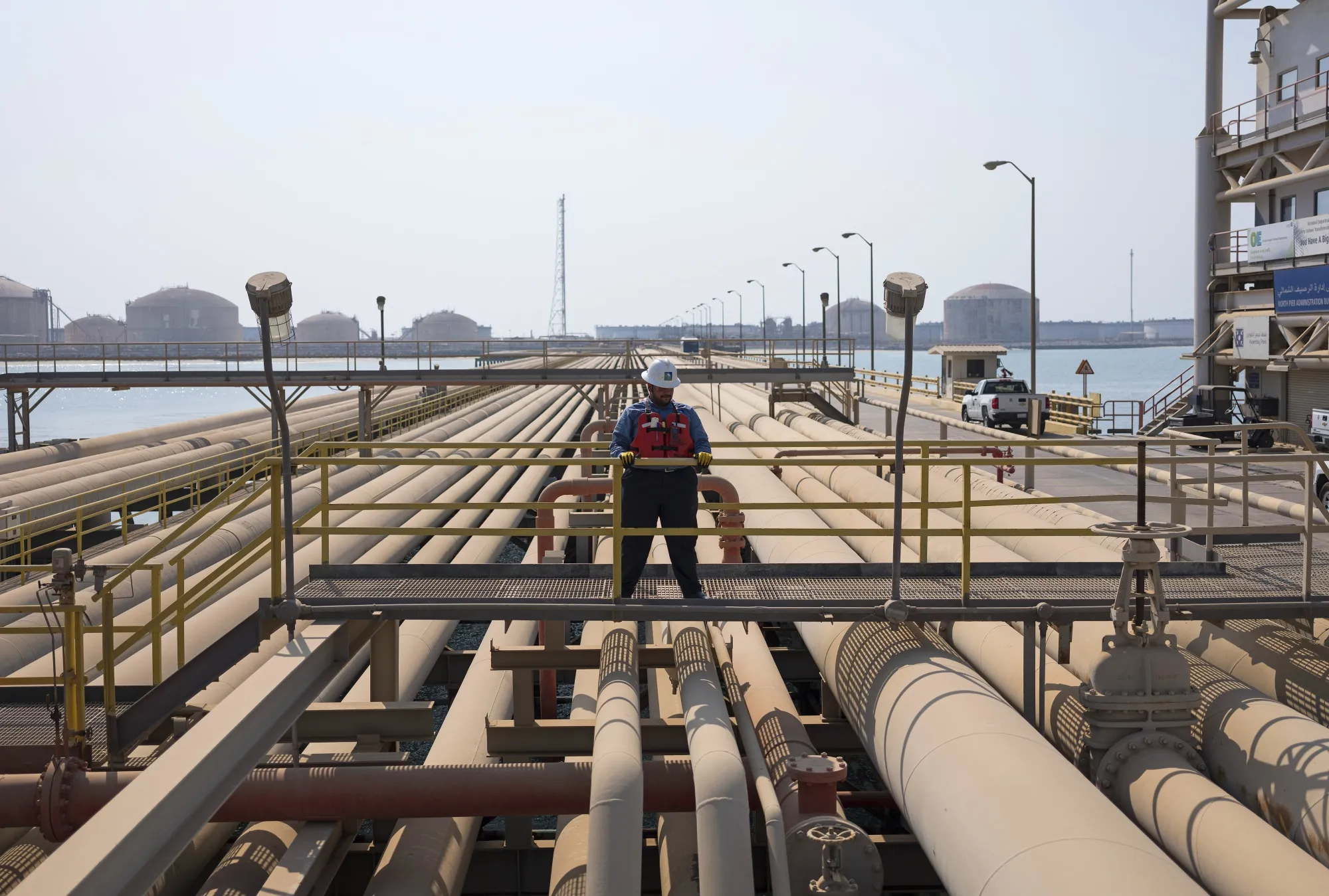
Saudi Aramco Ras Tanura oil loading Hormuz reopening 2026 resumed on Friday when two Very Large Crude Carriers controlled by Saudi shipping arm Bahri were seen loading crude at the world's biggest oil port after a near four-month halt, with a third VLCC waiting nearby and each vessel capable of carrying 2 million barrels, marking Saudi Arabia's return as the last major Gulf producer to resume exports from inside the Gulf following the preliminary U.S.-Iran deal to halt the war and reopen the Strait of Hormuz. The resumption comes against a backdrop of immediate concern after a ship belonging to Taiwan's Evergreen Marine was hit by an unknown object in the Strait of Hormuz on Thursday, with two U.S. officials telling Reuters that Iran had fired on the vessel and the British naval agency UKMTO pausing its strait escort operation in response, while Iran's Persian Gulf Strait Authority warned that vessels outside its designated routes would not be guaranteed safe passage. The attack's occurrence within days of the preliminary ceasefire agreement creates the specific durability test for the deal that energy markets and global shipping have been watching for, with oil prices falling more than a dollar a barrel on Friday after earlier edging up on the attack reports, as the competing pressures of rising supply from the Gulf restart and renewed security concerns about the strait's safety battle for price direction.
The energy and infrastructure significance of Ras Tanura's resumption extends beyond the symbolic milestone to the specific supply volume implications of the world's biggest oil port returning to operation after four months of enforced closure. Before the conflict, Ras Tanura exported more than 5 million barrels per day of crude from its Gulf-coast location west of the Strait of Hormuz, a volume whose absence from global markets has been one of the primary drivers of the elevated oil prices that have imposed inflationary consequences across the global economy since the conflict began in late February. Saudi crude exports had slumped to approximately 4 million bpd in the past three months from more than 7 million bpd in February according to shipping data, with Aramco diverting what exports it could through the Red Sea port of Yanbu after the Iranian blockade prevented Gulf access. The gap between the 7 million bpd pre-conflict export level and the 4 million bpd crisis-period level represents the specific supply contribution whose restoration over the coming weeks and months will be the most significant single factor in determining how quickly global oil prices return toward pre-conflict levels.
Rystad Energy's MENA research director Aditya Saraswat's assessment that two million barrels per day came back online in three weeks with the recovery spread across the region, and that shut-in Gulf production has fallen from 11.7 million bpd three weeks ago to 9.6 million bpd by mid-June, provides the specific quantitative framework for understanding the pace and scale of the supply recovery that the preliminary deal has enabled. The consultancy's expectation of full supply recovery across the region by year-end gives the market a forward guidance benchmark against which each week's supply data will be measured, with the pace of Ras Tanura's ramp-up, Iran's export restart under temporary sanctions lifting, and Iraq, Qatar, Kuwait, and UAE tender activity collectively determining whether the full recovery timeline advances or slips depending on the deal's security dimension holding against the Evergreen attack's implications.
How the Four-Month Gulf Supply Disruption Reshaped Global Energy Markets
Saudi Arabia's decision to shut Ras Tanura as a precautionary measure during the conflict and redirect its crude exports through the Red Sea port of Yanbu represented the largest single operational adjustment in Saudi Aramco's export history, requiring the reorientation of a supply chain built around Gulf-coast loading infrastructure toward an alternative port whose capacity and geographic position created specific constraints on the volumes and destinations that Saudi exports could serve during the conflict period. Yanbu's Red Sea location provides access to European and American markets through the Suez Canal without requiring passage through the Strait of Hormuz, making it the logical alternative for the portion of Saudi exports that could be maintained during the blockade, but its capacity is substantially lower than Ras Tanura's pre-conflict five-million-plus bpd throughput, creating the export volume gap whose contribution to global supply tightness has been one of the conflict's most economically consequential effects.
The last Aramco cargo loaded from Ras Tanura before Friday's resumption, a China-bound shipment on March 8 according to LSEG data, establishes the specific gap whose duration of more than three months documents the conflict's impact on the Gulf oil export infrastructure whose normalcy global energy markets had come to depend on over decades. China's position as the destination for Aramco's last pre-closure cargo reflects the Asian giant's role as Saudi Arabia's largest crude oil customer, and the disruption of the direct Gulf-to-Asia supply chain through Hormuz has been one of the specific supply security concerns that Chinese energy policy has been managing throughout the conflict period through stockdraw, increased Russian crude purchases, and the diplomatic pressure for ceasefire that Chinese officials have been applying through back-channel communications. The resumption's first visible loading, back toward the Asian market presumably, represents the reconnection of the supply chain whose disruption the Ras Tanura closure imposed.
The broader Gulf supply disruption, with Rystad estimating 11.7 million bpd of shut-in production at peak blockade impact, represents a supply loss from the market at a scale that no other single regional disruption in the post-1973 oil era has matched, creating the global energy market stress whose inflationary consequences have been felt from East Africa's agricultural budgets to European consumer energy bills to American gas prices. The conflict's supply disruption created the specific political domestic pressure on Trump that his administration cited as a motivation for accelerating the ceasefire negotiations, with the gas price impact on American consumers being among the most politically damaging aspects of a conflict whose support among the American public was declining as its economic costs became tangible.
Ras Tanura's Infrastructure and the Precautionary Shutdown Decision
Ras Tanura's shutdown during the conflict reflected the specific vulnerability assessment that Saudi Aramco and the Saudi government made about the risk that Iranian missile and drone capabilities posed to the world's largest oil export terminal, whose destruction would have imposed not just commercial costs on Saudi Arabia but a geopolitical crisis affecting global energy security that neither side's interests required escalating to. The terminal's exposure on Saudi Arabia's eastern coast directly facing the Gulf, where Iranian anti-ship missile systems and drone assets were demonstrably active throughout the conflict, created the specific operational risk that no commercial or national energy security consideration could justify accepting when temporary export rerouting through Yanbu provided a viable if reduced-capacity alternative. Saudi Arabia's 550,000 bpd domestic refinery at Ras Tanura, also shut as a precautionary measure, compounded the economic cost of the precautionary closure by reducing domestic refined product production during the same period.
The precautionary nature of the shutdown, rather than any actual attack on the facility, means that Ras Tanura's physical infrastructure has survived the conflict intact and can resume operations at its full technical capacity as quickly as the commercial logistics of restoring the supply chain allow. The speed with which two VLCCs were seen loading on Friday and a third was waiting suggests that Saudi Aramco had been preparing for the resumption in the days before the ceasefire deal was finalised, pre-positioning vessels and coordinating the cargo nominations that Gulf export loading requires. The Evergreen incident's impact on the resumption timeline will depend on whether Friday's loading represents the beginning of a smooth ramp-up or whether additional security incidents force another precautionary response from Aramco and Gulf producers more broadly.
The Evergreen Attack, Iran's Route Warning, and Supply Recovery Trajectory
The attack on the Evergreen Marine vessel in the Strait of Hormuz on Thursday, occurring within days of the preliminary ceasefire announcement, creates the specific security incident that tests whether the deal's text translates into operational safety for commercial shipping in ways that the global energy supply recovery requires to sustain its current trajectory. The UKMTO's decision to pause its escort operation following the attack is the most operationally significant immediate consequence for commercial shipping, because the British naval agency's escort coordination has been one of the primary security frameworks for vessels attempting Hormuz transit during the conflict period, and its pause leaves ships and shipping companies without the institutional safety guidance that has been informing their transit decisions.
Iran's Persian Gulf Strait Authority warning that vessels outside its designated routes will not be guaranteed safe passage creates the specific operational complexity that shipping companies, freight charterers, and oil loading planners must incorporate into their Hormuz transit decisions, because the authority's route designations and their relationship to normal commercial shipping lanes have not been publicly detailed in ways that allow straightforward compliance assessment. Two U.S. officials told Reuters that Iran had fired on the Evergreen ship, a attribution whose accuracy Iran's authority did not confirm, creating the specific information environment of competing official accounts that has characterised most of the conflict's incident attribution disputes. The combination of a confirmed attack, a paused escort operation, and an Iranian safe passage warning that implicitly threatens non-compliant vessels creates the security uncertainty that insurance markets, charterers, and oil loading planners will be repricing into their Hormuz transit calculations in the days following Friday's Ras Tanura resumption.
Saudi Aramco's decision to proceed with Friday's Ras Tanura loadings despite the Evergreen incident signals the commercial and geopolitical assessment that the deal's general framework remains intact and that the attack represents a security incident to be managed rather than a fundamental breakdown of the ceasefire that would require renewed shutdown. The competitive pressure to resume exports, with Iraq's SOMO, Qatar, Kuwait, and UAE all issuing crude tenders simultaneously and Iran rushing its exports under temporary sanctions lifting, creates the market dynamic in which any producer that delays resumption for additional security caution loses market share and pricing position to competitors who proceed. Saudi Arabia's decision to join the rush, despite being the last major Gulf producer to do so, reflects the specific commercial and geopolitical calculation that waiting longer serves neither Aramco's commercial interests nor Saudi Arabia's interest in demonstrating that the deal's Hormuz reopening commitment is being operationally fulfilled.