
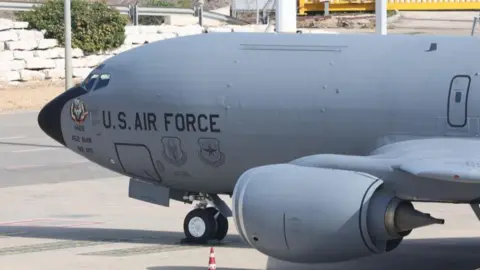
A US Israel Iran War military refuelling aircraft has gone down in western Iraq, killing four of its six crew members in one of the most tragic single incidents of the ongoing US-Israel war with Iran. US Central Command, known as Centcom, confirmed the deaths on Thursday and said rescue efforts for the remaining two crew members were still underway at the time of the announcement. The loss marks a devastating blow to the American military personnel involved in Operation Epic Fury, which began roughly two weeks ago and has already claimed the lives of soldiers, airmen, and support staff across the region.
The aircraft was a Boeing KC-135 Stratotanker, a long-serving aerial refuelling tanker that has been central to American air power for decades. It was actively involved in ongoing US operations against Iran when the crash occurred. A second aircraft was involved in the same incident but managed to land safely, sparing additional casualties. The contrast between the two outcomes has only deepened the grief surrounding the loss of four service members whose identities were being withheld pending notification of their next of kin.
Centcom confirmed that neither hostile nor friendly fire had been initially identified as the cause, though that assessment was walked back as more details emerged. Iran's military claimed on state television that an allied group had targeted the plane with a missile, a claim that directly contradicts the early American framing of the crash. The incident is now under formal investigation, with the circumstances still being assessed by US military officials.
What Happened and When the KC-135 Went Down Over Iraq
The crash occurred at approximately 2:00 PM Eastern Time on Thursday, which corresponds to 7:00 PM Greenwich Mean Time. Centcom described the crash as taking place over friendly airspace, but the location tells a more complicated story. Western Iraq is a region where pro-Iranian militias have long maintained a significant presence and operational capability. The area has seen repeated militia activity throughout the current conflict, and any claim of fully controlled or neutral airspace in that corridor must be understood in that geographic context.
The KC-135 typically carries a minimum crew of three personnel, including a pilot, a co-pilot, and a boom operator who is responsible for managing the refuelling arm that extends from the rear of the aircraft during midair transfer. The six crew members aboard this particular flight exceeded that standard minimum, suggesting it may have been operating in a more complex support configuration for the ongoing air campaign against Iranian targets. Four of those six individuals are now confirmed dead, with the search for the remaining two continuing in difficult terrain.
Iran's state television broadcast a claim from what it described as an allied armed group, asserting that the plane was struck by a missile rather than suffering a mechanical or accidental failure. If that claim is verified by US investigators, it would represent a significant escalation in the capacity of Iranian-linked militias to engage American aircraft operating at altitude. No group had formally claimed responsibility by the time of Centcom's most recent public statement, and the US military stopped short of confirming or denying the Iranian account while the investigation remained open.
The KC-135 Stratotanker and Its Role in American Military History
The KC-135 Stratotanker is one of the most important aircraft ever produced for the United States military. Boeing manufactured the aircraft throughout the 1950s and early 1960s, and it has remained in service for over six decades, which is a remarkable lifespan for any military platform. Its primary function is aerial refuelling, meaning it transfers fuel to other aircraft mid-flight, allowing fighter jets, bombers, and reconnaissance planes to dramatically extend their range without landing. This capability has been central to virtually every major American military operation since the Cold War era.
During the first Gulf War in 1990 and 1991, the KC-135 played an indispensable role in extending the range of coalition fighter jets and bombers, allowing them to reach targets deep inside Iraq from bases located far away. The aircraft became a symbol of American air power projection, and its continued presence in the current conflict against Iran is consistent with its historical role. Without tankers like the KC-135, the scale and reach of Operation Epic Fury would be significantly reduced, which is precisely why the aircraft represents a high-value target for any adversary seeking to degrade American operational capacity.
The loss of a KC-135 is not merely a human tragedy, though it is certainly that above all else. It is also a strategic signal. The US military has now confirmed the loss of at least four aircraft since the current war began a fortnight ago. Three F-15s were shot down earlier this month in what officials described as an apparent friendly fire incident over Kuwait, with all six crew members safely ejecting. The KC-135 crash brings the cumulative US military death toll in this conflict to eleven confirmed fatalities, a number that is expected to draw increased scrutiny from Congress and the American public.
Rising US Military Losses and the Human Cost of the Iran War
The death toll from Thursday's crash arrives at a moment when public and congressional attention on the human cost of the war is already growing. Eleven American service members confirmed dead in two weeks of combat operations represents a rate of loss that, while lower than some historical conflicts, carries enormous political weight in the current domestic climate. Military families across the United States are now confronting the reality that this war, which the administration described as a limited and decisive operation, has begun to claim American lives with regularity.
The identities of the four crew members killed in Thursday's crash are being withheld for 24 hours in accordance with US military protocol, allowing next of kin to be formally notified before any public release of names. That standard procedure reflects the deepest obligation the military recognizes in moments like this, ensuring that families hear the news directly before it reaches the broader public. For those four families, Thursday will be a day that divides their lives permanently into before and after.
The US-Israel war with Iran is now entering its third week with no ceasefire on the horizon. Russia has publicly called for an end to hostilities. The United Nations has issued warnings about civilian casualties on both sides. Iran has a new supreme leader who has vowed to continue the fight. And American service members are dying in a region where the geography of the conflict is more dangerous and more contested than early official statements suggested. The crash of the KC-135 over western Iraq is not just a military setback. It is a reminder that wars fought at scale, in complex and hostile environments, extract a human cost that no amount of air superiority can fully prevent.