
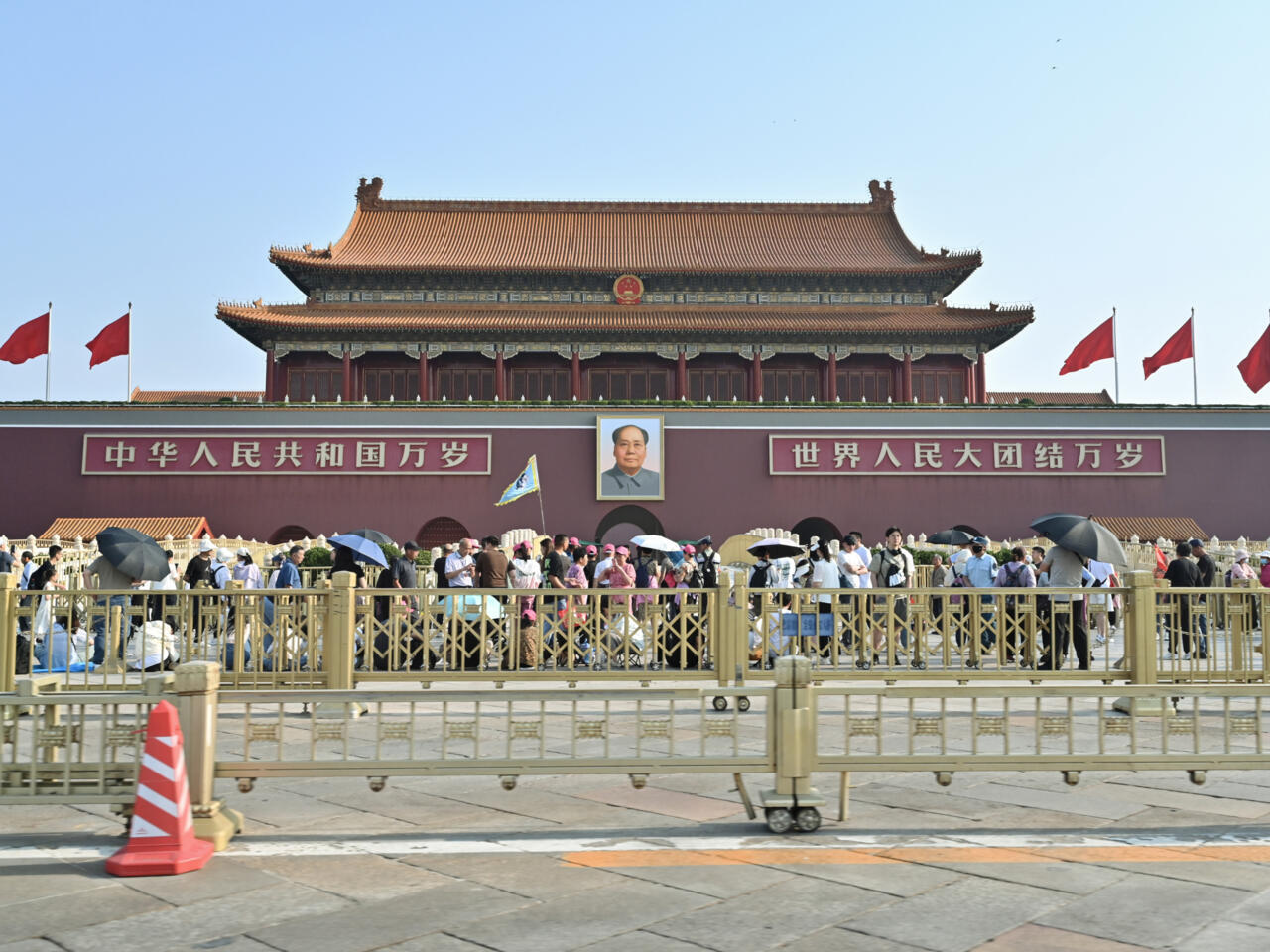
China and the United States clashed sharply on Thursday over the 37th anniversary of the China US Tiananmen Square crackdown, after Secretary of State Marco Rubio issued a formal statement marking the June 4 commemoration and Beijing responded by accusing Washington of distorting historical facts and interfering in its internal affairs. Chinese Foreign Ministry Spokesperson Mao Ning said China was "strongly dissatisfied and firmly opposed" to Rubio's characterisation of events, reiterating Beijing's position that the government reached "a clear conclusion" long ago about what it continues to describe as "political turmoil" in the late 1980s. Taiwan's President Lai Ching-te used the occasion to call on China to "face up to" the incident, acknowledge the truth, and open the door to reconciliation, a statement Beijing rejected through the same lens it applies to virtually everything Lai says, dismissing him as a "separatist" with no legitimate standing to address the Chinese people.
The exchange is an annual ritual of geopolitical contestation that has taken on sharper edges in recent years as US-China relations have deteriorated across nearly every dimension and as Taiwan's elected leadership has grown more explicit in using the anniversary to draw a contrast between democratic governance and the authoritarian system that governs the mainland. Rubio's statement followed what he described as "past practice" for the United States' top diplomat, positioning the commemoration as a matter of established foreign policy rather than a fresh provocation. But in the current diplomatic climate, where Washington and Beijing are simultaneously managing deep tensions on trade, technology, Taiwan, and military posture in the Pacific, even a formulaic annual statement carries strategic weight that both sides understand perfectly well, regardless of the ritualistic language in which it is dressed.
For global politics analysts, what makes the 2025 anniversary worth examining beyond its annual recurrence is the changed context in which it takes place. The erosion of Hong Kong's commemorative space following Beijing's imposition of the national security law in 2020 has eliminated the one place inside Chinese-governed territory where the June 4 anniversary was publicly and visibly marked at scale. That erasure was itself a global political signal about the direction of Beijing's governance philosophy, and its completion by 2025 gives the international diplomatic response to the anniversary a quality of documentation as much as commemoration: the annual statements from Washington, Taipei, London, and other capitals now serve partly as a public record of what Beijing has chosen not to acknowledge about its own history.
What Happened on June 4, 1989 and Why Beijing Has Never Provided a Full Account
The events that the Chinese government has spent 37 years suppressing began as student-led pro-democracy demonstrations in Beijing's Tiananmen Square that drew workers, intellectuals, and citizens from across Chinese society over several weeks of extraordinary public mobilisation. Chinese troops and tanks moved into the square before dawn on June 4, 1989, ending weeks of protests in a military crackdown that shocked the world and produced images, most famously the lone man standing before a column of tanks, that became defining symbols of individual resistance to state power in the late twentieth century. China has never provided a full account of what happened or a credible death toll. Rights groups and witness testimonies suggest the figure could run into thousands, a number the Chinese state has never confirmed, investigated, or memorialised.
Beijing's official framing of the crackdown, reiterated by Mao Ning on Thursday in language that has changed very little over nearly four decades, is that the government took necessary action against "counter-revolutionaries" who threatened to overthrow the ruling Communist Party. That framing serves a specific political function within China's domestic governance logic: by defining the protesters as enemies of the state rather than citizens exercising legitimate political expression, Beijing retains the narrative framework that makes June 4 unspeakable inside China without acknowledging that it has suppressed the truth. The "clear conclusion" that Mao referenced on Thursday is not an historical verdict reached through investigation and evidence; it is a political position maintained through censorship, and the gap between those two things is precisely what Rubio's statement identified when he said Beijing's censorship "could not erase memories" of what happened.
The global politics of June 4 commemoration shifted significantly after 2020 when Beijing imposed its national security law on Hong Kong, effectively ending the annual candlelight vigil in Victoria Park that had for decades drawn tens of thousands of participants. That vigil was one of the last large-scale public commemorations of the crackdown to take place inside Chinese-governed territory, and its suppression was widely understood internationally as a concrete demonstration of Beijing's willingness to use its expanded Hong Kong powers to erase the kind of civil society expression that distinguished the territory from the mainland. By Thursday 2025, the football pitches at Victoria Park had been repurposed for a fourth consecutive year as a pro-Beijing food and cultural bazaar, a substitution whose symbolism requires no interpretation. The global political response, including vigils in Germany, Australia, and other cities, as well as the British embassy's quiet 16-second animated tribute to the Tank Man posted on X, now represents the international community's collective insistence on holding the space for a history that Beijing is determined to close.
How Taiwan's Voice, US-China Diplomacy, and Hong Kong's Silence Shape the Anniversary's Global Stakes
Taiwan's use of the Tiananmen anniversary as a platform for political commentary about mainland China's governance has become one of the most geopolitically charged annual rituals in the Taiwan Strait relationship. President Lai Ching-te's Facebook post on Thursday, urging China to "acknowledge the truth, soothe the pain, and open the door to reconciliation and dialogue," was the kind of measured language that is easy to characterise as reasonable and that Beijing finds impossible to engage with on its merits precisely because engaging with it would require accepting that there is something to reconcile. Beijing's response, filtering everything Lai says through the "separatist" label, is itself a global politics signal: it tells the international community that China's leadership has decided that the Taiwan question and the June 4 question will both be managed through denial rather than dialogue, a posture that has direct implications for how regional governments assess the risk of escalation in the strait.
The US position, articulated by Rubio on Wednesday and reinforced by decades of consistent practice, is that the annual statement is not an act of interference but a statement of values: that those who demand free expression and peaceful assembly will eventually be vindicated. The Chinese foreign ministry's framing of that statement as an attempt to "smear China's political system and development path" is the standard counter-narrative, but it has become increasingly difficult to separate that counter-narrative from the broader pattern of Beijing's diplomatic behaviour, in which any international reference to Tiananmen, Hong Kong's changed status, or Taiwan's democracy is categorised as interference rather than legitimate political speech. That categorisation is itself a global politics problem, because it progressively narrows the space for the kind of candid bilateral dialogue on historical and governance questions that could, in theory, build the mutual understanding needed to manage the structural tensions between China and the democratic world.
The British embassy's 16-second animation, posting without caption a tribute to the Tank Man accompanied by a recording of the Internationale, is a small but telling indicator of how diplomatically cautious institutions are now finding oblique ways to mark an anniversary they feel obligated not to ignore while managing the relationship risks of explicit condemnation. That kind of indirect commemoration reflects a broader international calculation: that the Tiananmen anniversary matters enough to acknowledge, that the manner of acknowledgement is now diplomatically fraught in ways it was not fifteen years ago, and that the narrowing of acceptable expression around the anniversary tracks the broader narrowing of space for candid engagement with China on questions it defines as internal. For the global political system, that narrowing is itself the most important annual data point the June 4 anniversary now provides.