
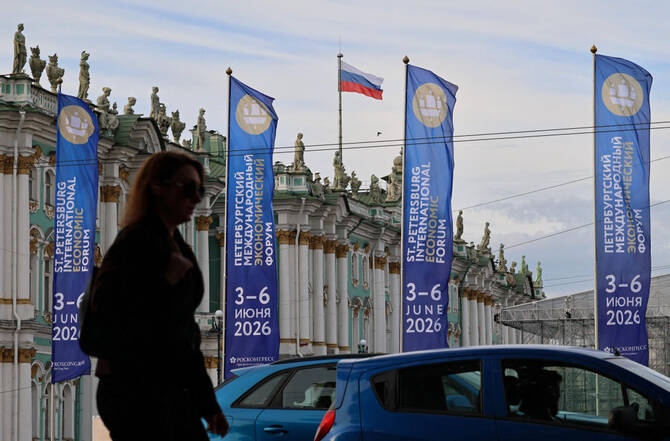
Ukraine Strikes drones struck an oil export terminal in St Petersburg on Wednesday morning, hours before President Vladimir Putin's flagship annual economic forum was scheduled to open in the same city, in a strike that combined military utility with maximum political symbolism. Smoke was visible from the historic city centre as Reuters correspondents on the ground reported hearing loud explosions in the early hours. Ukrainian President Volodymyr Zelenskyy confirmed his forces had hit the fuel terminal and also targeted a military facility near Russia's second city, while St Petersburg Governor Alexander Beglov acknowledged that "infrastructure objects" had been struck across three distinct districts. For political risk analysts watching the war, the timing and location of the strike carry a message that is impossible to misread: Ukraine War can reach the cities that matter most to Putin, and it can do so on the day he wants the world to see Russia at its most confident and investable.
The attack on St Petersburg carries a political risk dimension that goes considerably beyond the material damage to the oil terminal or the disruption to airport operations. St Petersburg is Putin's home city, the place where he was born, where he built his political network, and where he has consistently returned for major showcases of Russian state prestige. The city's annual international economic forum, widely referred to as Russia's answer to Davos, is one of the Kremlin's primary instruments for projecting the image of a Russia capable of attracting foreign investment, sustaining economic growth under sanctions pressure, and presenting itself as a normal and stable destination for global capital. A drone strike on an oil terminal in the same city on the opening morning of that forum is not an accident of timing. It is a calculated act of political disruption designed to make every foreign delegate, journalist, and investor arriving in St Petersburg that morning aware that the city they have entered is within reach of Ukrainian military capability.
Russia's air defences intercepted 59 drones overnight, according to Leningrad region governor Alexander Drozdenko, a figure that illustrates both the scale of the Ukrainian operation and the limits of the defensive response: intercepting 59 drones while one or more still reached their target inside a major Russian urban centre is not a clean defensive success. The disruption to Pulkovo airport, which had to temporarily restrict flights with more than 30 services delayed or cancelled, added a civilian and commercial dimension to the strike that amplifies its political risk signal. When an international economic forum designed to attract foreign investors is accompanied by airport closures, drone interception reports, and visible smoke plumes from city infrastructure, the message being sent to the global business and investment community about Russia's operating environment is one that no amount of forum programming can fully neutralise.
How Ukraine's Deep-Strike Drone Campaign Has Systematically Elevated Political Risk Inside Russia
The strike on St Petersburg is not an isolated incident but the latest escalation in a Ukrainian drone campaign that has been systematically raising the political risk premium attached to operating inside Russian territory. Over the course of the more than four-year war, Ukraine has progressively extended the range, precision, and ambition of its drone operations, moving from strikes on frontline military targets to attacks on energy infrastructure, oil refineries, military airfields, and, increasingly, targets in Russia's major urban centres including Moscow and now St Petersburg. Each successful strike inside Russia proper serves two overlapping strategic purposes: it degrades Russian military and energy infrastructure, and it forces the Kremlin to confront the domestic political consequence of a war that its own citizens were told was being fought far from home on foreign soil.
The energy infrastructure targeting dimension of the campaign carries particular economic and political risk significance. Oil export terminals are not peripheral military assets; they are nodes in the revenue chain that funds the Russian state's ability to sustain its war effort, pay its civil service, and maintain the social stability that protects Putin's domestic political position. A strike on an oil terminal in St Petersburg disrupts not only the local fuel logistics but sends a signal to energy markets, sanctions monitors, and the governments currently debating whether and how to tighten restrictions on Russian oil exports that Ukraine has the capability and the intent to degrade Russian energy export infrastructure from the inside. That signal has direct consequences for the political risk calculations being made by the insurance, shipping, and financial institutions whose participation in Russian energy trade is already a legally and reputationally complex decision.
The choice of St Petersburg as a target on the morning of Putin's economic forum reflects a sophisticated understanding of the political risk landscape that Ukraine's strategic planners are navigating. The forum, modelled explicitly on Davos, is one of the few remaining international platforms on which Russia is able to project economic credibility and attract the participation of foreign governments, state-owned enterprises, and private sector actors from countries that have not fully aligned with Western sanctions policy. Disrupting the forum's opening hours with a drone strike that generates smoke visible from the historic centre, forces airport closures, and dominates the international news cycle is a form of asymmetric political risk warfare: using military capability to inflict reputational and economic damage that compounds the physical infrastructure harm. For any investor or government representative sitting in a St Petersburg conference room on Wednesday morning, the morning's events made the political risk calculus of engagement with Russia considerably more complicated than it had been the evening before.
What the St Petersburg Strike Means for Russian Stability, Energy Markets, and the War's Trajectory
The political risk picture that emerges from Wednesday's strike has several distinct layers that analysts and decision-makers in government, finance, and business will need to disaggregate carefully. The most immediate layer is the operational: what was hit, how badly, and how quickly can it be repaired or replaced. Zelenskyy's confirmation that a fuel terminal and a military facility were struck establishes a dual targeting logic, one asset serving as a direct military and energy disruption, the other demonstrating that Ukraine's intelligence on Russian military infrastructure in the St Petersburg area is current and actionable. The intercept of 59 drones by Russian air defences confirms the operational scale of the attack, but the fact that targets were reached despite that defence posture is itself a political risk indicator for Russian authorities trying to assure both their domestic population and foreign partners that major cities are protected.
The economic forum dimension elevates the risk signal from operational to reputational. Putin's annual forum in St Petersburg functions as a geopolitical statement as much as an economic event. Its guest list typically includes representatives of countries that have maintained economic and diplomatic relationships with Russia despite Western pressure, and the forum's proceedings are closely watched by sanctions analysts, intelligence services, and financial institutions trying to assess the durability of Russia's economic resilience under wartime conditions. Wednesday's drone strike does not cancel the forum, but it reframes it: every panel discussion about Russian investment opportunity now takes place against a backdrop of fresh evidence that Ukrainian military capability reaches the city hosting those discussions. That reframing has a concrete political risk value that Ukraine's strategic planners have clearly calculated and will have factored into the decision to strike on this particular morning.
For the broader trajectory of the war, the St Petersburg strike reinforces a pattern that shows no sign of reversing. Both sides are escalating the geographic reach and the symbolic targeting of their respective strike campaigns, with Ukraine pressing deeper into Russian territory and Russia continuing its attacks on Ukrainian cities, energy infrastructure, and civilian areas. The governor of St Petersburg's acknowledgement of strikes across three city districts, and the Leningrad region governor's report of 59 intercepted drones, suggest an operation of significant scale rather than a symbolic pinprick, and Ukraine's willingness to conduct such an operation on the morning of a globally visible Russian event signals a confidence in its deep-strike capability that marks a genuine shift in the war's political risk landscape. For the governments, businesses, and financial institutions currently trying to calibrate their exposure to Russia, the message from St Petersburg on Wednesday morning is that the risk environment inside Russia is materially more complex than it was a year ago, and that complexity is not going to diminish while the war continues on its current trajectory.