
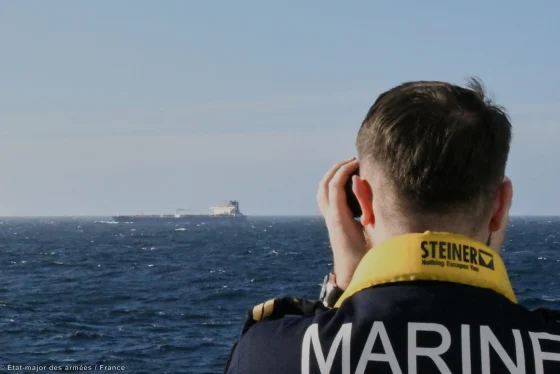
France intercepts Russian oil tanker shadow fleet sanctions 2026 enforcement reached a new level of assertiveness when French President Emmanuel Macron announced that the French Navy boarded the Tagor, a sanctioned Russian oil tanker flying a false flag, approximately 400 nautical miles west of Brittany in international waters on Sunday, with support from allied nations including the United Kingdom, in the fourth such French interception since September 2025 and the most publicly prominent enforcement action against Russia's shadow tanker network in European waters to date. Macron wrote on X that it is unacceptable for ships to circumvent international sanctions, violate the law of the sea, and fund the war that Russia has been waging against Ukraine for more than four years, framing the interception as a sanctions enforcement action rooted in international legal obligations rather than a provocative military escalation, and stating that the operation was conducted in strict compliance with the law of the sea. The Kremlin's response was immediate and dismissive, with spokesman Dmitry Peskov calling the seizure illegal and bordering on international piracy while stating that Russia was taking measures to ensure the safety of its cargo, a response that directly contests the legal framework within which France and its allies are conducting the boarding operations.
The Tagor's false flag status at the time of its interception is the specific maritime law violation that provides France with the most straightforward legal basis for the boarding, because flying a false flag, operating under the national registration of a country that has not actually authorised the vessel to fly its colours, is a violation of the United Nations Convention on the Law of the Sea that allows other states to board and inspect the vessel regardless of which flag it claims to be flying. Russia's shadow fleet of tankers has been using false flag arrangements alongside obscure ownership structures to evade the sanctions imposed on Russian oil exports since the February 2022 full-scale invasion of Ukraine, with the tankers effectively operating as an enforcement evasion network whose commercial function is to move Russian oil to buyers while obscuring the vessel identity, ownership, and cargo origin information that would trigger sanctions compliance obligations on buyers, insurers, and port authorities. France's interception of the Tagor continues the enforcement pattern it established in September 2025 and formalises the policy shift from allowing shadow fleet vessels to continue operating after fines to blocking them entirely.
The video shared by Macron showing armed French naval officers boarding the Tagor via helicopter is a deliberate piece of policy communication whose visual impact on the sanctions enforcement debate significantly exceeds its informational content about the specific boarding operation, because the image of military personnel rappelling onto a tanker demonstrates the physical reality of shadow fleet enforcement in a way that press releases and diplomatic notes cannot. France's decision to share the footage publicly reflects an assessment that visible enforcement serves the sanctions policy's deterrence objectives by demonstrating to the operators, owners, financiers, and insurers of the shadow fleet network that the risk of interception in European waters is no longer theoretical but has been demonstrated multiple times and is now supported by allied military cooperation. The BBC has noted it could not independently verify the footage, appropriate epistemic caution in a conflict-adjacent information environment where both sides have interests in shaping the narrative around maritime enforcement actions.
How Russia Built Its Shadow Fleet and How Sanctions Have Failed to Stop It
Russia's shadow fleet emerged as the primary commercial mechanism for circumventing the oil export sanctions that the United States, European Union, United Kingdom, and G7 partners imposed following the February 2022 invasion of Ukraine, with the sanctions architecture designed to remove Russia's oil revenues from the financial system while allowing Russian oil to continue flowing to non-sanctioning countries at prices below the G7 price cap that was intended to limit the revenue per barrel that Russia could earn. The shadow fleet's commercial architecture combines several evasion mechanisms: tankers purchased or leased through obscure ownership structures in jurisdictions with limited transparency requirements, registration under flag states whose regulatory capacity or willingness to enforce international standards is limited, insurance arrangements outside the Western financial system that eliminate the compliance leverage that P&I clubs in London and elsewhere provide, and cargo documentation practices that obscure the origin of the oil being transported.
The approximately 600 to 800 vessels that various tracking organisations have identified as belonging to Russia's shadow fleet represent a parallel global tanker market that has been assembled through the commercial innovation of sanctions evasion, drawing on pre-existing patterns of flag of convenience registration and beneficial ownership obscuration that the maritime industry has long used for tax and liability purposes and repurposing them specifically for sanctions circumvention at scale. The fleet's operation requires a global network of ship brokers, cargo traders, port operators, and financial intermediaries willing to work outside the Western-aligned sanctions compliance system, with much of this network concentrated in jurisdictions including the United Arab Emirates, Turkey, India, and China whose governments have not joined the Western sanctions regime and whose private sector actors are not legally bound by it. The shadow fleet's commercial success in moving Russian oil to markets including India and China has significantly limited the revenue reduction that Western sanctions advocates had expected the export restrictions to produce.
France's previous approach of allowing shadow fleet vessels to continue after their owners paid fines reflected an early enforcement posture that prioritised legal certainty over deterrence impact, because allowing vessels to pay fines and continue their commercial operations created a predictable cost of doing business rather than the prohibition of the activity that sanctions are intended to achieve. The shift to blocking vessels rather than fining them, announced by French authorities and manifested in the four boardings since September 2025, represents a policy evolution toward treating shadow fleet operation as an activity to be prevented rather than a compliance failure to be penalised, with the commercial consequences of vessel seizure being qualitatively more disruptive to the network's operations than the financial cost of fines that can be factored into the commercial calculations of shadow fleet operators.
The UK's Position and the Gap Between Policy and Enforcement
UK Prime Minister Starmer's March announcement granting permission for UK military forces to board sanctioned Russian ships established the legal and political framework for British participation in shadow fleet interceptions, providing the allied support dimension that Macron referenced in his X post and that gives France's enforcement actions the multilateral character that strengthens their legal and diplomatic standing. However, BBC Verify analysis documenting that almost 200 Russian shadow fleet vessels had entered UK waters since Starmer's mid-March announcement challenges the claimed deterrence effectiveness of the threatened interception policy, because the continued large-scale shadow fleet movement through UK territorial and adjacent waters suggests the operational posture has not matched the political announcement's apparent ambition.
The Ministry of Defence's characterisation of its activities as disrupting and deterring shadow fleet vessels without providing specific details about the actual number of interceptions or boardings leaves the public and policy community without the accountability information needed to assess whether the UK's contribution to allied shadow fleet enforcement is commensurate with its announced policy commitment. A deterrence policy whose effectiveness is assessed primarily through disrupting and deterring language rather than through specific enforcement metrics creates the political optics of strong action without the accountability of measurable outcomes, and the BBC Verify finding about continued shadow fleet vessel movements through UK waters suggests the deterrence claim requires more substantiation than the Ministry of Defence communication has provided. The contrast between France's specific four-interceptions-since-September accountability narrative and the UK's less specific disrupting and deterring framing illustrates different enforcement communication approaches whose implications for actual sanctions effectiveness are worth examining.
The Tagor Interception, the Legal Framework, and What Comes Next
The legal basis for France's interception of the Tagor under international maritime law is clearer than it would be for boarding a vessel that was genuinely registered under a non-sanctioning country's flag, because the false flag violation provides a UNCLOS-grounded justification that does not require France to assert universal jurisdiction over sanctions enforcement. Under UNCLOS Article 110, warships have the right to board merchant vessels on the high seas when there is reasonable grounds to suspect that the ship is without nationality or is flying a false flag, creating the specific legal hook that the Tagor's false flag status provided and that French naval authorities used to conduct the boarding without requiring the more contested legal claim that Western oil sanctions create universal enforcement jurisdiction. The law of the sea justification that Macron emphasised in his X post is therefore not rhetorical but legally significant, because it grounds the interception in an established and broadly accepted principle of maritime law rather than in the contested extraterritorial application of unilateral Western sanctions.
Russia's characterisation of the interception as bordering on international piracy inverts the legal analysis by treating the Russian vessel as a legitimately operating ship that was attacked rather than as a vessel engaged in illegal flag circumvention that was lawfully boarded. The piracy accusation is a recurring Russian diplomatic response to Western enforcement actions against its shadow fleet that reflects Moscow's strategic interest in delegitimising the sanctions enforcement framework rather than its genuine assessment of the applicable law, because piracy under international law requires private actors attacking ships for personal gain rather than state naval forces boarding vessels for law enforcement purposes. The Kremlin's statement that Russia is taking measures to ensure the safety of its cargo adds a veiled threat dimension to the diplomatic response without specifying what those measures might involve.
The four French interceptions since September 2025 have established France as the most operationally active enforcer of shadow fleet sanctions among European nations, and the Tagor boarding's public profile through Macron's X post and the helicopter footage suggests France is deliberately using each interception as a policy communication moment to build domestic and international support for the enforcement approach. If the EU's planned ban on Russian condensate from Yamal LNG entering into force in January 2027 is seen as the financial sanctions dimension of the pressure campaign, France's maritime enforcement actions represent the operational dimension, with both tracks seeking to reduce the revenue that Russia extracts from its energy exports to sustain its war effort in Ukraine. The coordination of financial sanctions tightening with physical enforcement of maritime law against vessels operating to circumvent those sanctions represents a more integrated approach to Russia sanctions pressure than the financial-only measures of the first post-invasion years.