
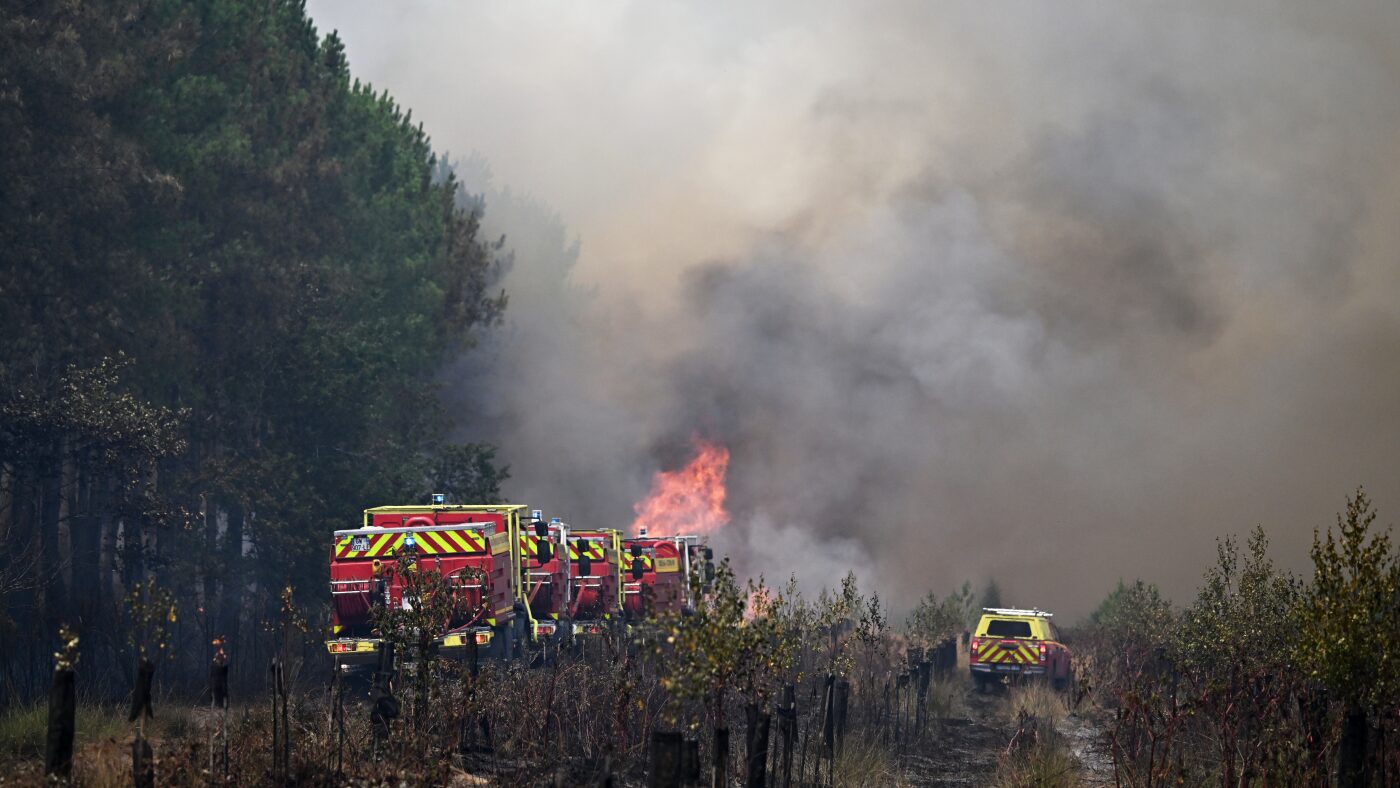
The wildfire burning west of Bordeaux has consumed 42,000 hectares and destroyed 240 homes, according to official figures from the Gironde regional government, as French President Emmanuel Macron visited the Departmental Fire and Rescue Operational Centre in Bordeaux on Tuesday to receive a briefing from fire commanders and thank the 2,750 firefighters, 1,500 military personnel, and 1,440 internal security personnel who have been working around the clock against a blaze that France's Interior Minister Laurent Nuñez has described as having a "life of its own." Eighty-eight firefighters have been injured since the fire began. The situation is described by fire crews as stabilized overnight but emphatically not under control, a distinction that has life-and-death consequences for the coming hours as temperatures are forecast to reach 37 to 40 degrees Celsius again on Wednesday, with the Gironde and Landes departments placed under yellow heatwave alert.
The fire remains nine miles from Bordeaux's southern outskirts. The burned area, at 42,000 hectares, is now larger than the entire city of Paris within the Périphérique. Canadian aerial assets, delivering bright red fire retardant over smouldering vegetation, have joined the 18 French aerial firefighting platforms already deployed, demonstrating both the scale of international assistance being mobilised and the inadequacy of what France alone can bring to bear against a fire this size. Drone footage from Le Porge, a town 18 miles west of Bordeaux, shows the kind of destruction that the aggregate statistics represent at the human level: roofless walls, ash-covered streets, and the skeletal remains of pine trees that were standing a week ago. The Gironde prefect has urged people not to return to evacuated areas. Approximately 220,000 people remain displaced in France, with another 105,000 evacuated in Spain where fires continue to burn uncontrolled across the Madrid, Ávila, and Toledo regions.
Beyond the immediate fire emergency, a health and environmental crisis is emerging that will extend well beyond the perimeter of the burned area. The fine particle pollution from 42,000 hectares of burning vegetation, releasing carbon monoxide, carbon dioxide, nitrogen oxides, and thousands of other combustion by-products, is creating air quality conditions that public health authorities have begun actively monitoring. Wildlife rescue centres across France have been pushed to what the International Fund for Animal Welfare describes as "breaking point," with exhausted swifts, dehydrated hedgehogs, and animals collapsing by roadsides arriving in numbers that overwhelm the centres' capacity. The agricultural, ecological, and human health consequences of the 2025 wildfire season will be measured and studied for years, but the early indicators suggest they extend considerably further than the fire perimeter itself.
The Full Operational Picture as of Wednesday
The Gironde regional government's official data release provides the most comprehensive single snapshot of where the wildfire stands. The 42,000-hectare burned area includes diverse land cover within the Landes de Gascogne plantation pine forest, agricultural land, and residential areas. The 240 homes destroyed represent a specific and recoverable statistic of physical loss, but they are attached to 240 families whose lives have been fundamentally disrupted at minimum and permanently altered in the worst cases. The 88 firefighters injured over the course of the operation, in a workforce of 2,750, represents an injury rate that reflects the extreme conditions under which operations have been conducted, including the pyrocumulonimbus event that temporarily made the fire self-generating in terms of wind patterns and ignition.
Macron's Tuesday visit to the Bordeaux fire coordination centre, accompanied by Interior Minister Nuñez, served multiple purposes simultaneously. Operationally, it provided senior political leadership with a direct briefing on the fire's status and the resources required. Politically, it communicated national government presence at the site of France's most acute domestic emergency. Symbolically, his statement that "the whole nation is behind you," directed at firefighters, echoed a formulation used during other major French national emergencies and carries specific resonance with a public that has been watching the crisis unfold for over a week. The Prince of Wales, from London, added an international note of solidarity: "These events are a stark reminder of the challenges posed by an increasingly extreme climate and the importance of protecting both people and nature," he wrote, in a message signed "W."
The overnight report from crews west of Bordeaux describes a "relatively good night" in which new outbreaks were extinguished and the overall burned surface did not increase. This is the operational definition of stabilization: the fire is not growing, but it has not been controlled. The critical distinction is that stabilization is conditional on the weather conditions that enabled it, cooler overnight temperatures and lower wind speeds, conditions that will not persist into Wednesday when 37 to 40-degree heat returns from the east. The crews' overnight task, creating additional firebreaks by clearing brush and locating and extinguishing any sign of new combustion from smouldering embers, is preparing the ground for a day that everyone involved knows will be among the most difficult of the operation.
The Science of How a "Life of Its Own" Fire Behaves
The phrase "life of its own," used by Interior Minister Nuñez to describe the Gironde fire, is not rhetorical exaggeration but a technical characterization that fire behaviour scientists would recognise immediately. A fire that has reached the scale and intensity of the Gironde event develops behavior patterns that are no longer primarily driven by the external weather conditions that determined its early spread. Instead, it creates its own local meteorological environment, influencing wind patterns, humidity, and convective activity in its immediate vicinity through the simple mechanism of releasing enormous quantities of heat energy continuously over a large area.
The pyrocumulonimbus that formed above the Gironde fire earlier in the week was the most dramatic expression of this self-generating behavior: a fire burning hot enough and at large enough scale to create a genuine thunderstorm capable of generating lightning and erratic ground-level winds that moved faster and from more varied directions than the background weather would have produced. The overnight stabilisation, welcome as it is, occurs partly because the fire's self-generated convection requires sustained high surface temperatures to maintain, temperatures that drop at night and create a brief window of reduced fire activity. The return of 37 to 40-degree heat on Wednesday is not just a weather forecast: it is a forecast of the conditions under which the fire's self-generating behavior could reactivate.
Wind from the east, specifically mentioned in Tuesday's assessments, is a critical variable. Easterly winds push the fire westward, away from Bordeaux and toward terrain where containment is easier because the fire has already burned much of the available fuel. Westerly winds, conversely, would push the fire toward Bordeaux's southern outskirts, reducing the 15-kilometre buffer that currently separates the burn perimeter from the city's edge. The forecast wind direction for Wednesday will be monitored by fire commanders and city authorities as the single most consequential weather variable of the day, more so even than the temperature, because direction determines which way the fire's "life of its own" behavior is oriented.
The Crisis as It Has Developed
Day one — Fire begins in Saumos, Gironde. Two firefighters die near Bordeaux airport. Initial evacuations ordered.
Days two to three — Fire spreads rapidly through plantation pine forest. Biscarosse fire opens in Landes. Cap Ferret peninsula evacuation ordered. Spain declares national emergency as fires merge near Madrid.
Day four — Pyrocumulonimbus forms above Gironde fire: a fire-generated thunderstorm. French military mobilized. Bordeaux western suburbs evacuation ordered. Total France-Spain evacuations exceed 220,000.
Day five, overnight — Winds ease. Slight rain. Fire stabilizes but is not controlled. Overnight crews work on firebreaks and new outbreak suppression.
Day six, Tuesday — Official Gironde data: 42,000 hectares burned, 240 homes destroyed, 88 firefighters injured, 2,750 firefighters and 1,500 military deployed. Macron visits Bordeaux coordination center. Canadian aircraft join 18 French aerial assets. Air quality health warnings begin. Wildlife rescue centers report capacity crisis. Prince of Wales issues solidarity statement. Spain's burned area reaches 77,000 hectares in Madrid-Ávila-Toledo regions.
Wednesday forecast — 37 to 40 degrees Celsius. Gironde and Landes under yellow heatwave alert. Spain's national weather service warns severe conditions to last until at least Sunday. Wind from the east expected to act on smouldering embers. The stabilization is expected to be tested.
Macron on the Ground and the Political Weight of "The Whole Nation Is Behind You"
Macron's physical presence in Bordeaux on Tuesday, at the operational center where fire commanders are coordinating a response involving thousands of personnel and dozens of aircraft, is a form of political communication as much as a managerial act. French presidents visit disaster sites when the scale of the event demands national solidarity rather than departmental management, and the Gironde fire, at 42,000 hectares and nine miles from France's eighth-largest city, clearly qualifies. The specific formulation "the whole nation is behind you" is drawn from a repertoire of crisis language that carries historical resonance in France, used during terrorist attacks, floods, and other national emergencies as a signal that the state's full authority and resources are engaged.
The political accountability conversation that was implicit in the crisis's first days has become more explicit as the scale of destruction becomes quantifiable. Two hundred and forty homes destroyed, 42,000 hectares burned, 88 firefighters injured: these numbers will be compared to the pre-crisis state of fire prevention investment in the Gironde and Landes, the implementation rate of post-2022 commitments to improved firebreaks and early detection, and the staffing levels of professional firefighting services in the region. That comparison will happen in parliamentary hearings, media investigations, and eventual official reviews. The government's handling of the immediate crisis, of which Macron's visit is the most visible element, will be assessed against the standard set by the crisis's unprecedented scale.
The Prince of Wales's statement, while diplomatic and non-specific in its policy implications, adds an international dimension to the political framing of the wildfire crisis as a climate emergency rather than an exceptional weather event. "An increasingly extreme climate" and "the importance of protecting both people and nature" are deliberate framings that connect the specific French and Spanish emergency to the broader international climate policy conversation in which the UK is an active participant. His statement joins those of EU officials and climate scientists in establishing a consensus framing that governments, including France and Spain, will need to respond to with policy commitments as well as emergency management resources.
42,000 Hectares of Timber, Agricultural Land, and Tourism Infrastructure
The economic value of what has burned in the Gironde is calculable at several levels. The plantation pine forest of the Landes de Gascogne is not wilderness: it is a commercial forest ecosystem that generates revenue from timber production, resin extraction, tourism, and the ecological services that include carbon storage, groundwater retention, and flood prevention for the surrounding agricultural lowlands. The 42,000 hectares burned represents a loss of standing timber, future yield potential, and the ecological infrastructure that underpins agricultural productivity in the broader region. Post-fire forest recovery takes decades, and the economic loss is therefore not a one-time write-down but a multi-decade reduction in the productive capacity of an area that generates significant economic activity.
The 240 homes destroyed represent a direct economic loss to their owners and insurers, but the insurance market's response to this event will shape the economics of property ownership across the Gironde and Landes for years. Insurance premiums for properties in the plantation pine zone have been rising since the 2022 fires and will increase further after 2025. Properties that are difficult or impossible to insure at affordable rates experience reduced marketability, reduced mortgage availability, and ultimately reduced value. The emergence of a "wildfire risk discount" in property markets across the most affected areas of southwest France is already observable in anecdotal form and will become measurable in the transaction data that follows the end of the crisis.
Tourism losses during the crisis have been total for affected areas and substantial for the broader southwest France region. With 220,000 people displaced and the Gironde prefect urging holiday-makers to stay away, the commercial infrastructure that serves the summer tourist economy has generated zero revenue during what should be the peak earning period of the year. The question for tourism businesses is not only this year's losses but whether the 2025 fires change the long-term attractiveness of the Atlantic coast pine forest as a holiday destination. Evidence from other regions that have suffered major wildfire seasons suggests that tourism recovers when areas are accessible, but that the recovery can take two to three seasons and is never complete for the most severely affected locations.
Air Quality, Agriculture, and the Wildlife Economy
The air quality consequences of the Gironde wildfire extend into business territory that is less immediately visible than property destruction but potentially more widespread in its economic effects. Wildfire smoke creates fine particle pollution that travels well beyond the fire perimeter, carried by wind patterns that can distribute PM2.5 particulate matter across hundreds of kilometers of otherwise unaffected territory. The specific pollutants released by burning vegetation, including carbon monoxide, carbon dioxide, nitrogen oxides, and polycyclic aromatic hydrocarbons, are harmful to human health at concentrations that can be reached well downwind of a major fire event. For businesses whose operations depend on outdoor workers, outdoor events, or high-footfall public spaces, elevated air quality warnings create operational and liability questions that affect decision-making even in areas not directly threatened by fire.
Agriculture in the regions adjacent to the burned area faces a different set of impacts. Fine particle deposition on crops reduces photosynthetic efficiency and can introduce chemical pollutants to agricultural products at concentrations that affect both quality and, in severe cases, safety for human consumption. Rivers and lakes that drain burned areas receive runoff containing ash, charred organic matter, and chemical residues that alter water chemistry, increasing acidity and reducing oxygen content in ways that damage freshwater ecosystems and, in some cases, affect the quality of irrigation water for downstream agriculture. These agricultural consequences are less photographically dramatic than burning buildings but are economically significant across a much larger area than the fire perimeter itself.
The wildlife rescue economy, represented by the International Fund for Animal Welfare's report of centers at "breaking point," illustrates a dimension of wildfire impact that is rarely captured in direct economic assessments. Wildlife rescue centers depend on donations, volunteer labor, and government wildlife protection grants to operate, and a crisis that pushes those centers beyond their capacity imposes costs on both the organizations involved and the ecosystems they support. The specific animals mentioned, exhausted swifts, dehydrated hedgehogs, animals collapsing by roadsides, represent species that occupy niches in agricultural and peri-urban ecosystems and whose population impacts from a wildfire season of this intensity will be measurable in ecological surveys conducted in the years that follow.
Air Quality Science, Climate Signals, and International Firefighting Solidarity
The deployment of Canadian aircraft to the Gironde wildfire is both a practical contribution and a visible symbol of the international firefighting solidarity that climate change is making a necessary feature of global emergency management. Canada, which has its own severe annual wildfire season in British Columbia, Alberta, and the Northwest Territories, has developed expertise in aerial fire suppression using large tanker aircraft and has deployment agreements with several European countries for mutual assistance during peak fire seasons. The presence of Canadian aircraft, dropping bright red retardant over smouldering Gironde pine forest, represents a global wildfire mutual aid network operating in real time.
The air quality science emerging from this crisis has implications that extend to urban populations far from the fire perimeter. Wildfire smoke events in Europe have been shown to elevate PM2.5 concentrations at ground level across countries that are not themselves experiencing fires, with documented health impacts on populations with respiratory and cardiovascular conditions. The specific combination of a high-pressure system, which creates the temperature inversion described in official health communications, and easterly winds carrying smoke from the Gironde toward French and potentially European populations to the west and north, creates a public health event whose geographic footprint is substantially larger than the 42,000-hectare fire area.
For the global climate policy conversation, the 2025 European wildfire season is generating data and imagery that will be cited in the upcoming UN climate negotiations. The specific combination of facts, the fastest-warming continent producing its largest peacetime natural disaster response in living memory, a fire nine miles from a major city of 850,000, a health crisis extending beyond the fire perimeter into the broader population, represents precisely the kind of documented, quantifiable consequence of climate change that drives policy action in ways that projected scenarios cannot. The political and scientific documentation being produced in real time in the Gironde will be used in climate policy arguments for decades.
Air Quality, Health Impacts, and What the IFAW Is Seeing on the Ground
The public health dimension of the 2025 European wildfire season is being assessed in real time by air quality monitoring agencies, hospital epidemiologists, and environmental health researchers who are tracking the relationship between fire smoke exposure and health outcomes across the affected regions. Fine particles from wildfire smoke, specifically PM2.5 particles of 2.5 micrometres or smaller in diameter, penetrate deep into the lungs and can enter the bloodstream, causing short-term inflammation responses and contributing to long-term risks of respiratory and cardiovascular disease with cumulative exposure. The populations most at risk are those with pre-existing respiratory conditions, the elderly, pregnant women, and children, precisely the demographic groups that were prioritized in evacuation planning for the nursing homes and summer camps mentioned in early crisis reports.
The temperature inversion mechanism explained in official communications provides crucial context for understanding why air quality impacts extend beyond the immediate fire vicinity. Under normal atmospheric conditions, warmer air rises and disperses pollutants vertically into the upper atmosphere. A high-pressure system creates an inversion layer in which a warm air mass sits above cooler surface air, acting as a physical barrier that traps pollutants near ground level where people breathe. The combination of a high-pressure system producing the extreme heat driving the fires and simultaneously trapping the smoke those fires produce is not coincidental: it is the same meteorological pattern, creating both the fire weather and the air quality crisis simultaneously.
The IFAW's "breaking point" report from wildlife rescue centers adds an ecological dimension that connects the fire's immediate impacts to longer-term biodiversity consequences. Swifts, which fly continuously except when nesting and are among the most energetically demanding of European bird species, are vulnerable to smoke inhalation that compromises their respiratory system during flight. Hedgehogs, which shelter in leaf litter and undergrowth, are displaced by fires that destroy their habitat and exposed to heat stress and dehydration when forced into open terrain. These are not charismatic megafauna with large conservation budgets; they are the components of the ecological fabric of the landscape that the wildfire has burned, and their losses compound the economic and environmental costs of the crisis in ways that will not be fully understood for years.
Wednesday's Heat, the Ongoing Spain Crisis, and the Recovery Question
Wednesday's heatwave — Temperatures of 37 to 40 degrees Celsius, combined with easterly winds acting on smouldering embers across 42,000 hectares of partially burned vegetation, are the immediate operational challenge. Fire crews who worked through the night on firebreaks and new outbreak suppression will face a day in which every one of those smouldering embers is a potential new fire start. The 18 French aerial assets and Canadian aircraft will fly maximum daily sorties. Whether the overnight stabilization holds through Wednesday afternoon, when temperatures peak, will be the day's defining question.
Spain's ongoing emergency — Spain's fires continue to burn with 77,000 hectares affected in the Madrid-Ávila-Toledo regions and a new front in Valencia. Spain's national weather service has warned that severe fire weather conditions will persist until at least Sunday. Pedro Sánchez's Valencia visit and the national emergency declaration provide political coordination, but the operational challenge of managing multiple simultaneous fire fronts across a geographically dispersed area remains.
Air quality monitoring — Public health authorities across France and potentially neighboring countries are monitoring PM2.5 concentrations as the fire continues to produce smoke. Advisories for vulnerable populations to limit outdoor exposure and remain indoors will continue as long as fire activity and the high-pressure trapping conditions persist.
Return for evacuees — The 220,000 people displaced in France evacuate and 105,000 in Spain cannot return to evacuated areas until fire authorities declare specific zones safe. That process will be uneven: some areas far from the fire perimeter will be cleared relatively quickly, while communities closest to the burn scar will face longer waits as air quality, structural safety, and fire risk assessments are completed.
Insurance and recovery planning — The process of assessing 240 destroyed homes, quantifying agricultural losses, and supporting displaced residents through insurance claims and government emergency relief will begin as soon as zones are declared accessible. The scale and efficiency of that response will determine how quickly affected communities can begin the recovery process.
What to Watch Next
Whether Wednesday's temperature spike reactivates fire behavior in the Gironde and whether the overnight firebreak work proves sufficient to prevent major new outbreaks as heat peaks in the afternoon.
Air quality forecasts and official health advisories for populations downwind of the Gironde fire, particularly as the high-pressure system that is trapping pollutants at ground level continues to dominate the regional weather pattern.
The trajectory of Spain's fires across the Madrid-Ávila-Toledo regions and the new Valencia front as severe fire weather conditions are forecast to persist through at least Sunday.
The official timeline for allowing evacuees to begin returning to specific zones within the broader evacuation area, and the condition of communities like Le Porge when residents are first permitted to see what the fire has done to their town.
The post-crisis evaluation process in both France and Spain, including parliamentary scrutiny of fire prevention investment and the implementation record of post-2022 commitments, which will determine what structural changes are made before the next fire season.