
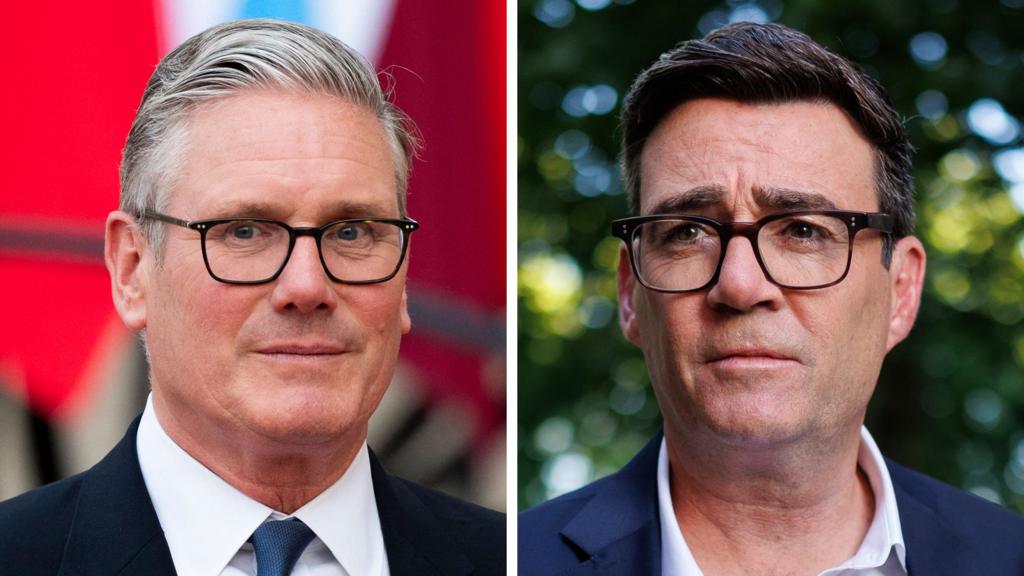
Andy Burnham became the United Kingdom's prime minister on Monday, the fifth person to hold the office in four years, after Keir Starmer delivered his final address as prime minister and both men travelled to Buckingham Palace for the formal handover of power. At the Palace, Starmer had a final private audience with King Charles before Burnham was received by the monarch and asked to form a government. The visit marked Burnham as the fourth prime minister of King Charles III's reign, which began in 2022. After the Palace, Burnham returned to Downing Street to deliver his first speech as prime minister.
The ceremony of the handover, while steeped in tradition, reflects a stable constitutional process in a political era that has been anything but. The UK has now had five prime ministers since the summer of 2022, when Boris Johnson was still in office. He was followed by Liz Truss, Rishi Sunak and Keir Starmer, before Burnham's arrival on Monday. Each transition has involved the same formal Palace visit, the same handshake with the King replacing the historical practice of kissing the royal hand, and the same photographic record taken for posterity. The ritual has remained constant even as the leaders cycling through it have changed with unusual speed.
Burnham is "acutely conscious" of the political churn at the top, according to advance briefings on the content of his Downing Street speech. In it, he is expected to promise "more breathing room" for Britain and to argue for a more "stable and responsible" politics. The framing is deliberate: after four years in which prime ministerial tenure has been measured in months rather than years, the promise of stability carries real political weight with an electorate that has watched the revolving door of Number 10 with mounting frustration. Conservative leader Kemi Badenoch wished the new prime minister "every success" but warned he was entering Downing Street without a "clear plan."
Burnham's first policy announcements include scrapping digital ID, supporting North Sea oil drilling, and a 20% business rate cut for pubs and music venues
Burnham has remained deliberately tight-lipped on the specifics of his programme, but a picture of his early priorities has emerged from his office and from campaign materials. He will scrap plans for a government-issued digital ID for all British adults, a decision his office framed as a move to shift focus onto "the daily priorities facing people across the country." He will also announce plans for new oil and gas drilling in the North Sea, though the BBC understands he is likely to support existing licences rather than issuing new ones, placing him within the Labour government's existing energy framework rather than breaking from it.
On water and energy, Burnham has previously called for "greater public control" but stopped short of committing to full nationalisation, a position that will be tested almost immediately given that lenders to Thames Water are preparing to challenge any moves to bring the country's biggest water company into public ownership. The cost of living agenda will feature prominently in his early weeks, with plans expected to give people "breathing space," though the specific measures had not been disclosed ahead of his Downing Street speech on Monday. During his campaign to become the MP for Makerfield, his team also published a commitment to cut business rates for pubs and music venues by 20%, funded by higher taxes on warehouses used by large online retailers.
The policy landscape Burnham inherits is constrained by the Labour Party's 2024 general election manifesto, which was Keir Starmer's platform. Emma Burnell, editor of the LabourList website, told BBC Breakfast that Burnham can "rejig the priorities" within that framework but cannot simply rewrite policy from scratch. She said there was "real optimism" about Burnham within the party but also a clear-eyed recognition that this was Labour's "last chance" to make a real difference. "It's going to be a long, hard project," she said. "I don't think he's going to be able to do it overnight. He will need to show that there is real, tangible progress being made."
"To be clear to people, it can't be done overnight. But you've got to show people where we're going, and then the steps towards it. And that's what I'm going to try to do." Andy Burnham, speaking to The Times
Why there is no general election when the prime minister changes in the UK
A frequently asked question on a day like today is why Britain does not hold a general election when a new prime minister takes office without one having been called. The answer lies in the UK's constitutional framework. The prime minister can choose to call a general election at any point, but there is no legal requirement for one when the premiership changes hands within the same Parliament. The current Parliament began on 9 July 2024 following the general election of that year. The next election must legally be held no later than 15 August 2029, which is five years from the start of the current Parliament plus 25 working days to run a campaign.
There will inevitably be calls for a general election, particularly from opposition parties who would argue that voters should have the chance to endorse or reject a prime minister they did not elect. Labour's calculation is equally clear: an election called now could result in losses in Parliament that the party would not want. Burnham's task is therefore to build a governing record quickly enough to make the case for his leadership before the 2029 deadline, without the immediate democratic mandate that a fresh election would provide.
Burnham brings a distinctive governing record from his time as Mayor of Greater Manchester, and his approach to the role of prime minister is expected to reflect the style he developed there. He has said he intends to "do things in a different way" after what he describes as a "decade of it just not working." He told The Times he plans to lay a "long" path to a "new kind of economy," acknowledging the scale of the project. In the same interview, he revealed that his father, who has Alzheimer's, is not aware that his son is about to lead the country. "It's a family achievement," Burnham said, "although he doesn't know it, it still makes me feel that we've kind of done something together."