
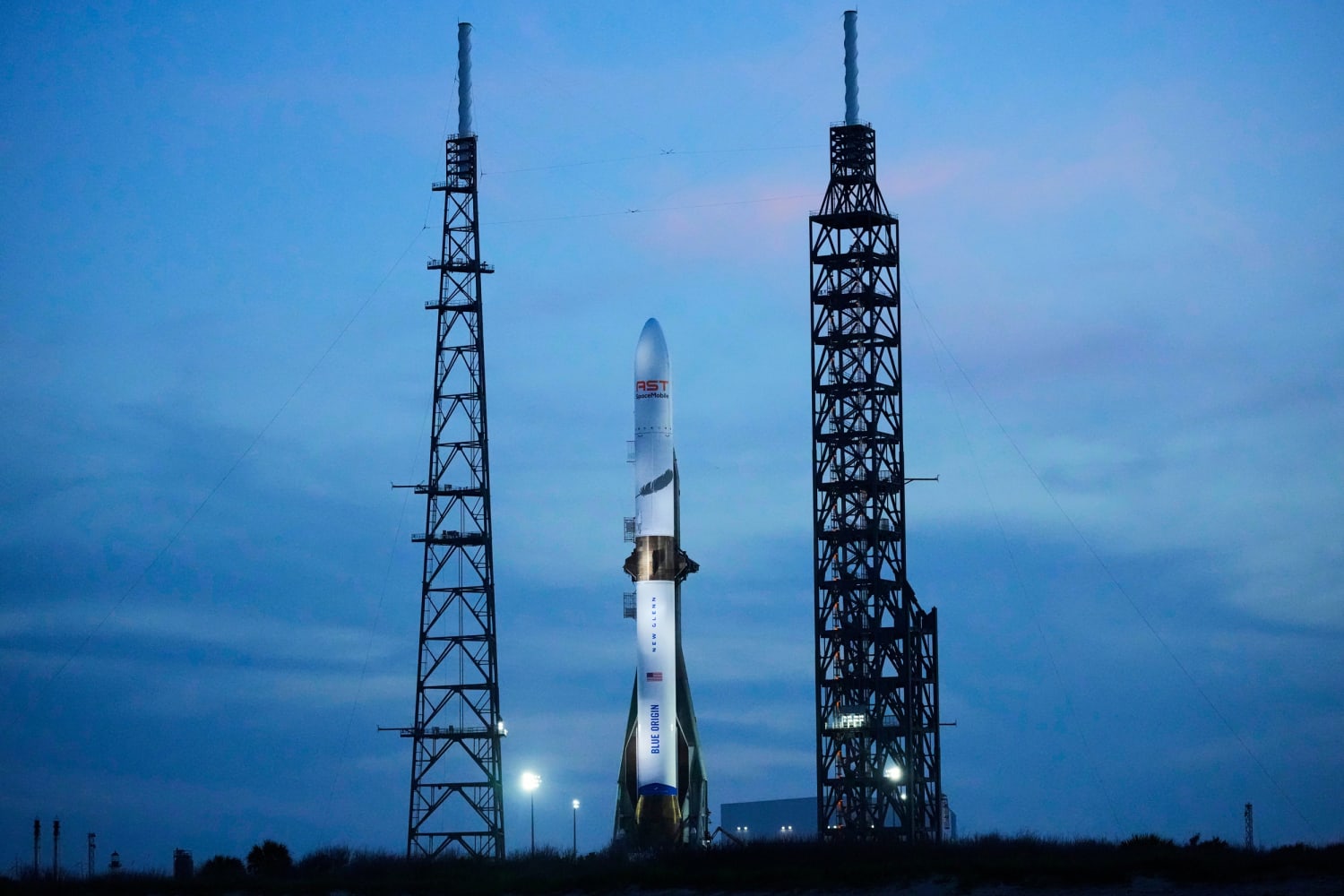
Blue Origin New Glenn rocket exploded on a launch pad at a Space Force facility in Cape Canaveral, Florida, on Thursday night during what the company was conducting as a hot-fire ground test, a critical phase of rocket development in which engines are ignited at full power while the vehicle remains bolted to the pad. No injuries were reported and emergency management officials confirmed no threat to the public, but the explosion delivered a significant setback to one of the most ambitious commercial space technology programmes currently competing for supremacy in the new era of heavy-lift reusable rocketry. Jeff Bezos, the Amazon founder who leads Blue Origin, confirmed all personnel were safe and indicated the company would begin investigating the root cause immediately.
The technical significance of the failure is considerable. A hot-fire test is specifically designed to validate the propulsion system of a rocket under real operational conditions before any flight attempt, making it one of the most controlled and carefully monitored procedures in the pre-launch engineering sequence. That the New Glenn exploded during this phase rather than surviving it suggests a failure in the propulsion system, fuel management, or structural integration that engineers had not identified through prior testing. Bezos acknowledged the severity on X with characteristic directness: "It's too early to know the root cause but we're already working to find it. Very rough day, but we'll rebuild whatever needs rebuilding and get back to flying. It's worth it."
The timing of the explosion could not have been more consequential. Just one day earlier, NASA Administrator Jared Isaacman had publicly praised Blue Origin's role in the Artemis programme and announced the agency had awarded Blue Origin a $188 million contract to help build a permanent Moon Base. Isaacman responded to the explosion by confirming NASA was aware of the incident and would assess impacts on both the Artemis programme and the Moon Base initiative as information became available. "Spaceflight is unforgiving, and developing new heavy-lift launch capability is extraordinarily difficult," he said, framing the explosion as an inherent risk of frontier technology development rather than a specific failure of oversight or process.
How Blue Origin Built New Glenn and Why Its Technology Race With SpaceX Matters
The New Glenn rocket represents Blue Origin's most serious attempt yet to compete directly with SpaceX in the commercial heavy-lift launch market, a segment that Elon Musk's company has dominated for the better part of a decade through its Falcon 9 and Falcon Heavy platforms. New Glenn is a two-stage orbital rocket designed to be fully reusable, with a first stage capable of landing itself after launch in the same manner that SpaceX pioneered with its Falcon 9 boosters. The ambition behind New Glenn is not merely to match SpaceX's capability but to offer a credible alternative that gives satellite operators, government agencies, and commercial customers a second reliable option in a market where single-provider dependence has long been seen as a structural risk.
Blue Origin has been working on New Glenn for years, investing heavily in its BE-4 liquid methane engines, which also power United Launch Alliance's Vulcan Centaur rocket, giving the engine a dual-customer profile that adds commercial significance to the technology's track record. The company achieved its first successful New Glenn orbital launch earlier in 2025, demonstrating that the rocket could reach orbit and that its first stage booster recovery system functioned as designed. That milestone made Blue Origin a credible contender in the commercial and government launch market and set the stage for the deeper NASA partnership that Isaacman celebrated just 24 hours before the explosion. Thursday's accident erases that forward momentum and forces the engineering team back into investigation and remediation mode before any further test or launch activity can proceed.
Elon Musk's response to the explosion captured the competitive but respectful tone that defines the public posture of the two companies toward each other. "Most unfortunate. Rockets are hard," Musk wrote on X, a statement that is simultaneously sympathetic and a quiet reminder of how much SpaceX has invested in solving the exact engineering problems that Blue Origin is still working through. The commercial space technology sector is not a zero-sum game in the short term; NASA and government agencies benefit from having multiple capable launch providers. But in the long term, every delay Blue Origin suffers is time SpaceX uses to deepen its technical lead, expand its customer base, and cement its position as the default platform for both commercial and government heavy-lift missions.
What the Explosion Means for NASA Artemis, Moon Base Plans, and the Future of New Glenn Technology
The immediate technological priority for Blue Origin following the explosion is root cause analysis, a rigorous engineering process that involves examining every component, sensor reading, video feed, and telemetry data point from the moments before, during, and after the anomaly to identify exactly what failed and why. Until that process produces a clear answer, Blue Origin cannot responsibly resume hot-fire testing or attempt a launch, and the timeline for returning New Glenn to operational status is genuinely unknown. The Federal Aviation Administration, which regulates all commercial space activities in the United States and must sign off on any return-to-flight, did not immediately respond to requests for comment, but its investigation and approval process will add a regulatory dimension to the engineering timeline that Blue Origin cannot control or compress unilaterally.
For NASA, the explosion introduces uncertainty into the Artemis programme at a moment when the agency was building confidence around its 2028 Moon landing target. Blue Origin's New Glenn is not the only rocket in NASA's Artemis architecture, but the company's Human Landing System and the newly announced Moon Base contract both rely on New Glenn as a core delivery platform. A prolonged grounding of the rocket directly affects NASA's ability to move hardware, payloads, and eventually crew-supporting infrastructure to lunar orbit and the Moon's surface on the schedule that the agency has publicly committed to. Isaacman's measured response, calling for a thorough investigation and offering to support Blue Origin through the process, reflects both genuine institutional concern and the diplomatic necessity of maintaining a functioning partnership with a key contractor whose technology is now under serious scrutiny.
The broader technology question raised by Thursday's explosion is whether Blue Origin's engineering maturity is where it needs to be to support the kind of sustained, schedule-dependent programme that Artemis and Moon Base require. SpaceX's Starship, which has had its own dramatic test explosions, has progressed through an iterative development model that treats failures as engineering data rather than programme-ending events. Blue Origin will need to apply a similar philosophy to New Glenn's recovery, moving quickly through investigation, design modification, and re-testing to demonstrate that the programme retains the technical momentum that Thursday night's explosion appeared to interrupt. Bezos's statement that the company will "rebuild whatever needs rebuilding" is the right framing, but the pace and quality of that rebuilding will determine whether New Glenn remains a credible part of America's lunar technology infrastructure or cedes ground to SpaceX in the most consequential space race of the current decade.