
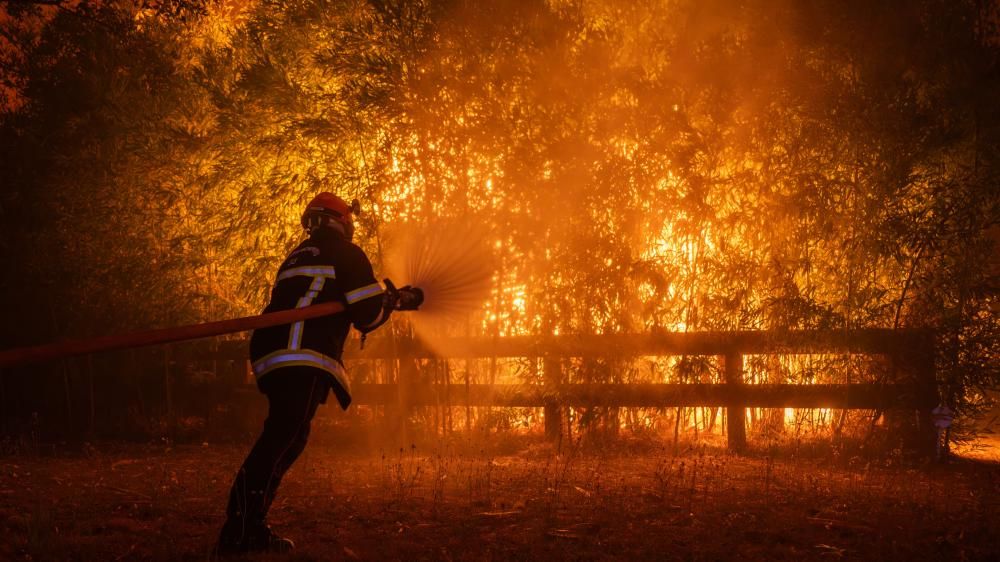
A wildfire that has consumed an area larger than the Isle of Wight is burning nine miles from the outskirts of Bordeaux Wildfire 330,000 Evacuated, Pyrocumulonimbus, a city of 850,000 people, after generating a rare and terrifying meteorological phenomenon: a pyrocumulonimbus, a fire-driven thunderstorm that produces its own winds and lightning, making the blaze self-sustaining and directionally unpredictable in ways that overwhelm conventional firefighting strategies. The National Firefighters Federation of France (FNSPF) has described the situation as "David versus Goliath," a framing that captures both the physical disproportion between the resources available to fight the fire and the scale of the emergency and the psychological weight of defending a major European city against a force that is now generating its own weather. More than 330,000 people have been evacuated across France and Spain, with many sleeping in makeshift shelters in sports halls and exhibition centers, as French President Emmanuel Macron holds a crisis cabinet meeting and Spanish Prime Minister Pedro Sánchez prepares to visit fire-hit areas in Valencia.
The overnight period brought moderately encouraging news: the fire near Bordeaux did not advance, winds eased, and a small amount of rain fell, allowing the Gironde prefecture to describe the situation on Monday morning as "broadly stable." But the relief is conditional and time-limited. Temperatures are forecast to reach 40 degrees Celsius on Tuesday, a return to the extreme heat conditions that drove the fire's most aggressive behavior over the preceding days. France's Interior Minister Laurent Nunez had described the fire's movement as "very unfavorable" and "erratic" on Sunday. Bordeaux's mayor Thomas Cazeneuve confirmed on Sunday that there were no current plans to evacuate the city's 850,000 residents, a statement that, while reassuring in its specificity, acknowledges the possibility explicitly by ruling it out. The motorway south of Bordeaux toward Spain has been closed. Rail services to the south and west have been suspended. The city is, in logistical terms, partially isolated.
In Spain, the scale of the emergency has similarly escalated beyond any previous precedent. Approximately 77,000 hectares have been burned in the Madrid, Ávila, and Toledo regions alone, according to ecological transition minister Sara Aagesen. Around 90,000 people have fled from those regions. A new front has opened in Valencia on the eastern coast, forcing 15,000 people from their homes in a city far from the originally affected area, demonstrating that the wildfire crisis is not geographically contained to the southwest of the country but is spreading to multiple Spanish regions simultaneously. "Difficult hours lie ahead," Sánchez told the country, one of the more somber public warnings issued by a sitting prime minister in response to a domestic natural disaster and a signal that official assessments of the coming days are not optimistic.
The Pyrocumulonimbus and the Threat to Bordeaux Explained
The emergence of a pyrocumulonimbus above the Gironde wildfire represents a qualitative escalation in the fire's danger that requires explanation beyond the language of scale and numbers. A pyrocumulonimbus, sometimes abbreviated as pyroCb, is a cumulonimbus thunderstorm cloud generated by the intense heat of a major wildfire. When a fire burns at sufficient intensity and scale, it creates a thermal column that rises rapidly into the upper atmosphere, drawing in air from the surrounding environment and generating convection powerful enough to form a genuine storm cloud. That cloud then produces lightning, erratic wind patterns at ground level, and in some cases dry lightning strikes that can ignite new fires beyond the main fire perimeter. The fire, in effect, becomes a weather engine, making itself more powerful and more unpredictable than a fire burning without that feedback loop.
The FNSPF's "David versus Goliath" description reflects this reality: a pyrocumulonimbus-generating fire is not simply a large fire that can be managed with enough resources. It is a fire system that has crossed a threshold where its own dynamics, rather than external suppression efforts, are the primary driver of its behavior. Aerial water bombing and ground-based backfire operations remain part of the response toolkit, but their effectiveness is substantially reduced when the fire is generating its own wind patterns that can redirect suppression efforts, carry embers far ahead of the main front, and create spot fires in locations that ground crews cannot rapidly reach. The French military's firebreak operations and the EU aircraft operating in the Gironde are working against a fire that is, for the moment, partly beyond the control of any assembly of human resources.
The fire area, described as larger than the Isle of Wight, approximately 380 square kilometers, and located 15 kilometers from Bordeaux's southern outskirts, has created infrastructure consequences that are already affecting the city's 850,000 residents even without an evacuation order. The closure of the A63 motorway south of Bordeaux toward Spain removes one of the main evacuation routes and creates supply chain disruption for everything from tourism to logistics. The suspension of rail services to the south and west reduces the options available to residents who would need to leave and, in the immediate term, prevents tourists from departing the affected region by train. The Gironde prefecture's appeal for holiday-makers to stay away from the area is a public acknowledgement that the arrival of additional people would compound an already strained resource picture.
Understanding the Pyrocumulonimbus and What It Tells Us About 2025's Fire Season
The pyrocumulonimbus formation above the Gironde is not a random occurrence. It is a predictable consequence of fire behavior at extreme scale in conditions of high heat, low humidity, abundant fuel, and atmospheric instability. Pyrogenic convection events have been documented in the Australian bushfires of 2019-2020, the 2021 British Columbia wildfires in Canada, and the 2020 California wildfire season in the United States, each of which produced pyroCb events that dramatically worsened fire behaviour and created new ignition points through dry lightning. The emergence of a pyrocumulonimbus in France marks the arrival in western Europe of a fire behavior phenomenon previously associated primarily with the largest and most intense fire seasons in the Southern Hemisphere and the western United States.
The conditions that enabled a fire to reach pyrocumulonimbus intensity in the Gironde combine the structural factors identified in the current crisis with specific atmospheric conditions. The Gironde's plantation pine forests provide a continuous, dense fuel load with high flammability under dry conditions. The preceding drought, the record June heat recorded by Copernicus, and the abundant vegetation growth from the wet winter created the fuel state necessary for a fire burning at the scale that generates the upward thermal columns required for pyroCb formation. The return of 40-degree heat on Tuesday, forecast with confidence by meteorological services, means the atmospheric conditions that enabled the pyrocumulonimbus to form are likely to recur, potentially reactivating the storm behavior that overnight rains temporarily suppressed.
Understanding the pyrocumulonimbus is important for the public because it explains why statements from officials about the fire being "broadly stable" overnight can coexist with warnings about "difficult hours" and a "David versus Goliath" challenge. Stability in a pyroCb-associated fire is conditional on the atmospheric conditions that suppressed the convection column overnight, primarily the reduction in surface temperature and the slight rain. When those conditions reverse, as they are forecast to do on Tuesday, the fire's behavior can shift rapidly from stable to extreme. The professional assessment reflected in both French and Spanish official communications is that the next 48 to 72 hours, as temperatures return to extreme levels across both countries, represent the period of greatest risk for both the Bordeaux fire and the ongoing Spanish emergencies.
How the Crisis Reached This Point
Earlier in the week — Wildfire begins in Saumos, Gironde. Two firefighters die near Bordeaux airport. Initial evacuations ordered around the fire perimeter.
Thursday and Friday — Fire spreads rapidly through Gironde pine forests. Biscarosse fire opens in Landis region. France evacuates over 60,000 from Cap Ferret peninsula and surrounding area. Spain declares national emergency as fires merge near Madrid. EU Civil Protection Mechanism activated by both countries.
Saturday — Total evacuations cross 220,000. French military mobilized. Bordeaux western suburbs evacuation ordered. NASA facility in Spain affected. Spain's Isabel Díaz Ayuso describes Madrid fires as worst in regional history.
Sunday — French Interior Minister Nunez describes fire as moving "erratically" toward Bordeaux. The pyrocumulonimbus forms above the Gironde fire, the first pyroCb event recorded in France. Spain's evacuations exceed 90,000 in the Madrid, Ávila, and Toledo regions. Valencia fire opens, forcing 15,000 from their homes. Ecological transition minister Aagesen confirms 77,000 hectares burned in the Madrid region alone. Bordeaux mayor rules out city evacuation but confirms motorway and rail closures.
Overnight Sunday to Monday — Winds ease. Slight rain falls. Fire near Bordeaux does not advance. Gironde prefecture reports situation "broadly stable." Overnight assessment provides conditional relief.
Monday — Total evacuations across France and Spain confirmed at more than 330,000. Many thousands sleeping in sports halls and exhibition centers. Macron convenes emergency cabinet meeting. Sánchez to visit Valencia. 40-degree heat forecast for Tuesday across affected regions.
Macron's Crisis Cabinet and the Politics of an Unprecedented Emergency
Emmanuel Macron's decision to convene an emergency ministerial meeting on Monday is the clearest signal yet that the French government views this crisis as a political emergency as well as a humanitarian one. Crisis cabinet meetings in France, called under the authority of the president and the prime minister, are reserved for situations where the scale and nature of a challenge requires coordinated decision-making at the highest level of government rather than delegation to departmental and prefectural authorities. The fact that the Gironde prefect, the interior minister, and now the president himself are all publicly engaged with the crisis reflects a recognition that fire management at the operational level cannot be separated from national political accountability at the moment when a city of 850,000 people is potentially threatened.
The "David versus Goliath" framing from the FNSPF is as much a political communication as a tactical assessment. By explicitly naming the disproportion between firefighting resources and the scale of the emergency, the federation is making a public argument about resource adequacy that will be used both to justify international assistance requests and to frame post-crisis investigations into whether France had invested sufficiently in prevention and firefighting capacity. The combination of a pyrocumulonimbus event, a scale of evacuation unprecedented in French peacetime history, and an emergency requiring military mobilization and EU aircraft represents a significant political liability for a government that had committed to improved fire management following the 2022 Gironde season.
In Spain, Pedro Sánchez's decision to visit Valencia rather than Madrid reflects a specific political calculation about where the most acute, visible, and humanly compelling story is developing. Valencia, a major Mediterranean city on Spain's eastern coast far from the originally affected Madrid region, demonstrates that the wildfire emergency is expanding geographically rather than being contained. The 15,000 evacuations from Valencia add a new regional dimension to a crisis that was already testing national capacity, and Sánchez's visit signals both national concern and the political imperative of being seen in the worst-affected communities at a moment when official statements acknowledge that "difficult hours lie ahead."
A Wildfire Crisis That Is Costing France and Spain Billions
The economic cost of the 2025 European wildfire emergency is accumulating at a rate that will require billions of euros of public and private response. The most immediate dimension is infrastructure: the A63 motorway closure south of Bordeaux disrupts a major arterial route connecting France and Spain wildfire, affecting freight logistics, tourism movement, and the economic connections between two countries that are among Europe's most significant bilateral trading partners. Rail suspensions compound the disruption. The economic consequence of partial isolation for a city of 850,000 people during the peak tourist season is difficult to quantify precisely but is clearly substantial.
Property losses in the Gironde alone will be significant. The fire area, larger than the Isle of Wight and approaching 15 kilometers from Bordeaux's outskirts, has consumed pine forest with significant commercial timber value alongside residential properties, campsite infrastructure, and agricultural land. Insurance claims will be proportionate to the unprecedented scale of the event. The reinsurance market, which backs large-scale natural disaster risk, will absorb a loss event that is likely to exceed any previous French wildfire claim on record, and the repricing of that risk in subsequent underwriting cycles will affect every property owner in the fire-prone southwest of France.
For Spain, the 77,000 hectares burned in the Madrid, Ávila, and Toledo regions represents an agricultural and ecological loss of enormous scale. The specific combination of regions, encompassing the agricultural lowlands around Toledo, the highland forests of Ávila, and the peri-urban landscape of the Madrid region, contains a diverse range of economic activity including cereal farming, livestock grazing, vineyards, and the outdoor recreation economy. Quantifying the immediate losses requires damage surveys that will take weeks to complete, but the scale of burned area relative to the 2022 season, which was itself unprecedented, makes this year's economic impact likely to exceed any previous benchmark.
Tourism Collapse, Logistics Disruption, and the Changing Economics of Fire Risk
The business impact of a wildfire that has partially isolated Bordeaux, one of France's premier tourism destinations and wine-producing regions, extends across multiple sectors simultaneously. Bordeaux's wine industry, which centers on the Médoc, Pessac-Léognan, and St-Émilion appellations that surround the city, is approaching the critical late-summer period when vineyard management determines the quality of the annual harvest. Fire smoke, altered humidity conditions, and the agricultural disruption created by a fire perimeter nine miles from the city's southern outskirts all create risks for a wine industry whose product quality is highly sensitive to the conditions during the growing season's final weeks.
The logistics sector has been directly disrupted by the A63 motorway closure. The autoroute between Bordeaux and the Spanish border is a critical freight corridor for goods moving between the Iberian Peninsula and northern Europe, including fresh produce, manufactured goods, and the commercial traffic that underlies the bilateral trade relationship between France and Spain. The closure reroutes freight through alternative and less efficient paths, adding time and cost to supply chains that had not budgeted for the disruption. The duration of the closure, which depends on fire containment progress and road safety assessment, is currently unknown, creating ongoing uncertainty for logistics planners managing time-sensitive freight.
The campsite and summer tourism economy has effectively collapsed across the evacuation zones. With more than 330,000 people displaced into sports halls and exhibition centers, and with the Gironde prefect urging holiday-makers to stay away from the affected area, the commercial infrastructure that depends on summer visitor spending, including campsites, rental properties, restaurants, surf schools, and outdoor activity businesses along the Atlantic coast, is generating zero revenue during its most commercially critical period. Many of these businesses will seek relief through emergency government support schemes and business interruption insurance, but the adequacy of those mechanisms for an event of this unprecedented scale is untested.
The Pyrocumulonimbus as a Climate Milestone and Its Meaning for the World
The formation of a pyrocumulonimbus above the Gironde wildfire is a milestone in European climate history that will be studied by fire scientists and climate researchers for years. Pyrogenic convection events of the intensity required to generate a pyroCb have previously been documented in Australia, Canada, and the western United States, regions where the combination of fire season length, fuel availability, and atmospheric conditions had reached the threshold for extreme fire behaviour. Their emergence in Atlantic France, in the Gironde's plantation pine forests, marks a geographic expansion of extreme fire behavior into European regions that had not previously been considered capable of generating fires of this intensity.
The international climate and emergency management community is watching the French and Spanish emergencies for what they reveal about the adequacy of existing institutional frameworks for simultaneous multi-country extreme weather emergencies. The EU's Civil Protection Mechanism, simultaneously activated by France and Spain, is being tested against a scenario its designers had not specifically modelled: two major economies, both with significant fire emergencies, requiring the same category of aerial firefighting resources from the same pool of European member state contributions at the same time in the same week. The constraints that exposes will inform EU-level discussions about emergency preparedness investment in the years ahead.
For governments worldwide, particularly those managing regions where increasing fire risk is a growing concern, the 2025 Europe heatwave season provides a set of case studies in what happens when fire risk that has been growing gradually crosses thresholds that transform it from a manageable seasonal hazard into a system-level emergency. The specific thresholds, the pyrocumulonimbus formation, the merger of separate fire fronts into a single uncontainable blaze, the geographic expansion from recognised fire risk zones into new areas, are all phenomena that fire risk modelers and emergency planners in vulnerable regions can study and incorporate into preparedness frameworks before they face equivalent emergencies themselves.
Fire Scientists on the Pyrocumulonimbus, the Overnight Stability, and Tuesday's Forecast
Fire scientists will explain the overnight stability near Bordeaux in terms of the atmospheric dynamics that suppress pyrogenic convection during cooler, more humid nighttime conditions. The pyrocumulonimbus is a diurnal phenomenon: it is most likely to form and intensify during the afternoon and early evening when surface temperatures are highest, atmospheric instability is greatest, and the thermal column above the fire has maximum energy. The overnight easing of winds and the slight rainfall are consistent with the nocturnal suppression of convective activity that allows fire crews to make operational progress, consolidate containment lines, and position resources for the following day's challenge.
The 40-degree forecast for Tuesday is precisely the temperature at which the atmospheric conditions that generated Monday's "broadly stable" assessment are most likely to reverse. Surface heating increases the thermal column above the fire; lower humidity reduces the effectiveness of moisture as a natural fire suppressant; afternoon sea breezes or diurnal wind patterns can change the fire's direction rapidly in coastal pine forest terrain. The firefighting strategy for Tuesday will need to account for the possibility that the overnight stabilization is temporary, that the pyrocumulonimbus behavior could reactivate, and that the fire's proximity to Bordeaux, 15 kilometers and closing if conditions turn, means that any significant directional change could reduce response time to a degree that makes defensive operations around the city's southern outskirts the primary priority.
The FNSPF's public communications have been notable for their directness about the limits of firefighting capacity against a pyrocumulonimbus-generating fire. Fire agencies in most countries are trained to communicate confidence and control, and the choice to use "David versus Goliath" as the public characterization of the challenge reflects an institutional decision to be transparent about the genuine difficulty of the situation rather than to manage public perception with reassuring language that the operational reality does not support. That transparency has value for emergency management: when the public and political leadership understand that the fire is partially beyond conventional control, decisions about pre-emptive evacuations, resource requests, and contingency planning are made on the basis of accurate information rather than false confidence.
The Tuesday Temperature Spike and the Decisions That Will Define the Coming Days
Tuesday's heat — The 40-degree forecast is the single most important meteorological variable of the coming 48 hours. If it materializes as forecast, fire behavior near Bordeaux could shift rapidly from Monday's stable assessment to active, erratic movement toward the city's outskirts. Aerial operations will be at maximum intensity throughout the day. Military firebreak crews established overnight will be the first test of whether the containment lines hold.
Bordeaux evacuation decision — Mayor Cazenave has ruled out a city evacuation as of Sunday, but the 15-kilometre distance and the forecast heat create a scenario in which that decision may need to be revisited if Tuesday's fire behavior is severe. Any evacuation of an 850,000-person city within 24 to 48 hours of a decision represents one of the most logistically complex operations a French prefecture has ever attempted.
Valencia containment — Spain's newest fire front, responsible for 15,000 Valencia evacuations, will be assessed by Pedro Sánchez during his Monday visit. Whether the Valencia fire is brought under control quickly or develops into a third major simultaneous emergency will determine how Spain's already stretched resources are distributed.
Macron's crisis meeting outcomes — The decisions made at Monday's emergency cabinet meeting will include resource allocation, military task assignments, international assistance requests beyond the current EU aircraft deployment, and communication strategy for the population of Bordeaux and the surrounding region. Public statements from the meeting will be watched closely for any upward revision in the official assessment of the risk to the city.
Post-crisis investigation — The pyrocumulonimbus formation, the scale of evacuations, the motorway and rail closures, and the unprecedented character of the emergency in the Gironde will all become subjects of post-crisis investigation. The FNSPF's "David versus Goliath" framing has already positioned the question of resource adequacy as central to that inquiry.
What to Watch Next
Whether Tuesday's 40-degree heat reactivates the pyrocumulonimbus above the Gironde fire and whether the containment lines established overnight hold against a return to extreme fire behavior.
Whether Bordeaux's mayor and the Gironde prefecture maintain their position against a city-wide evacuation or revise it if Tuesday's fire behavior moves the fire materially closer to the city's outskirts.
The outcomes of Macron's emergency cabinet meeting, particularly any decisions about additional resource requests, military deployments, or changes to the public communication strategy around the Bordeaux risk.
The trajectory of the Valencia fire and whether Sánchez's visit is followed by resource commitments that can prevent a third simultaneous major Spanish emergency from developing.
The meteorological forecast for the remainder of the week after Tuesday's heat spike, and whether any cooling or rain is forecast that could provide the sustained weather change needed to allow meaningful containment progress.