
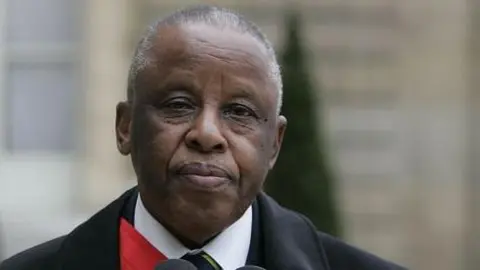
Botswana has lost one of its most respected and consequential leaders with the passing of former President Festus Mogae dies, who died at the age of 86. The Botswana government confirmed the news and immediately declared three days of national mourning in honor of a statesman whose decade in power left a lasting imprint on the southern African nation's economy, public health systems, and democratic institutions. Mogae served as Botswana's third president from 1998 to 2008, a period that tested the country's governance frameworks and health systems in profound ways, and his responses to those tests earned him recognition far beyond his country's borders. His death marks the end of a life defined by public service, intellectual rigor, and a genuine commitment to the welfare of ordinary Botswana citizens.
The news of Mogae's passing drew expressions of grief and tribute from across Africa and the international community, reflecting the degree to which his leadership was admired not just domestically but as a model of what principled, effective governance in a developing nation could look like. During his presidency, Botswana maintained its reputation as one of Africa's most stable and well-governed democracies while simultaneously confronting one of the most devastating public health crises in its history. The combination of sound economic management and courageous public health leadership that characterized his tenure established Mogae as a figure of continental and global significance, and his post-presidential career in international development and governance advisory work extended that influence well beyond his time in office.
Mogae was born on August 21, 1939, in Serowe, a town in central Botswana that has produced several of the country's most significant public figures. He pursued his education in Britain, acquiring the economic training that would later define his approach to managing Botswana's natural resource wealth and public finances. He returned home to join Botswana's civil service shortly after the country gained independence in 1966, beginning a career in public administration that would eventually carry him to the highest office in the land through decades of disciplined, methodical service rather than the dramatic political ruptures that have characterized leadership transitions in many of his regional neighbors.
How Festus Mogae Built a Career of Distinction Before Reaching the Presidency
The path that led Festus Mogae to the presidency of Botswana was built on foundations of technical expertise and institutional loyalty rather than populist politics or military power. After completing his studies in Britain, where he developed the economic thinking that would inform his later policymaking, Mogae entered Botswana's civil service at a foundational moment in the young nation's history. Independence in 1966 had left Botswana as one of the poorest countries in the world, heavily dependent on British aid and with almost no developed infrastructure or institutional capacity. The men and women who entered public service in those early years were building a state almost from scratch, and the quality of that founding generation of civil servants would do much to determine Botswana's long-term trajectory.
In previous decades of his career, Mogae served in a series of increasingly senior economic and financial roles that gave him an unusually deep understanding of how Botswana's diamond-based economy functioned and what its structural vulnerabilities were. His tenure as finance minister was particularly significant, as it placed him at the center of decisions about how to manage the extraordinary revenues flowing from the country's diamond partnership with De Beers and how to translate that mineral wealth into sustainable human development rather than the resource curse that has undermined so many other mineral-rich African states. His success in that role demonstrated an economic discipline and long-term thinking that distinguished him from finance ministers in comparable countries who prioritized short-term political popularity over fiscal responsibility.
His appointment as vice president under President Ketumile Masire positioned him as the clear heir to the presidency and gave him additional years of executive preparation before he formally assumed the top office in 1998. That transition was itself a demonstration of the institutional maturity that Botswana had developed, with power passing between elected leaders according to constitutional rules rather than through contestation or crisis. When Mogae assumed the presidency, he inherited a country with genuine strengths but also with a public health emergency of terrifying proportions already taking shape, and the decisions he made in the early years of his presidency about how to respond to that emergency would define his legacy more than any other single element of his time in power.
The HIV/AIDS Crisis That Defined Mogae's Presidency and His Courageous Public Response
When Festus Mogae became president of Botswana in 1998, the country was in the grip of one of the most severe HIV/AIDS epidemics anywhere in the world. Infection rates were among the highest globally, with estimates suggesting that a substantial proportion of Botswana's adult population was living with the virus at a time when effective antiretroviral treatment was either unavailable or unaffordable across most of sub-Saharan Africa. The epidemic threatened to reverse decades of hard-won development gains, deplete Botswana's working-age population, overwhelm its healthcare system, and leave an entire generation of children orphaned and vulnerable. Many African leaders of that era responded to the epidemic with denial, silence, or stigmatizing language that deepened the harm already being done.
Mogae chose a radically different path. He spoke about HIV/AIDS openly, directly, and without the shame or evasion that characterized official responses in too many neighboring countries. He acknowledged the scale of the crisis with unflinching honesty, describing it in terms that communicated genuine urgency rather than bureaucratic distance. Under his leadership, Botswana developed and implemented one of the African continent's most comprehensive national programs to combat HIV/AIDS, including an ambitious antiretroviral treatment rollout that was pioneering in its scope and ambition at a time when such programs were rare across the developing world. The program drew on Botswana's diamond revenues and international partnerships to fund treatment access that most comparable countries could not yet contemplate.
The results of Mogae's HIV/AIDS policy were measurable and significant. Infection rates in Botswana declined, treatment access expanded dramatically, and the country's public health infrastructure was strengthened in ways that had lasting benefits beyond the immediate epidemic response. Mogae's willingness to stake his personal and political credibility on an honest public engagement with the crisis gave his health ministry the political cover to implement policies that faced social resistance and stigma. His approach was later recognized internationally as a model of how political leadership can make a decisive difference in public health outcomes, and he received numerous international awards and recognitions for this work both during and after his presidency.
Mogae's Legacy of Democratic Governance and the Smooth Transition of Power
One of the elements of Festus Mogae's legacy that receives less public attention than his HIV/AIDS response but is equally significant for Botswana's long-term institutional health is the manner in which he left office. After completing the maximum two terms permitted under Botswana's constitution, Mogae stepped down in 2008 and handed power to his vice president, Ian Khama, in a transition that was smooth, constitutional, and entirely free of the political drama that has surrounded leadership changes in many African states. That transfer of power reinforced Botswana's reputation as one of the continent's most stable and well-governed democracies and demonstrated that the country's constitutional term limit framework was a genuine constraint on executive power rather than a formality to be circumvented.
In earlier decades of post-independence African history, the peaceful voluntary departure of a sitting president who retained significant personal popularity and institutional support was far from guaranteed even in countries with formal term limit provisions. Mogae's clean exit from the presidency, following the precedent set by his predecessors and establishing a norm for his successor, contributed to a culture of democratic accountability that has been one of Botswana's most valuable and distinctive national assets. His post-presidential life reinforced that contribution, as he engaged actively in international governance initiatives, development advisory work, and climate and health advocacy rather than attempting to maintain domestic political influence in ways that could have undermined his successor's authority.
The three days of national mourning declared by the Botswana government following Mogae's death reflect the depth of respect that his leadership commands across the country's political spectrum and social landscape. He governed a small nation with large natural resource wealth and the ever-present risk that such wealth creates for corruption, inequality, and institutional degradation, and he left it in measurably better condition than he found it. That outcome, straightforward as it sounds in description, is rarer in practice than it should be among leaders of resource-rich developing nations, and it is the foundation on which Festus Mogae's historical reputation will rest.