
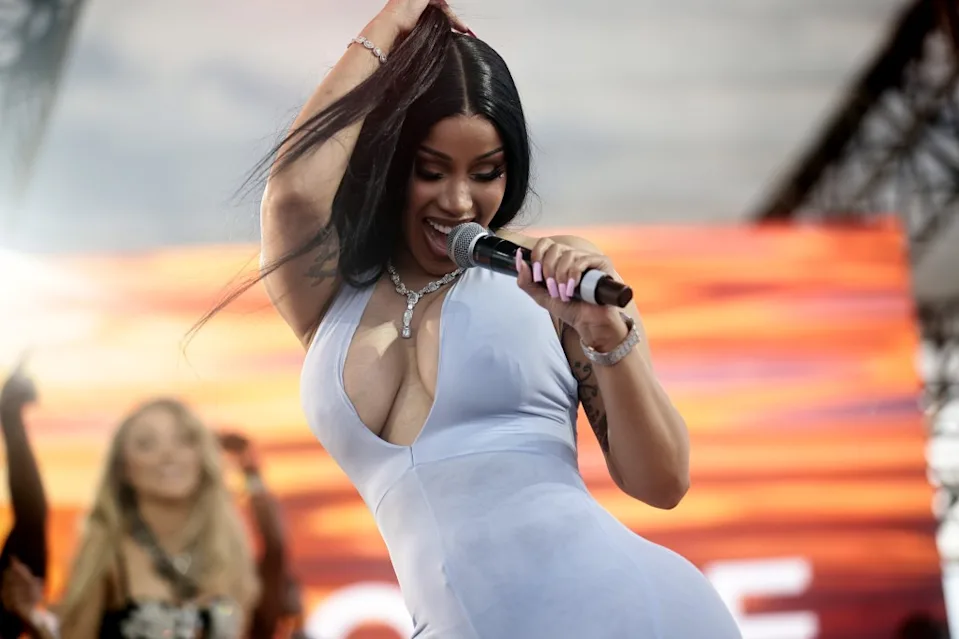
Cardi B Little Miss Drama Tour New Jersey stop at the Prudential Center in Newark delivered exactly what the arena full of devoted fans had come for and then considerably more, as the rapper born Belcalis Almanzar turned her first-ever solo headlining show in her adopted home state into a two-hour celebration of raunch, bravado, genuine musical talent, and the kind of performer-audience connection that makes a concert feel like a personal event rather than a commercial production. The show supporting her long-awaited chart-topping sophomore album Am I the Drama, released in 2025, came fresh off two sold-out nights at Madison Square Garden earlier the same week, but Cardi made it abundantly clear from the opening moments that the New Jersey crowd occupied a special category in her emotional geography. This was not just another arena date on a successful tour. This was a homecoming by a woman who has lived in Bergen County since 2015 and who used the occasion to settle, loudly and joyfully, any lingering questions about where exactly Cardi B calls home.
The declaration came early and landed to roaring approval. Belcalis is from the Bronx, Cardi told the crowd, but Cardi B is from New Jersey. She followed it with an unapologetic defence of her adopted state and a stream of specific local references that demonstrated eight years of genuine residency rather than a strategic geographical repositioning. Trenton family Easters, stripping in Passaic at the now-closed Mr. B's, her best friend from Jersey City, her family from Trenton all made their appearance in the night's running commentary that ran alongside and through the music like a biographical soundtrack. The specificity of those references is what separated them from generic crowd-pleasing geographic namedrops and transformed them into something that felt authentic, the genuine affection of someone who has actually lived in and among the communities she was celebrating.
The show itself was a high-octane display of everything that makes Cardi B one of the most compelling live performers in contemporary pop-rap, combining physical performance that included pole twirling, chair gyrations, and sustained choreographic intensity with vocal delivery that consistently reminded audiences that she is a more skilled rapper than her celebrity profile sometimes allows casual observers to register. The night also featured a surprise appearance from Paterson native Fetty Wap, recently released from prison after three years on drug charges, for a deafening duet of his 2015 hit Trap Queen that brought a specific local resonance to what was already a deeply New Jersey evening. And then there was the twerking contest. More on that shortly.
Cardi B's Journey From Bronx to Bergen County to Superstardom
Cardi B's ascent from the Bronx to the top of the American music industry is one of the more remarkable origin stories in contemporary popular culture, combining a background in exotic dancing that she has never apologised for or obscured, a social media personality that made her famous before her music did, and a genuine rap talent that has been recognised by commercial results more definitively than by critical consensus. The 2017 debut single Bodak Yellow became the first solo rap single by a female artist to reach number one on the Billboard Hot 100 since Lauryn Hill in 1998, and the 2018 debut album Invasion of Privacy became the first album by a female rapper to reach number one in its opening week since Lauryn Hill's The Miseducation of Lauryn Hill in 1998. Those are not minor statistical accomplishments. They are measures of genuine cultural impact that define an era.
The seven-year gap between Invasion of Privacy and the 2025 sophomore album Am I the Drama was a period of public scrutiny, personal turbulence, creative struggle, and expanding celebrity that kept Cardi in the public conversation even in the absence of new music at the pace that commercial pop culture's attention economy demands. Her marriage to rapper Offset, their relationship's public tensions and eventual separation, her acting work in Hustlers and her television presence on Netflix's Rhythm and Flow, and her continued social media dominance maintained her profile through a recording silence that would have diminished many artists. The release of Am I the Drama as a chart-topping album and the subsequent Little Miss Drama arena tour represent the payoff on that sustained period of audience maintenance without a full-length project.
The geographical dimension of Cardi's identity has been a running cultural conversation since the 2021 social media post where she described her Bergen County mansion as being in New York, a characterisation that New Jersey natives greeted with the specific combination of amusement and mild offence that Garden State residents reserve for those who fail to distinguish between the two states. Her correction of the record, both in the live stream that preceded the Newark show and in the concert itself, was received with the enthusiasm of a constituency that had been waiting for the acknowledgment. The specificity of her Jersey references, particularly the Passaic stripping admission that she delivered without the slightest defensiveness, is consistent with the unapologetic autobiographical honesty that has always been one of her most distinctive qualities as a public figure.
The Invasion of Privacy Era and What Made Her Different
The 2018 debut album Invasion of Privacy established Cardi B as a complete album artist rather than merely a singles phenomenon, demonstrating across its thirteen tracks a versatility that encompassed hard trap rap, Latin-inflected pop, melodic R&B, and the kind of personal emotional disclosure that gives albums their staying power beyond the immediate commercial moment. The tracks Be Careful, Ring, and Thru Your Phone, which appeared together in the Newark show's most visually striking set piece inside an ornate cage with elastic band bars, represent the album's more vulnerable register, a side of Cardi that commercial attention tends to overshadow but that her audience knows well and responds to with genuine emotional recognition. These are not filler tracks. They are the songs that explain why her debut album has accumulated the streaming numbers it has across seven years of continued discovery by new listeners.
The I Like It single with J Balvin and Bad Bunny, which anchored the Newark show's Latin music segment, represented a different kind of achievement, the seamless integration of Cardi's Dominican heritage into a global pop-Latin crossover that preceded and in some ways anticipated the mainstream breakthrough of Latin music in the American pop market. The Newark performance of that segment, with a dozen or more dancers in colourful outfits waving flags from Mexico, Puerto Rico, Colombia, Jamaica, and other Latin and Caribbean countries and cultures, was described by the reviewer as a spiritual cousin to Bad Bunny's Super Bowl halftime show, a comparison that acknowledges the genuine cultural bridge that I Like It represented when it was released and that the live performance still delivers. The celebration of hemispheric Latino culture in a New Jersey arena, where that heritage is deeply woven into the audience's own identity, produced one of the night's most emotionally resonant moments.
The press single from 2019, performed during the Newark show's most ferocious stretch alongside newer cuts Check Please and Trophies, represents Cardi at her most combative and technically demanding, a mode of rap performance that requires both breath control and rhythmic precision that casual observation of her celebrity profile might lead audiences to underestimate. The reviewer's observation that she is an underrated force on the mic, more deft than casual fans may appreciate, reflects a recurring critical assessment of Cardi that the commercial data has always supported but that the sensationalised dimensions of her public image sometimes obscure. The Newark show gave that technical skill appropriate space alongside the spectacle.
The 2018 Newark Show and How Much Has Changed
The contrast between the 2018 Newark performance, described by the same reviewer as an uninspired 45-minute set where Cardi whined and stumbled despite being the genre's white-hot breakthrough artist, and the 2026 two-hour headlining show is the clearest measure of how significantly her development as a live performer has progressed across the intervening eight years. A 45-minute underperformance in 2018 when she was riding the momentum of Bodak Yellow and Invasion of Privacy reflects the reality that breakthrough commercial success and live performance capability do not automatically arrive together, and that many artists who achieve rapid fame require years of touring experience to translate their recorded artistry into a commanding arena presence. The 2026 version of Cardi B at the Prudential Center has done that work and arrived at a level of live performance confidence and competence that the 2018 version was not yet ready to deliver.
The physical demands of the Newark show, which involved sustained choreography including pole twirling, a twerking contest with several audience finalists brought to the stage, chair performances with dollar bills raining down, and a spectacular finale with angel wing chair ascending high into the arena, reflect a performance architecture that requires both athletic conditioning and theatrical discipline that you cannot fake across two hours in front of a sold-out arena. Cardi's former exotic dancer background gives her a physical performance vocabulary that is both distinctive and genuinely skilled, and the Newark show used that vocabulary with the confidence of someone who has made peace with her professional history and recognises it as an asset rather than a liability to be managed.
The transition from the 2018 performance to the 2026 headline show at the same arena is also a story about the maturation of Cardi's relationship with her own celebrity. A 2018 artist in the first year of her breakthrough is still negotiating the demands of sudden superstardom, managing the gap between the performer she was in smaller venues and the performer a sold-out arena requires. An artist in 2026 who has lived through the full arc of that celebrity, who has completed and toured a successful sophomore album, who has maintained her audience through a seven-year recording gap, and who is performing in the arena of her adopted home state with a local reference arsenal that could only have been assembled through eight years of genuine residency, is a different kind of performer entirely.
The Show, the Setlist, and the Twerking Contest
The appearance of Fetty Wap as the night's surprise guest carried a specific New Jersey resonance that made it more than a standard celebrity cameo, because Fetty Wap's connection to New Jersey is genuine and deep rather than incidental. Born Willie Maxwell in Paterson, one of New Jersey's most storied and challenged urban communities, Fetty Wap's 2015 breakthrough with Trap Queen made him one of the most commercially successful New Jersey-origin artists of the decade and a figure whose Paterson roots are as central to his identity as Cardi's New Jersey residency is to hers. His appearance at the Newark show, his first major public performance since his January release from prison after three years on federal drug conspiracy charges, gave the evening a reunion quality that extended beyond the standard surprise guest formula.
The Trap Queen duet delivered the deafening audience response that the song's New Jersey associations and Fetty Wap's return warranted, with Cardi's welcome home Fetty Wap introduction providing the emotional framing that converted a song performance into something closer to a homecoming celebration. The choice of that specific song for that specific moment in a New Jersey arena demonstrated the kind of curatorial intelligence that distinguishes a well-constructed concert from a setlist of greatest hits in sequence. Trap Queen at that moment, with that introduction, for that audience, was the right call in a way that the same song performed differently would not have been, and the crowd's response confirmed that the calculation was correct.
The violet cat suit, the turquoise bloom of hair that bobbed throughout the two hours, and the visual consistency of Cardi's stage presence across the full performance created the kind of coherent visual identity that makes concert photography and fan social media documentation feel like documentation of a distinct artistic vision rather than a collection of outfit changes. The physical charisma that is one of Cardi's most undeniable qualities was deployed at full intensity from the first song to the last, maintaining the energy level that a two-hour show requires without the visible fatigue that can undermine the final third of long sets. The Newark audience got the full version of Cardi B at her current performance peak.
The Latin Segment, the Cage Set Piece, and the Artistic Range
The Latin-inflected section of the Newark show, built around I Like It and a run of tracks that drew on Cardi's Dominican heritage, deployed a troupe of a dozen or more dancers in a flag ceremony that celebrated the Latino and Caribbean communities represented in the audience with a visual generosity that went well beyond the standard concert dancer filler. The flag display encompassing Mexico, Puerto Rico, Colombia, Jamaica, and numerous other nations and cultures in a single sustained sequence was the kind of gesture that requires both production investment and genuine cultural conviction, and in a New Jersey arena where that cultural spectrum is literally present in the audience rather than aspirationally invoked, it landed as authentic celebration rather than demographic calculation.
The cage set piece, with its elastic band bars and the smoky purple skirt performance of Be Careful, Ring, and Thru Your Phone, provided the evening's moment of greatest artistic contrast, slowing the pace and dropping the temperature in a way that allowed the audience to engage with the more emotionally complex dimension of Cardi's catalogue without the distraction of the high-energy spectacle that surrounded it. The reviewer's acknowledgment that the artistic nuance ended about there, and that Cardi B is as subtle as a sledgehammer who knows who she is, is both an honest assessment and a recognition that the sledgehammer mode is what her audience primarily comes for and what she delivers with exceptional skill. The cage sequence worked precisely because it was brief and well-placed within a larger show architecture that knew its own identity.
The cross-over radio hits that closed the show, Girls Like You with Maroon 5 and Finesse with Bruno Mars, performed as Cardi ascended on a chair with angel wings, provided the commercially familiar, emotionally satisfying ending that arena concerts require and that Cardi's catalogue can deliver without compromising the harder rap identity of the rest of the set. The ascent into the arena sky on that chair was the night's single most theatrical visual moment, combining the physical spectacle of the stage engineering with the symbolic resonance of an artist who has risen from Bronx origins to Bergen County wealth, from Passaic strip clubs to Madison Square Garden, from social media persona to genuine pop culture institution, all while remaining unmistakably, unapologetically herself.
The Twerking Contest and What It Says About Cardi's Relationship With Her Audience
The $5,000 twerking contest that sent the Prudential Center aisles filling with contestants was the night's most talked-about moment and the clearest expression of the relationship between Cardi B and her audience that makes her concerts feel different from conventional pop arena shows. The announcement that the arena's best twerker would win $5,000 converted thousands of audience members from passive spectators into active participants competing for a prize with the kind of enthusiasm that only a performer with genuine audience trust can generate. The aisles filling with contestants doubling over and shaking their backsides for the camera crew, the handful of finalists brought to centerstage, and the eventual winner who the reviewer notes had clearly been practicing captured the specific democratic energy that Cardi's performances generate, the sense that she and her audience are in the same world rather than on opposite sides of a stage barrier.
The winner taking home $5,000 is not a trivial sum, and the willingness to give that money directly to an audience member rather than to a charity or through a promotional mechanism reflects the personal generosity and direct audience engagement that Cardi has cultivated throughout her career. The moment also served as a reminder that her background as an exotic dancer, which she references without defensiveness, gives her a specific relationship with the performance culture of twerking that allows her to celebrate it without irony or apology in a way that reframes what might be criticised as gratuitous as genuinely celebratory. The reviewer's dry observation that they had seen a lot of things in that arena but this was new captures the specific novelty of the moment without diminishing its entertainment value.
The overall verdict of the Newark show, implicit in the reviewer's comparison to the 2018 performance and explicit in the final characterisation of it as a moment of triumph for the newly anointed Jersey girl, is that Cardi B has arrived at a stage of her career where the live performance matches the recorded artistry and the cultural significance in a way that was not yet true eight years ago. The Little Miss Drama tour has a superstar at its centre who has done the work required to deliver a top-flight arena show, and the New Jersey stop gave that superstar the specific audience, the specific local resonance, and the specific emotional stakes to produce something that went beyond a good concert into something closer to a cultural event.