
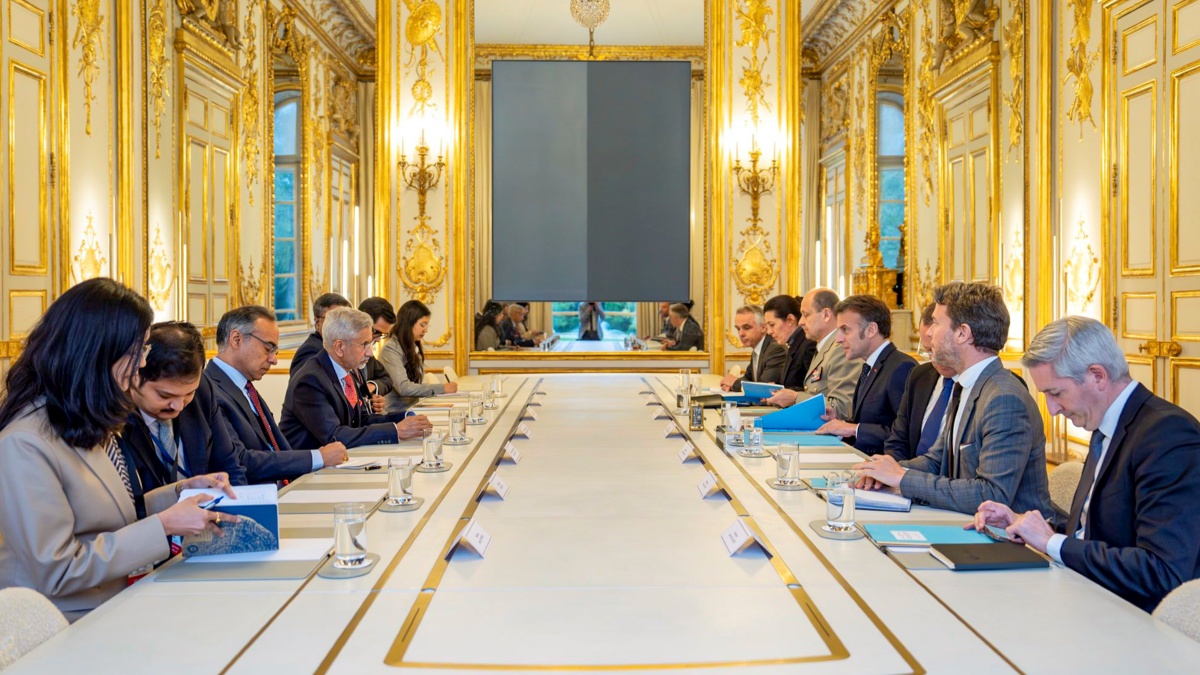
Chinese Vice Premier Zhang Guoqing will participate in a video conference hosted by French President Emmanuel Macron on Thursday focused on global economic imbalances, in what represents a rare and diplomatically significant instance of China engaging directly with the China Joins Macrons G7 framework ahead of the summit in Evian-les-Bains next week. The inclusion of Beijing in Macron's so-called "Global Convergence for Growth" call, confirmed by a Chinese foreign ministry spokesperson, comes as France makes a last-ditch attempt to establish a cooperative economic dialogue with China before the European Union decides whether to significantly toughen its trade policy toward Beijing. G7 leaders meet in France from June 15 to 17, and EU leaders convene immediately afterward, with China's trade practices set to dominate both agendas in ways that will shape the global trading system for years to come.
The diplomatic significance of Zhang's participation is amplified by Beijing's longstanding posture toward the G7, which China has consistently dismissed as an illegitimate grouping unrepresentative of the world order and inappropriate for discussing global affairs. That China has chosen to send a senior vice premier to engage with a Macron-hosted call organised around G7 concerns about Chinese economic behaviour reflects a calculation in Beijing that the costs of complete non-engagement are now higher than the costs of selective participation. Five G7 nations have received Chinese leaders in Beijing since December, a pattern of high-level meetings that suggests China is actively managing its relationship with each major European economy individually even as it publicly rejects the G7 framework as a collective institution. That combination of bilateral engagement and multilateral scepticism is a characteristic feature of Chinese diplomatic strategy, and Thursday's video conference tests whether Macron can use the pre-summit moment to convert bilateral goodwill into collective progress on trade rebalancing.
The structural backdrop to the call is one of mounting European alarm at what analysts are describing as a "second China shock," a phrase that deliberately invokes the original China shock of the 2000s when China's accession to the World Trade Organization and its dominance of low-value manufacturing decimated industrial employment across Europe and North America. The second shock, unlike the first, is arriving at the high end of the value chain: Chinese electric vehicles, lithium-ion batteries, solar panels, and other advanced technology products are now competing directly with European manufacturers in categories where European industry had expected to maintain a competitive advantage. The alarm that European governments are expressing is therefore not simply about trade deficits but about whether the industrial and technological foundations of the European economy can survive a competitive challenge of this scale and speed.
How China's Trade Surplus and Industrial Policy Created the Crisis That Macron Is Trying to Manage
The economic confrontation between Europe and China that Thursday's call is attempting to address through dialogue rather than tariffs has been building for several years across multiple industry sectors. China's record trade surplus, driven by an industrial policy that combines state subsidies, cheap financing, domestic demand management, and a deliberate strategy of moving up the value chain from low-cost manufacturing toward advanced technology exports, has created a structural imbalance that European governments have been debating how to respond to with increasing urgency. The scale of Chinese state support for its electric vehicle sector in particular, which has enabled Chinese manufacturers to price their products well below what European competitors can match on production costs alone, has prompted the European Commission to impose provisional tariffs and triggered a formal investigation into unfair subsidisation.
Beijing has rejected the European subsidy allegations and responded to the tariff investigations with its own framing: that other countries are undermining global trade rules by imposing unilateral measures that violate WTO principles, and that China's industrial competitiveness reflects genuine productivity gains and economies of scale rather than distortive state intervention. That counter-narrative is not without partial validity, as the line between legitimate industrial policy and trade-distorting subsidies is genuinely contested in international trade law, but it has done little to address the political pressure that European governments face from manufacturers, trade unions, and voters who are watching Chinese competitors gain market share in sectors that represent the core of the European industrial base. Macron's December meeting with Xi Jinping in Beijing, in which he told the Chinese president that China should help rebalance economic relations cooperatively or Europe would have little choice but to adopt protectionist measures, was the clearest articulation of that ultimatum at the highest diplomatic level.
Germany's position within this European debate is the most consequential single variable for how it resolves. As Europe's largest trading economy and one of China's most significant export destinations and bilateral trade partners, Germany has historically been the strongest internal brake on European Commission moves to tighten trade policy toward Beijing. German carmakers, chemical companies, and machinery manufacturers have deep commercial dependencies on the Chinese market, and Berlin has consistently argued that tariff escalation risks triggering Chinese retaliation that would hurt European exporters more than Chinese ones. But as Chinese electric vehicle manufacturers have begun competing directly with Volkswagen, BMW, and Mercedes-Benz in both the Chinese domestic market and in third markets globally, the political calculus in Germany is shifting. Some German lawmakers have begun calling explicitly for a tougher European stance toward Beijing, a development that removes one of the most reliable sources of internal EU resistance to trade policy hardening.
What Thursday's Call, the G7 Agenda, and the EU Summit Mean for the Trade Architecture
Thursday's Macron-hosted video conference is best understood as a diplomatic test of whether China is prepared to make any substantive offer on trade rebalancing that European governments can credibly present to their populations as a cooperative outcome, before the harder decision-making processes of the G7 and EU summits produce outcomes through less cooperative mechanisms. Macron's approach, seeking bilateral and now quasi-multilateral dialogue with Beijing before collective European decisions are locked in, reflects a diplomatic philosophy that places continued engagement above strategic clarity, a position that has critics within Europe who argue that dialogue without consequences enables rather than discourages Chinese trade practices. Whether Thursday's call produces any concrete commitments from Zhang beyond general language about cooperation will determine whether the Macron diplomatic track has value as a trade policy instrument or functions primarily as a delay mechanism that benefits China by postponing European collective action.
The G7 summit agenda, centred on how member economies should respond to waves of low-priced Chinese exports entering their markets, will be the most consequential collective trade policy discussion among major Western economies since the original China shock debates of the early 2000s. The G7 comprises France, Britain, Canada, Germany, Italy, Japan, and the United States alongside the EU, and the United States under Trump has already moved further and faster on tariffs targeting Chinese goods than its European partners. The question for Evian is whether European G7 members will align more closely with the US tariff approach, pursue the Macron diplomatic track of negotiated rebalancing, or find some combination of the two that individual European governments can sell domestically. Germany's internal political shift on China trade policy makes the European position at the G7 genuinely uncertain in a way that it was not a year ago, and that uncertainty creates space for Macron to position France as the architect of whatever collective European response emerges.
The EU summit immediately following the G7 raises the stakes considerably by bringing the institutional decision-making machinery of the European single market into direct engagement with the China trade question. EU trade policy is a collective competence, meaning decisions about tariffs, market access, and anti-subsidy measures require agreement among member states that have different levels of China exposure and different degrees of vulnerability to Chinese retaliation. The combination of a G7 discussion, a bilateral Macron-China call, five months of high-level Beijing visits from G7 leaders, and an imminent EU summit creates a diplomatic convergence point that China's leadership clearly recognises as consequential enough to engage with, even through a format it officially considers illegitimate. What that engagement produces in terms of concrete trade policy outcomes will define the trajectory of the EU-China economic relationship for the next decade.