
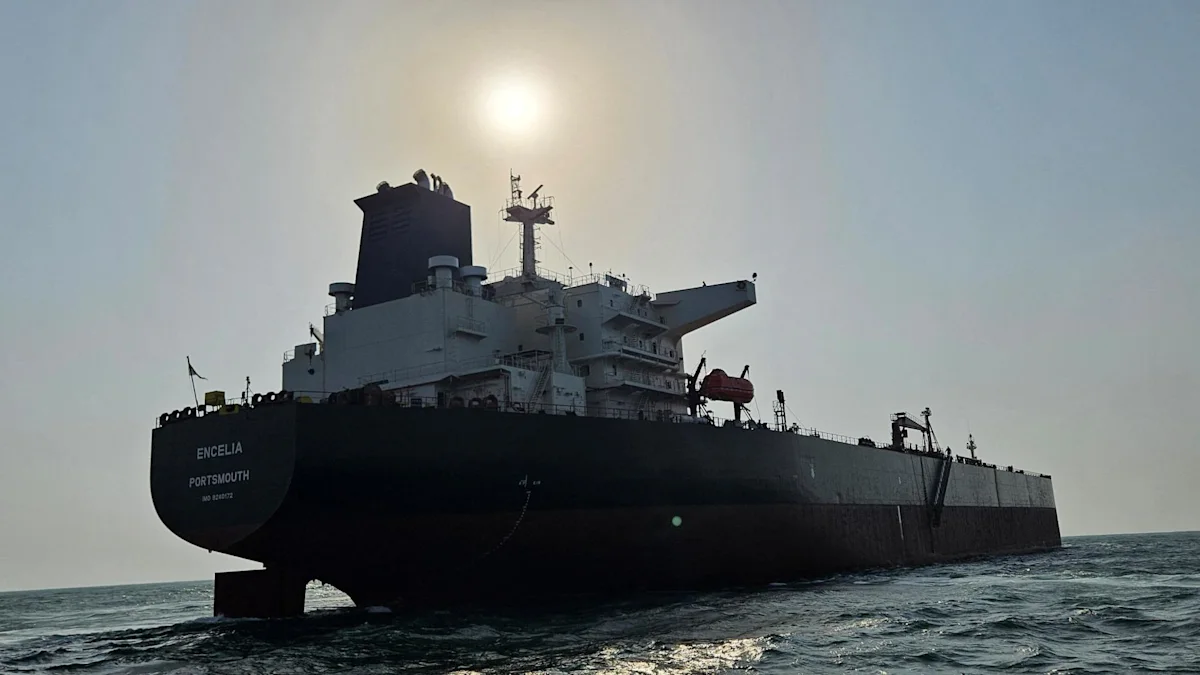
On Friday, the US fires tanker military disabled a commercial tanker in the Gulf of Oman after the vessel's crew attempted to run the American blockade on Iranian ports at least four times. Navy Captain Tim Hawkins, spokesman for US Central Command, told AFP that the crew was "repeatedly warned, didn't comply" and that US forces fired into the ship's engine room, disabling it. "The ship is no longer transiting to Iran," Hawkins said. It is the second commercial vessel the United States has disabled since reimposing the blockade earlier this month, establishing a pattern of enforcement action against vessels attempting to supply Iran during an active military confrontation.
Simultaneously, Saudi Arabia launched airstrikes on Houthi targets in the Yemeni port city of Hodeida and on nearby Kamaran Island, after the Iran-backed Houthi movement announced a maritime blockade and attacked Saudi ships. The Houthis responded by firing a missile at the Saudi city of Jizan, with their media reporting on Saturday morning that a "Yemeni missile strike" had caused fires there. Saudi authorities issued emergency alerts for Jizan province. The Houthis warned that Saudi targeting of "civilian facilities" constituted "a dangerous escalation" and that the attacks "will not go unanswered."
The third front developed at sea. Houthi threats to shipping in the Red Sea helped push Brent crude oil back above $100 a barrel during the week, the highest since May. The price later fell more than $4 to just over $96 on Friday afternoon, Reuters reported, after two Chinese-chartered supertankers successfully passed through the Bab el-Mandeb Strait, the narrow chokepoint at the southern end of the Red Sea connecting to the Gulf of Aden. The temporary price relief from those two transits illustrates how finely balanced the oil market's assessment of risk in these waterways has become: a single successful passage can move the price by several dollars in an afternoon.
The collapse of the June MOU and the logic of parallel escalation
To understand why three military fronts are active simultaneously, it is necessary to understand how the June ceasefire agreement collapsed and what each party calculated they would gain from continued fighting. In June, the US and Iran Exchange signed a 14-point Memorandum of Understanding agreeing to halt military operations and reopen the Strait of Hormuz, with a 60-day window to negotiate a more permanent settlement. Three weeks later, Trump declared the ceasefire "over" after Iranian attacks on ships in the strait triggered a US military response. That sequence, agreement followed by breach followed by resumption of hostilities, established that neither side trusted the other to hold to the framework and that both were willing to use the MOU as a temporary pause rather than a genuine foundation for de-escalation.
The Houthi dimension adds a layer of complexity that is both strategic and operational. The Houthis are Iran's most operationally active regional proxy in terms of maritime warfare, having demonstrated during the 2023-2024 Red Sea crisis that they could significantly disrupt international shipping through drone and missile attacks on commercial vessels. Their announcement of a maritime blockade against Saudi Arabia, and their simultaneous attacks on Saudi ships, reflects a coordinated escalation strategy in which Iranian pressure on the Strait of Hormuz and Houthi pressure on the Red Sea and Bab el-Mandeb simultaneously raise the costs for any party attempting to maintain normal maritime commerce in the region. Both chokepoints must be secure for global energy and trade flows to operate normally. Both are currently under active military threat.
Saudi Arabia's strikes on Hodeida and Island are its direct military response to Houthi attacks on its ships and the maritime blockade announcement. Saudi Arabia and the Houthis have been in a state of conflict since 2015, interrupted by periods of ceasefire negotiation, most recently a UN-brokered truce that had significantly reduced hostilities. The resumption of direct Saudi strikes and Houthi missile attacks on Saudi cities represents a breakdown of that fragile calm, driven by the broader regional escalation of the US-Iran conflict that has given the Houthis both political cover and, their critics argue, operational encouragement from Tehran to open a new front.
From the June MOU to three simultaneous fronts
June 2026
US and Iran sign 14-point Memorandum of Understanding agreeing to halt military operations and reopen the Strait of Hormuz. A 60-day negotiating window is established.
Three weeks later
Iran attacks commercial ships in the Strait of Hormuz. US responds militarily. Trump declares the ceasefire "over."
Early July 2026
US blockade on Iranian ports. First commercial tanker disabled by US forces for attempting to run the blockade.
13 consecutive nights
US conducts strikes on Iran for 13 consecutive nights. Iran retaliates with drone strikes on US military facilities and bases across the Middle East.
This week
Houthis announce maritime blockade of Saudi Arabia and attack Saudi ships. Brent crude briefly exceeds $100 per barrel, highest since May.
Friday July 25
Saudi Arabia strikes Hodeida and Island. US disables second tanker in Gulf of Oman. Houthis fire missile at Jizan. Oman delegation arrives in Tehran for Hormuz talks. Trump says negotiations continuing: "We are locked and loaded."
Next week
US-UK London conference on Hormuz. US and Chairman of the Joint Chiefs Dan Caine attending. Netanyahu meets Trump at White House on Tuesday.
Trump's dual-track strategy and the diplomatic parallel running alongside the war
The most striking political feature of Friday's events is the explicit acknowledgment by President Trump himself that negotiations with Iran are continuing while military operations proceed simultaneously. Speaking at the White House, Trump said: "We are talking to them. I think they're being serious. I think they are being by far the most serious that we've seen them, but that doesn't mean we get there." He then described his exit strategy in binary terms: "There's a military exit where we just keep going just the way we are, and we can even make it a heavier dose, and it's knocking out everything they have. Or there's a smarter strategy that you make a deal." Both options were presented as live possibilities within the same press conference.
That dual-track posture, bombing and negotiating simultaneously, is not unprecedented in American foreign policy but is unusual in the directness with which Trump is articulating both options as equally available. The Oman delegation's arrival in Tehran for Hormuz talks on the same day as the tanker disabling and the Saudi-Houthi exchange reflects how deeply the diplomatic and military tracks are running in parallel. Oman, which controls the Strait of Hormuz's southern coastline and has historically served as an intermediary between the US and Iran, is the indispensable back-channel in any scenario that ends in a negotiated settlement. Its active engagement suggests both sides retain a channel for communication even as the fighting intensifies.
The scheduled meeting between Netanyahu and Trump at the White House on Tuesday adds another political dimension. Israel's role in the original February strikes that began the war and its ongoing interest in Iran's nuclear and military capabilities mean that any deal framework that Trump might reach with Tehran will need Netanyahu's assessment and at minimum his tacit endorsement. The London conference on the Strait of Hormuz, with and the Chairman of the Joint Chiefs attending, signals that the US is also conducting military-level coordination with allies on how to manage the strait's security going forward, whether through a negotiated settlement or continued enforcement operations.
Oil at $100, two maritime chokepoints under threat, and what this means for energy markets
Oil briefly crossing $100 per barrel this week is a significant psychological and market threshold, even if the subsequent pullback to $96 on Friday afternoon suggests markets are not yet pricing in a sustained supply shock. The $100 level matters because it is the price at which energy costs begin to have measurable second-order effects on consumer spending, industrial production, and central bank policy in import-dependent economies. Europe, which has already been managing elevated energy costs since the 2022 Russia-Ukraine war, is particularly exposed to sustained oil prices above $100, as is Japan, India, and South Korea, all of which import the overwhelming majority of their crude oil from Gulf producers whose export routes pass through the Strait of Hormuz.
The Brent price drop on Friday afternoon, triggered by the successful passage of two Chinese-chartered supertankers through the Bab el-Mandeb Strait, illustrates how reactive energy markets are to moment-by-moment developments in these waterways. The Bab el-Mandeb, at the southern end of the Red Sea, is a separate but closely linked chokepoint to the Strait of Hormuz. Ships transiting between Asia and Europe or the Americas must pass through one or both. With Houthi threats to the Bab el-Mandeb renewed and the Strait of Hormuz under active US-enforced blockade conditions, the two most critical junctions in global maritime energy trade are both simultaneously elevated-risk environments for commercial shipping.
The second disabled tanker is particularly significant for energy markets and shipping economics. A US military policy of firing into the engine rooms of vessels attempting to deliver cargo to Iran establishes a clear precedent: commercial ship operators who accept Iranian cargo contracts or attempt to run the US blockade face not just seizure but physical damage to their vessels. That risk calculation will affect charter rates, insurance premiums, and the willingness of ship owners and operators to accept Iranian-linked business even from buyers who are not themselves sanctioned. The global network of oil traders, refiners, and logistics companies that have been quietly managing Iran's sanctioned exports for years faces a materially different risk environment than existed before the military enforcement of the blockade began.
Shipping, insurance, and the industries restructuring around Middle East risk
For the global shipping industry, the combination of US enforcement operations in the Strait of Hormuz and Houthi threats in the Red Sea is creating the most challenging maritime risk environment since the post-2022 period. Shipping companies must now make routing decisions between the Suez Canal route, which passes through the Red Sea and the Bab el-Mandeb under Houthi threat, and the Cape of Good Hope alternative route around southern Africa, which adds days to transit times and significantly increases fuel and operating costs. War risk insurance premiums for vessels transiting either of these areas have increased substantially, adding further cost pressure to already elevated freight rates.
The oil industry's exposure is the most direct. Any sustained disruption to crude flows through the Strait of Hormuz affects approximately 20 percent of global oil trade, including significant volumes of Saudi, UAE, Kuwaiti, Iraqi, and Iranian crude. Saudi Aramco, the world's largest oil exporter, has its own direct exposure to the Houthi conflict through attacks on Saudi infrastructure and shipping. The 2019 Abqaiq attacks demonstrated how vulnerable Saudi oil infrastructure can be to drone and missile strikes; the current environment raises the same concerns with the Houthis operationally active again after a period of relative calm.
For energy-importing businesses, particularly manufacturers and transport companies in Europe and Asia, the oil price trajectory over the next four to six weeks will determine whether the current Middle East escalation creates a meaningful cost shock or remains within ranges that can be managed. Purchasing managers and chief financial officers in energy-intensive industries will be watching the London conference outcome and any diplomatic signals from the Oman mediation with direct commercial interest: a credible path to reopening the Strait of Hormuz would push oil prices down quickly; a further breakdown in negotiations would push them up.
Two chokepoints, one war, and the supply chain implications for the world economy
The simultaneous threat to the Strait of Hormuz and the Bab el-Mandeb Strait is without modern precedent in its simultaneity, even if each individual threat has historical parallels. The 1980s Tanker War, in which Iraq and Iran attacked each other's oil tankers during the Iran-Iraq war, disrupted Persian Gulf shipping significantly but did not simultaneously threaten the Red Sea route. The 2023-2024 Houthi campaign against Red Sea shipping reduced Suez Canal traffic by approximately 40 percent in its peak period, with ships rerouting around the Cape of Good Hope. The current crisis combines both threats: the Suez-Red Sea route under Houthi threat and the Hormuz route under US enforcement and Iran-US military exchange.
The implications for global supply chains extend beyond energy. The same waterways that carry oil also carry manufactured goods, agricultural commodities, and consumer products between Asia and the rest of the world. Container shipping rates, which had already been elevated by post-pandemic supply chain disruptions, are now subject to an additional Middle East war premium. Longer Cape of Good Hope routes mean longer transit times, higher inventory requirements, and reduced flexibility in just-in-time manufacturing supply chains that were rebuilt around the assumption of reliable, predictable shipping times through the Suez Canal.
The Chinese dimension adds a further layer of global significance. China is the world's largest importer of crude oil and has significant trade relationships with both Iran, which it has continued to purchase oil from despite sanctions, and Saudi Arabia, which is its largest oil supplier. China's interest in stable maritime trade through both the Strait of Hormuz and the Red Sea is enormous, and the successful passage of two Chinese-chartered supertankers through the Bab el-Mandeb on Friday, which briefly pushed oil prices down, reflects active Chinese commercial engagement in navigating the current risk environment. Beijing's diplomatic position, which has consistently called for de-escalation and maintained that it opposes military solutions in the region, gives it a formal stance to deploy in international forums while its commercial interests drive practical engagement with both sides of the conflict.
What Trump's "locked and loaded" posture means for negotiation prospects
Trump's public statements on Friday encapsulate the central ambiguity of the current US posture. He simultaneously described Iran as being "by far the most serious that we've seen them" in negotiations, suggested a deal was possible, said the US was "locked and loaded" for continued or intensified military action, and described a military exit strategy of "just keep going" and making it "a heavier dose." This is not a contradiction in Trump's strategic communication style; it is the style itself. The deliberate maintenance of maximum pressure while keeping a deal option open is a negotiating posture that has been described by Trump's allies as "maximum pressure" and by his critics as strategic incoherence. Its effectiveness in the Iran context depends entirely on whether Iran's leadership reads the military pressure as a genuine existential threat that makes a deal preferable, or as a finite operation they can outlast.
"There's a military exit where we just keep going just the way we are, and we can even make it a heavier dose, and it's knocking out everything they have. Or there's a smarter strategy that you make a deal."
President Donald Trump, White House, Friday July 25, 2026
"We disabled the tanker after the crew attempted to run the blockade at least four times prior. The crew was repeatedly warned, didn't comply, and US forces on scene disabled the ship after firing into its engine room."
Navy Captain Tim Hawkins, US Central Command spokesman, speaking to AFP
Iran is being "by far the most serious" in negotiations, says Trump. He is also "locked and loaded." Both things can be simultaneously true in a conflict where neither side has yet concluded that the cost of fighting exceeds the cost of conceding.
The scheduled London conference, with the Chairman of the Joint Chiefs, suggests the military track is being managed at the highest operational level within the US government, separate from but coordinated with the diplomatic track that Oman is facilitating. That institutional separation between the military coordination track and the diplomatic mediation track is characteristic of how the US has managed complex conflicts before: maintaining military pressure while keeping diplomatic channels open through third parties who can communicate with the adversary more freely than direct US engagement allows.
What happens next
The London conference on the Strait of Hormuz next week is the most important near-term diplomatic event for the conflict's trajectory. With the Chairman of the Joint Chiefs attending, the conference will presumably coordinate military posture among US allies on Hormuz security, but the Oman mediation running parallel means there is also a diplomatic dimension to what is communicated out of London. Whether the conference produces a public statement that signals any shift in US conditions for a ceasefire, or whether it focuses purely on military coordination, will be the first major indicator of where the diplomatic track is heading.
The Netanyahu-Trump meeting at the White House on Tuesday will shape the deal space available to Trump in any Iran negotiations. Israel's Netanyahu deal specific interests, including constraints on Iran's nuclear and its ability to support regional proxies, are not necessarily aligned with the conditions that would be minimally acceptable to Iran. Netanyahu's influence over what Trump will and will not accept in a deal framework has been a factor in every US-Iran negotiation since the 2015 JCPOA, which Trump withdrew from partly under Israeli pressure during his first term.
For oil markets, the coming week will be defined by whether the Oman mediation produces any tangible signal of progress toward a reopening of the Strait of Hormuz. A credible de-escalation signal would push Brent crude back below $90. A further breakdown, or a new escalation involving Saudi infrastructure, the Bab el-Mandeb, or a third disabled tanker, would likely push prices back above $100 and toward the levels that begin to materially affect inflation and growth forecasts in importing economies. Energy traders, shipping companies, and governments watching their currency reserves will all be calibrating their positions against the same fundamental uncertainty: whether the simultaneous military and diplomatic tracks produce a deal this month or an escalation that makes a deal impossible before summer's end.